Many everyday cooking tasks quietly assume that both hands are available. One hand stabilizes a bowl, ingredient, or container while the other operates the tool. That assumption becomes obvious when the same task is attempted with one hand because grip, stability, leverage, and control suddenly matter more than speed.
A practical one-handed review of kitchen tools shows which designs reduce the need for constant repositioning and which depend heavily on a second hand. These differences matter for people with limited dexterity, temporary injuries, or anyone who values easier, more controlled kitchen movement.
Key Takeaways
- Tongs and shears generally translate well to one-handed use because the operating motion stays in one hand.
- Non-slip bases often matter as much as the tool itself when bowls or ingredients need stabilization.
- Powered or mounted openers can reduce the twisting and counterforce required by manual designs.
- Large, comfortable handles improve control when grip strength or dexterity is limited.
- One-handed testing should prioritize stability and safety rather than task speed.
What One-Handed Use Tests Reveal About Kitchen Tools
Tongs Need Balanced Tension
Tongs are naturally suited to one-handed operation because the same hand provides the opening and closing motion. The easiest models combine manageable spring tension with textured handles and tips that meet evenly. Excessively stiff tongs increase hand fatigue, while weak or slippery tips force repeated attempts to grip the same food.
Among common cooking tools, tongs perform best when they can pick up both small vegetables and heavier food without requiring a second hand to steady the utensil.
Shears Offer Direct Control
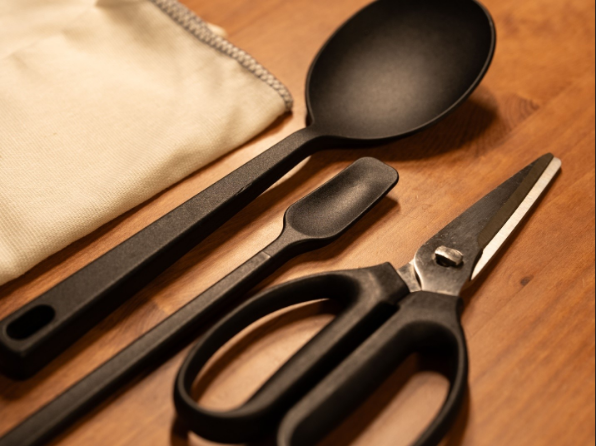
Kitchen shears also perform well because the user controls cutting, opening, and closing with one hand. Large finger openings and sharp blades reduce the amount of force required for herbs, packaging, and light food-preparation tasks. Dull blades create more resistance and can encourage awkward hand positions.
For premium kitchenware, comfortable handle geometry is more meaningful than decorative features. A tool that opens fully and returns smoothly is easier to use repeatedly.
Peelers Depend on Stability
A Y-shaped peeler can be easy to control, but the ingredient itself becomes the challenge. Round or wet produce may roll when the second hand is unavailable to hold it. A non-slip mat, food holder, or adaptive board can provide the missing stability without changing the peeler.
This is a useful reminder that one-handed performance depends on the complete setup. Small kitchen accessories that stop movement can improve ordinary tools more than replacing every utensil with a specialized version.
Openers Expose Two-Handed Tasks
Manual can and jar openers often require one hand to stabilize the container while the other twists, clamps, or rotates. That combination makes them difficult in a one-handed test. Electric, mounted, or clamp-style designs can reduce the need for opposing force, although each still requires safe positioning.
The most useful model is the one that holds the container securely and completes the opening motion without demanding repeated wrist twisting.
Bowls Change Mixing Performance
Whisks and spatulas are easy to move with one hand until the bowl starts sliding. Heavy mixing bowls, silicone bases, and non-slip mats perform better because they replace the stabilization normally supplied by the second hand. Thick mixtures reveal this difference quickly.
Accessible kitchen storage also matters. Keeping the bowl, mat, and frequently used utensils within easy reach reduces unnecessary lifting and repositioning before mixing even begins.
Strainers Benefit from Attachment
A traditional colander often requires two hands when hot cookware must be held and tilted safely. Clip-on strainers change the task by attaching directly to the pot, reducing the number of separate objects that must be controlled. The attachment must be secure enough to remain in place under the weight of food and water.
The strongest one-handed designs simplify the sequence of the task rather than merely changing the handle shape. That principle applies across kitchen tools used for draining, measuring, cutting, and serving.
Conclusion
One-handed testing shows that stability, grip, leverage, and task sequence are often more important than speed. Tongs and shears translate naturally to one hand, while bowls, peelers, openers, and strainers depend much more on how the surrounding setup prevents movement. The most useful kitchen tools reduce the need for a second stabilizing hand without creating new safety or control problems.
FAQs
What should a one-handed tool test measure besides speed?
Useful tests can compare grip force, slippage, task completion, repositioning, fatigue, control, and whether the tool remains stable throughout the task.
Can a non-slip mat improve ordinary kitchen tools?
Yes. A stable base can keep bowls, boards, and containers from moving, which may make standard tools easier to operate with one hand.
Are electric tools always easier to use one-handed?
No. Button placement, setup, cleaning, and the need to stabilize the appliance still matter, so powered operation should be evaluated as part of the full task.
What kitchen layout helps one-handed cooking?
Frequently used items should be stored within comfortable reach, with uncluttered work surfaces and stable zones for mixing, cutting, and opening containers.
When is an adaptive tool worth considering?
It is most useful when a repeated task remains difficult or unsafe even after improving stability, grip, work height, or the surrounding setup.