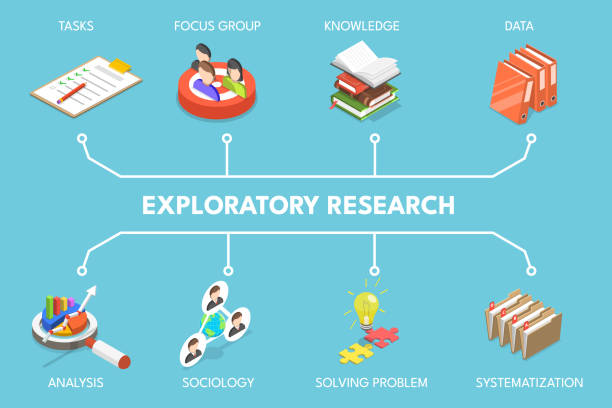
3D Isometric Flat Vector Illustration of Exploratory Research, Social Data Collection
Qualitative research gives you a way to understand people beyond statistics and percentages. Instead of focusing mainly on numbers, you look at experiences, opinions, behaviours, perceptions, and the meanings people attach to them.
For example, imagine you want to understand why some postgraduate students struggle to adapt to university life. A questionnaire might tell you how many students experience difficulties. Interviews, however, can help you understand what those difficulties actually feel like, what causes them, and how students make sense of their experiences.
That is what makes qualitative academic research so useful. It allows you to explore the detail behind a research problem. At the same time, it requires careful planning because every decision, from choosing participants to analysing interviews, needs to connect logically with your research question.
What Is Qualitative Academic Research?
Qualitative research is an approach used to explore experiences, perspectives, behaviours, relationships, and social contexts. Researchers usually work with words, observations, documents, recordings, or other non-numerical forms of data.
Some common sources of qualitative data include:
- One-to-one interviews
- Focus groups
- Observations
- Diaries and personal accounts
- Documents and historical records
- Online material
- Visual and multimedia sources
There is also more than one way to conduct qualitative research. Established approaches include phenomenology, ethnography, grounded theory, narrative research, and case study research.
Creswell and Poth’s work on qualitative inquiry is particularly useful for understanding these different approaches and deciding which one fits a particular research problem. Their fifth edition, published in 2024, also considers developments in contemporary qualitative research.
The important thing is not to pick a method because it sounds interesting. Start with the problem you want to investigate and work backwards from there.
Start With a Clear Research Question
A qualitative project usually becomes much easier once you have a focused research question.
Think about what you actually want to understand. Are you interested in people’s experiences? Their perceptions? A particular social process? The way a group responds to a situation?
For example:
How do international postgraduate students experience academic adjustment during their first year at university?
This is much more useful than asking something broad such as:
What do students think about university?
The first question gives you a clear group and a specific experience to investigate. The second could take you in dozens of directions.
Before settling on your question, I recommend asking yourself:
- What am I genuinely trying to understand?
- Who can provide useful information about it?
- Why is qualitative research suitable?
- What has previous research already discovered?
- What remains unclear?
Your literature review should help you answer those questions. It should show where your study fits rather than simply list everything other researchers have written.
Choose a Research Design That Fits
Once your question is established, you can decide which qualitative research design makes sense.
Phenomenology
Phenomenology is concerned with people’s lived experiences. You might use it to explore what it is like for students to experience academic burnout or for patients to live with a particular condition.
Grounded Theory
Grounded theory is generally used when the researcher wants to develop an explanation or theory from the data rather than simply test an existing theory.
Ethnography
Ethnography involves studying people, practices, relationships, and culture within a particular social setting.
Case Study
A case study examines a defined case in considerable depth. The case could be an organisation, university department, community, programme, or particular event.
Narrative Research
Narrative research focuses on people’s stories and how they describe and make sense of their experiences.
These approaches overlap in some respects, but they are not interchangeable. Your methodology should explain why the approach you selected is appropriate for the question you are asking.
Decide How You Will Collect Data
Your qualitative data collection methods should follow naturally from your research design.
Interviews are particularly common in student research because they allow you to ask prepared questions while still giving participants room to explain their experiences in their own words.
Semi-structured interviews can be especially useful. You prepare a set of core questions but retain enough flexibility to ask follow-up questions.
For instance, instead of asking:
Did you find online learning difficult?
you could ask:
Can you describe an experience of online learning that you found challenging?
The second question gives the participant something to talk about. It may reveal issues you had not considered when designing the study.
A basic interview guide might include:
- An introduction to the study
- Consent and recording information
- A few introductory questions
- Main research questions
- Follow-up prompts
- A closing question
I also recommend conducting a pilot interview before collecting all your data. It is surprisingly useful. You may discover that a question is confusing, repetitive, too personal, or simply does not produce the information you expected.
Select the Right Participants
You do not normally select qualitative participants in the same way you would select a large statistical sample.
Researchers commonly use purposive sampling, where participants are deliberately chosen because they have experiences or characteristics relevant to the research question.
Other approaches include criterion sampling, maximum-variation sampling, snowball sampling, and convenience sampling.
There is no universal rule saying that every qualitative study needs a particular number of participants.
A 2022 systematic review examined sample sizes in qualitative interview studies and found that relatively homogeneous studies with narrowly defined objectives often reached saturation within approximately 9–17 interviews. However, the researchers also stressed that sample requirements vary according to the research question, population, and type of saturation being considered.
Another useful concept is information power. In simple terms, if your participants provide highly relevant and detailed information, you may require fewer participants than you would for a study involving a broader or more diverse population.
So don’t write, “I chose 15 participants because 15 is the recommended number.” Explain why your particular sample makes sense for your study.
Deal With Ethics Before Collecting Data
Ethics should be considered before your first interview, not when you are writing the final chapter.
If you are conducting research involving people, check your university’s research ethics requirements. You may need formal approval before recruiting participants or collecting information.
Important issues normally include:
- Informed consent
- Privacy and confidentiality
- Anonymity
- Secure data storage
- Potential risks
- Participants’ right to withdraw
- Recruitment procedures
- Management of sensitive information
Informed consent is also more than getting someone to sign a form. It involves giving participants understandable information about the study so they can make an informed decision about taking part. Guidance from the U.S. Department of Health and Human Services provides further detail on informed-consent requirements.
Your own university’s ethics policy should remain your primary reference because requirements vary between institutions and research settings.
Conduct Your Data Collection Carefully
A good qualitative interview is more than reading questions from a sheet.
You need to listen.
Suppose a participant says, “I found the first semester really difficult.” You could simply move to the next question. But you might learn much more by asking:
What made that period difficult for you?
Or:
Can you tell me a little more about that experience?
These follow-up questions often lead to the most useful material.
At the same time, be careful not to lead participants towards answers you expect.
For example, asking:
Why did online learning make you anxious?
already assumes that online learning made the participant anxious.
A more open question would be:
How did you experience online learning?
The difference may seem small, but it can have a significant effect on the kind of data you collect.
If you record interviews, obtain the appropriate consent and follow the procedure approved by your institution. After each interview, make brief notes about anything relevant while the conversation is still fresh in your mind.
Organise and Transcribe the Data
Once interviews or observations begin, you will quickly accumulate a lot of material.
Give each participant a study ID or pseudonym where appropriate. Keep identifying information separate from your working research files when your research protocol requires this.
Transcription also needs some thought.
You might produce a detailed verbatim transcript, or you may use a more selective transcription approach depending on your methodology. If pauses, laughter, interruptions, or other features of speech are important to your analysis, decide in advance how you will record them.
One mistake I would avoid is leaving analysis until every interview has been completed.
Start looking at your data as the project develops. Early analysis can reveal gaps in your interview questions and may show that you need to explore an unexpected issue with later participants.
Analyse the Data
There are several ways to conduct qualitative data analysis, and the right choice depends on your research design.
Thematic analysis is one of the approaches students frequently encounter because it can be used to identify patterns across qualitative datasets.
Braun and Clarke’s work has been particularly influential in the development of thematic analysis, including their later work on reflexive thematic analysis.
A practical analysis process might look like this:
- Read through your dataset carefully.
- Become familiar with what participants are saying.
- Identify potentially meaningful sections.
- Assign initial codes.
- Look for relationships and patterns between codes.
- Develop possible themes.
- Review and refine those themes.
- Define what each final theme represents.
- Connect the findings back to your research question.
It helps to understand the difference between a code and a theme.
Imagine that several participants talk about problems participating in online classes. You might create codes such as “poor internet connection”, “fear of speaking”, “lack of confidence”, and “limited interaction.”
Those codes might contribute to a broader theme about barriers to meaningful participation.
A theme should therefore tell the reader something meaningful about the dataset. It should not simply repeat the interview question.
Consider Saturation Carefully
You will probably encounter the term data saturation while reading qualitative research literature.
Saturation is commonly associated with the point at which collecting additional data stops producing substantial new insights relevant to the study.
But I would not treat saturation as a fixed participant number.
The point at which saturation is reached can depend on your research question, participant group, interview structure, analytical approach, and the kind of information you are looking for. Recent methodological research continues to examine how saturation should be understood and documented.
For that reason, your methodology should explain how you decided that enough data had been collected.
That explanation is much more convincing than simply writing, “Data collection stopped when saturation was reached.”
And if you are working on a dissertation or capstone project and need additional academic support with planning, structure, or methodology, capstone project help uk can be considered alongside guidance from your supervisor and university.
Make Your Research Trustworthy
A qualitative study does not become credible simply because it contains dozens of participant quotations.
You need to show how you moved from raw data to your conclusions.
Depending on your research design, you might use strategies such as:
- Reflexive notes
- An audit trail
- Peer or supervisor discussion
- Triangulation
- Participant feedback where appropriate
- Clear documentation of coding decisions
- Careful use of participant quotations
- Discussion of researcher positionality
- Explicit acknowledgement of limitations
Reflexivity deserves particular attention.
As a researcher, you bring your own experiences and assumptions into the research process. Those factors can influence how you ask questions, interact with participants, interpret their answers, and decide which patterns matter.
You do not necessarily need to pretend that this influence does not exist. Instead, explain it honestly where it is relevant to the study.
Write the Findings as an Argument
One of the easiest ways to weaken a qualitative dissertation is to turn the findings chapter into a collection of quotations.
A better approach is to make each theme part of an argument.
For example, you might have a theme called:
Developing confidence through peer interaction
Begin by explaining what the theme means and how it appeared across the dataset.
Then introduce a carefully selected quotation from a participant.
“At first I didn’t speak because I thought everyone else knew more than me.”
After the quotation, explain what it tells the reader.
Perhaps the participant’s comment illustrates how perceived academic differences affected classroom participation. You could then compare this observation with other participants’ accounts and connect it with relevant literature.
The quotation provides evidence. Your analysis provides the meaning.
That distinction is important.
Report the Research Transparently
When writing your methodology chapter, give the reader a clear picture of what you actually did.
Explain:
- What question you investigated
- Why you chose the methodology
- How participants were recruited
- Why the sample was appropriate
- How data were collected
- How data were stored and managed
- How the analysis was conducted
- How ethical requirements were addressed
- How reflexivity was considered
- What limitations affected the study
The Standards for Reporting Qualitative Research (SRQR) provide a useful framework for transparent reporting. For interview and focus-group studies, the COREQ checklist contains 32 reporting criteria covering areas such as the research team, study design, analysis, and reporting.
The EQUATOR Network’s qualitative research resources are also worth checking when preparing your final manuscript.
Common Problems to Watch Out For
Several mistakes can make an otherwise promising qualitative study difficult to defend.
Choosing interviews without a reason
Interviews are not automatically the correct method simply because they are familiar. Explain why they allow you to answer your particular research question.
Using an unexplained sample
Don’t simply state the number of participants. Explain who they were, how you recruited them, and why they were relevant.
Asking leading questions
Your questions should allow participants to express their own experiences rather than confirm your assumptions.
Collecting too much data
More interviews do not automatically mean better research. If you collect more material than you can analyse properly, the quality of your analysis may suffer.
Treating coding as highlighting
Coding is not simply finding interesting sentences. It is part of a systematic analytical process.
Overclaiming your findings
A qualitative study can provide deep insight without claiming to represent an entire population statistically.
A Simple Final Checklist
Before submitting your qualitative research project, I would check each of these points:
- Is the research question focused?
- Does qualitative methodology genuinely fit the question?
- Is the research design explained?
- Is the participant-selection strategy justified?
- Have ethical requirements been addressed?
- Are your data-collection procedures clear?
- Is your analysis systematic?
- Are your themes meaningful?
- Have you considered your own position as a researcher?
- Do quotations support rather than replace your analysis?
- Are your conclusions supported by the data?
- Have you acknowledged limitations?
- Have you followed appropriate reporting guidance?
Final Thoughts
Conducting qualitative academic research is not simply a matter of interviewing a few people and looking for interesting quotations. The real work is creating a logical connection between the research question, methodology, participants, data, analysis, and conclusions.
If you take the time to make those connections clear from the beginning, the project becomes much more manageable.
You also do not need to make your research unnecessarily complicated. A focused question, appropriate participants, thoughtful data collection, transparent analysis, and honest discussion of limitations can produce a strong qualitative study.