India Anti Microbial Fabrics Market Overview
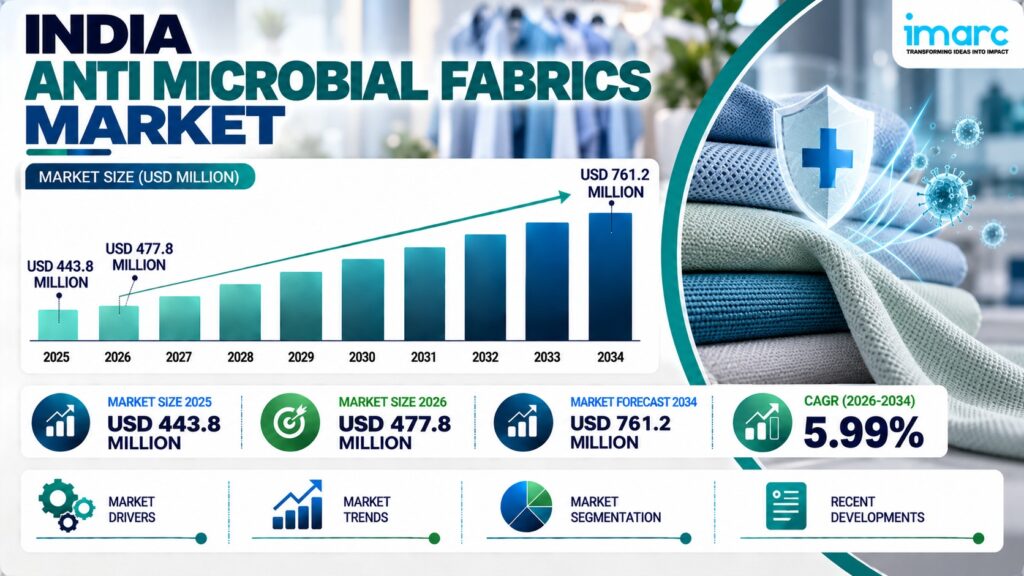
India’s anti microbial fabrics market stands as a critical segment within the broader technical textiles and functional apparel industry, encompassing active agents such as synthetic organic compounds, metal and metallic salts, bio-based, and others. These specialized fabrics are extensively utilized across diverse applications including medical textiles, apparel, commercial textiles, home textiles, industrial textiles, and others, spanning North India, South India, East India, and West India. The anti microbial fabrics market size in India reached USD 443.8 Million in 2025, expanded to USD 477.8 Million in 2026, and is projected to reach USD 761.2 Million by 2034, exhibiting a steady compound annual growth rate (CAGR) of 5.99% during 2026-2034.
The market is expanding due to a heightened societal focus on personal hygiene, health, and infection control across both consumer and institutional demographics. In the healthcare sector, the stringent necessity to mitigate hospital-acquired infections (HAIs) drives immense volume demand for antimicrobial bed linens, scrubs, surgical gowns, and privacy curtains. Simultaneously, shifting consumer lifestyles and the premiumization of casual wear have accelerated the demand for odor-resistant, sweat-wicking activewear, athleisure, and innerwear. With consumers and regulatory bodies increasingly prioritizing eco-friendly, bio-based treatments over harsh synthetic chemicals, domestic textile manufacturers are continuously innovating to integrate highly durable and sustainable antimicrobial finishes directly into everyday fabrics, structurally fortifying the industry’s growth trajectory.
Market Snapshot
-
Current Market Size (2025): USD 443.8 Million
-
Market Size (2026): USD 477.8 Million
-
Projected Market Size (2034): USD 761.2 Million
-
CAGR: 5.99%
-
Metal and metallic salts (such as silver, zinc, and copper) represent a prominent active agent segment, highly favored for their broad-spectrum efficacy, thermal stability, and exceptional durability through intensive industrial wash cycles.
-
Medical textiles constitute a leading application segment, fundamentally driven by uncompromising hygiene protocols in hospitals and the widespread deployment of antimicrobial fabrics in surgical wear, wound dressings, and hospital upholstery.
-
South India and North India command significant regional market shares, supported by massive concentrations of textile manufacturing clusters, export-oriented units (EOUs), and expansive healthcare infrastructure across these geographies.
What Growth Factors Are Driving India Anti Microbial Fabrics Market?
- Rising Emphasis on Healthcare Hygiene and Infection Control:
The primary catalyst for antimicrobial fabrics in India is the healthcare sector’s aggressive push to curb hospital-acquired infections (HAIs). Hospitals, clinics, and eldercare facilities are systematically replacing conventional textiles with antimicrobial variants for patient gowns, doctor scrubs, bed sheets, and privacy curtains. These fabrics proactively inhibit the colonization and multiplication of pathogenic bacteria and fungi upon contact, significantly reducing cross-contamination risks. As India’s healthcare infrastructure rapidly expands across Tier-2 and Tier-3 cities, institutional procurement of medical-grade antimicrobial textiles represents a massive, recurring volume driver.
- Surging Demand in Sportswear, Athleisure, and Daily Apparel:
The integration of antimicrobial technologies has transcended medical applications to become a standard expectation in consumer apparel. With India’s growing fitness culture and the mainstreaming of athleisure, consumers demand high-performance fabrics that resist odor-causing bacteria during intense physical activity. Antimicrobial agents neutralize body odor and prevent fabric degradation caused by microbial growth, extending the garment’s lifespan and reducing the need for frequent washing. This functional value addition is driving major domestic and international apparel brands to incorporate antimicrobial finishes into their activewear, socks, and intimate apparel lines.
- Growth of the Commercial and Hospitality Sectors:
India’s booming hospitality and commercial real estate sectors generate substantial demand for specialized commercial textiles. Premium hotels, corporate offices, and public transit systems are increasingly deploying antimicrobial upholstery, carpets, and window treatments to maintain rigorous indoor hygiene standards and enhance guest confidence. The ability of these fabrics to resist mildew, mold, and persistent odors in humid Indian climates makes them highly attractive for high-traffic commercial environments.
Request Sample Report – TOC, Charts & Key Insights: https://www.imarcgroup.com/india-anti-microbial-fabrics-market/requestsample
Government Policy Support
-
National Technical Textiles Mission (NTTM): A flagship government initiative designed to position India as a global leader in technical textiles. The mission provides substantial financial outlays for R&D, innovation, and domestic manufacturing of specialized fabrics, including Meditech (medical textiles) and Protech (protective textiles).
-
Production Linked Incentive (PLI) Scheme for Textiles: By offering aggressive financial incentives for the domestic manufacturing of Man-Made Fibers (MMF) and technical textiles, this scheme encourages domestic mills to upgrade their finishing capabilities and integrate advanced antimicrobial coatings.
-
Make in India Initiative: Broad policy support aimed at reducing import dependency for high-performance functional textiles, encouraging foreign direct investment (FDI) and joint ventures in domestic textile processing and specialty chemical manufacturing.
-
Bureau of Indian Standards (BIS) Guidelines: The formulation of standardized testing protocols and quality benchmarks for functional and protective textiles ensures product authenticity, fostering consumer and institutional trust in domestically manufactured antimicrobial fabrics.
What Are the Latest Emerging Trends in India Anti Microbial Fabrics Market?
- Shift Toward Eco-Friendly and Bio-Based Antimicrobial Agents:
As environmental awareness rises and global brands commit to sustainable supply chains, there is a pronounced industry pivot toward bio-based antimicrobial agents. Traditional synthetic organic compounds and heavy metals are increasingly facing regulatory scrutiny regarding their environmental toxicity and wastewater discharge impacts. In response, textile chemical formulators are developing natural antimicrobial finishes derived from plant extracts (such as neem, aloe vera, and peppermint), chitosan (derived from crustacean shells), and bio-synthesized peptides. These sustainable alternatives offer effective microbial protection while ensuring skin safety and strict eco-compliance.
- Advancements in Nanotechnology and Silver Nanoparticles:
Nanotechnology is revolutionizing the application and durability of antimicrobial finishes. Manufacturers are rapidly adopting silver nanoparticles (AgNPs) because of their exceptionally high surface-area-to-volume ratio, which allows for powerful antimicrobial action at very low concentrations. Unlike traditional topical coatings that degrade after a few washes, nano-engineered antimicrobial agents are embedded directly into the polymer matrix during the fiber spinning process or permanently cross-linked to the fabric surface. This ensures the antimicrobial efficacy lasts for the entire lifecycle of the garment, highly appealing to both military and healthcare procurement agencies.
- Integration into Home Textiles and Smart Fabrics:
The application of antimicrobial technology is rapidly expanding into home textiles, including mattress ticking, pillows, towels, and kitchen linens. Consumers in humid Indian climates are actively seeking home textiles that resist mold, dust mites, and damp odors. Furthermore, the nascent integration of antimicrobial properties with smart textiles—fabrics embedded with sensors for health monitoring—is opening niche opportunities in premium sportswear and advanced geriatric care.
How will India Anti Microbial Fabrics Market Evolve in the Coming Years?
The India anti microbial fabrics market possesses highly resilient growth prospects through 2034, driven by the indispensable requirement for hygiene in healthcare, the functional evolution of everyday apparel, and proactive government support for technical textiles. The market is projected to expand from USD 443.8 Million in 2025 to USD 477.8 Million in 2026, reaching USD 761.2 Million by 2034 at a compound annual growth rate of 5.99%. As the domestic textile industry moves up the value chain, the baseline integration of odor-control and hygienic finishes will transition from a premium feature to a standard industry norm. Textile manufacturers and specialty chemical providers that invest in permanent, wash-durable bio-based finishes, secure verified efficacy certifications, and forge strategic partnerships with leading activewear and healthcare brands are strategically positioned to capture dominant market share over the next decade.
How Is India’s Anti Microbial Fabrics Market Segmented?
➤ By Active Agent
-
Synthetic Organic Compounds
-
Metal and Metallic Salts
-
Bio-based
-
Others
➤ By Application
-
Medical Textiles
-
Apparel
-
Commercial Textiles
-
Home Textiles
-
Industrial Textiles
-
Others
➤ By Region
-
North India
-
South India
-
East India
-
West India
Competitive Landscape — By IMARC GROUP
The India anti microbial fabrics market features a highly competitive and technologically driven landscape. It is characterized by the presence of global specialty chemical giants, dedicated antimicrobial technology licensors, and massive vertically integrated domestic textile conglomerates. Competition centers on the wash durability of the antimicrobial treatment, broad-spectrum efficacy against evolving pathogens, skin safety (dermatological testing), and compliance with global environmental standards (such as OEKO-TEX and bluesign). Market leaders frequently partner directly with downstream apparel and home textile brands, providing co-branded hangtags that communicate hygiene and odor-control benefits directly to the end consumer.
Note: If you need specific information that is not currently within the scope of the report, we can provide it to you as a part of the customization.
Frequently Asked Questions
How big is the anti microbial fabrics market in India?
➤ The India anti microbial fabrics market reached USD 443.8 Million in 2025 and expanded to USD 477.8 Million in 2026, supported by the rising demand for medical textiles and the mainstreaming of odor-resistant activewear.
What is the projected growth rate of the India anti microbial fabrics market?
➤ The market is projected to reach USD 761.2 Million by 2034, registering a steady compound annual growth rate (CAGR) of 5.99% between 2026 and 2034, propelled by the adoption of eco-friendly bio-based agents and expanding healthcare infrastructure.
What are the key factors driving market growth?
➤ Key drivers include strict infection control protocols necessitating antimicrobial bed linens and scrubs in hospitals, shifting consumer preferences toward high-performance sports and daily apparel, and strong government initiatives boosting the domestic technical textiles industry.