Market Outlook
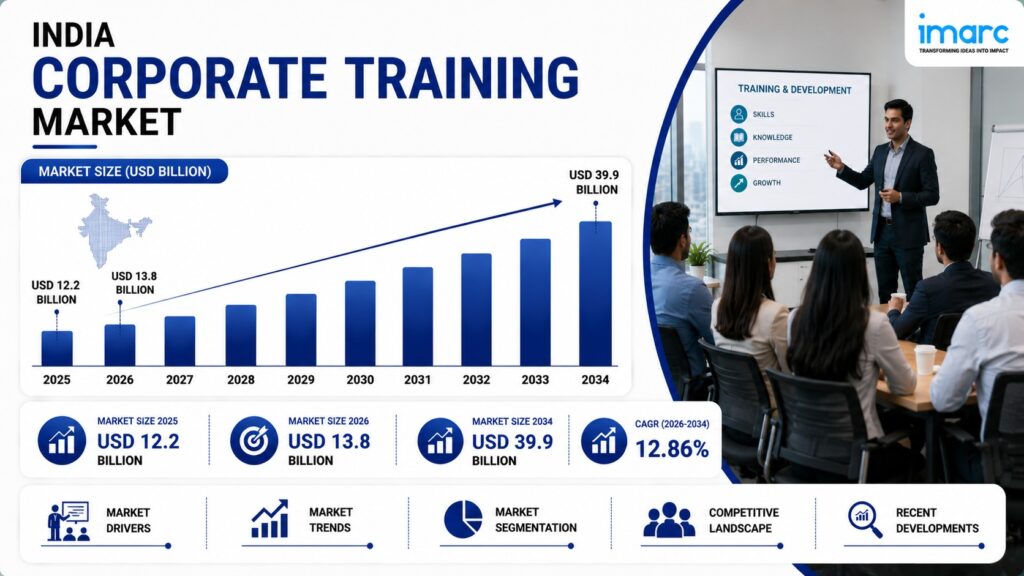
The India corporate training market grew from USD 12.2 Billion in 2025 to USD 13.8 Billion in 2026. The market is expected to reach USD 39.9 Billion by 2034, exhibiting a growth rate (CAGR) of 12.86% during 2026-2034. The market expansion is underpinned by restructured government skilling programmes, rising enterprise demand for live, instructor-led corporate learning over purely self-paced formats, and continued consolidation among corporate training specialists through acquisitions and managed-service contracts. Sustained expansion of India’s IT-BPM and Global Capability Centre workforce, growing enterprise investment in AI-related upskilling, and continuous innovation in training delivery formats necessitate sustained platform and content investment across the value chain.
Deepening enterprise adoption of managed learning services and rising consolidation among established training providers are further strengthening India’s organised corporate training ecosystem, collectively expanding the overall India corporate training market share. The industry demonstrates resilience amid profitability pressure across several platforms and persistent skills-placement mismatches in complementary public skilling programmes, benefiting from sustained enterprise L&D budgets, rising demand for outcome-linked training contracts, and continued growth of India’s white-collar workforce requiring structured upskilling.
Market Snapshot:
- Market Size (2025): USD 12.2 Billion
- Market Size (2026): USD 13.8 Billion
- Forecast Market Size (2034): USD 39.9 Billion
- CAGR: 12.86% (2026-2034)
- Technical Trainings Covered: Soft Skills, Quality Training, Compliance, Others
- End Use Industries Covered: Retail, Pharmaceutical and Healthcare, Financial Services, Professional Services, Public Enterprises, Information Technology, Others
- Regions Covered: North India, West and Central India, South India, East and Northeast India
What are the Growth Factors of the Corporate Training Market in India?
- Government-Backed Skill India Programme Restructuring
The Union Cabinet approved the restructuring of the Central Sector Scheme into a composite “Skill India Programme” in March 2025, merging PMKVY 4.0, the PM National Apprenticeship Promotion Scheme and the Jan Shikshan Sansthan Scheme, with a combined outlay of Rs. 8,800 crore for 2022-23 to 2025-26. The government has separately approved the Pradhan Mantri Skilling and Employability through Upgraded ITIs (PM-SETU) scheme, with an estimated outlay of Rs. 60,000 crore, to upgrade 1,000 ITIs, reinforcing a broader public skilling ecosystem that complements enterprise-funded corporate training.
- Rising Enterprise Demand for Live, Instructor-Led Learning
Simplilearn’s revenue from live learning programmes surged 65% year-on-year to Rs. 565 crore in FY25, even as revenue from self-paced online courses collapsed 95% to Rs. 23 crore over the same period, according to the company’s regulatory filings. This sharp divergence signals strong and growing enterprise appetite for structured, cohort-based, instructor-led corporate training over purely self-directed online learning formats.
- Corporate Training Specialists Scaling Through M&A and Managed Contracts
upGrad has built out its enterprise training capabilities partly through the acquisition of Centum Learning, a dedicated corporate training solutions provider, and now serves over 3,000 corporate partners through its upGrad Enterprise platform. NIIT Learning Systems generated approximately USD 390 Million in revenue visibility in FY25 from 93 managed learning customers, illustrating how multi-year managed learning contracts are producing more predictable, recurring revenue streams for established corporate training providers.
- Expanding IT-BPM and GCC Sector Anchoring Enterprise Training Demand
India’s technology sector, including IT services, BPM and Global Capability Centres, generated estimated revenue of USD 283 Billion in FY25, up 5.1% year-on-year, with the country now hosting more than 1,750 Global Capability Centres, according to Nasscom. This large and continuously expanding white-collar workforce base represents a recurring, high-volume source of demand for compliance, technical and leadership training across India’s organised corporate sector.
Grab a sample copy of this report: https://www.imarcgroup.com/india-corporate-training-market/requestsample
What Are the Key Trends Shaping the Market?
- Divergence Between Self-Paced and Live Learning Formats
Corporate learning providers are witnessing a pronounced shift in revenue mix away from self-paced online courses toward live, cohort-based and enterprise-commissioned training programmes. This trend, most visibly illustrated by Simplilearn’s contrasting segment performance in FY25, suggests that enterprise buyers increasingly value structured, accountable, outcome-linked training delivery over open-enrolment self-study content.
- Consolidation Through Acquisition of Corporate Training Specialists
Larger, diversified education technology companies continue to acquire specialised corporate training providers to build out enterprise-facing capabilities rapidly rather than solely through organic development. upGrad’s acquisition of Centum Learning, a corporate training solutions provider previously under Bharti Enterprises, exemplifies this consolidation trend within India’s fragmented corporate learning provider landscape.
- Managed Learning Services Model Gaining Enterprise Traction
Enterprise buyers are increasingly favouring managed learning services, in which providers integrate learning administration, content development, technology platforms and strategic consulting into a single, multi-year contract. NIIT Learning Systems’ base of 93 managed learning customers in FY25 illustrates how this model can support high-retention enterprise relationships beyond simple transaction-based course sales.
- AI-Driven Upskilling Emerging as a Core Growth Engine
Leading corporate and professional learning platforms have identified artificial intelligence-related upskilling as a primary growth driver in FY25, reflecting rising enterprise demand for employee training in AI tools, data literacy and related technical competencies. This demand is expected to remain a key area of corporate training investment as organisations across sectors integrate AI into their operations.
What Are the Major Market Challenges?
- Weak Utilisation of Complementary Public Skilling Programmes
PMKVY 4.0 had utilised only around 14% of its allocated budget and met just a tenth of its certification target for 2025-26, according to data shared by the Ministry of Skill Development and Entrepreneurship with Parliament. A Parliamentary Standing Committee flagged this poor budget utilisation in March 2026, recommending an outcome-based redesign and a National-Level Skill Board, highlighting persistent execution gaps in the public skilling ecosystem that private corporate training providers must often compensate for.
- Profitability Pressure Across Corporate Learning Platforms
Despite revenue growth, upGrad posted a consolidated net loss of Rs. 273.35 crore in FY25, though narrowed from Rs. 559.5 crore in FY24, while Simplilearn’s overall operating revenue fell 26% year-on-year even as its corporate-facing live learning segment grew strongly. This uneven profitability across leading providers illustrates the ongoing challenge of balancing growth investment with sustainable unit economics in India’s corporate training sector.
- Persistent Skills-Placement Mismatch Despite Rising Investment
Only around 5% of India’s workforce is formally skilled, compared with 60-80% in economies such as Germany and South Korea, while placement rates under flagship government skilling schemes often remain below 20%. This persistent gap between training volume and employable, placement-linked outcomes continues to challenge both public and private training providers seeking to demonstrate measurable return on training investment.
Explore the Full Report with Charts, Table of Contents, and List of Figures: https://www.imarcgroup.com/india-corporate-training-market
How Is the Market Segmented?
- By Technical Training: The market is segmented into Soft Skills, Quality Training, Compliance and Others, reflecting the breadth of capability areas that organisations invest in to build both interpersonal effectiveness and role-specific technical proficiency among employees.
- By End Use Industry: The market is segmented into Retail, Pharmaceutical and Healthcare, Financial Services, Professional Services, Public Enterprises, Information Technology and Others, spanning the range of sectors that rely on structured corporate training to meet regulatory, technical and workforce-development requirements.
- Regional Insights: The market is segmented into North India, West and Central India, South India, and East and Northeast India, reflecting differences in corporate headquarters concentration, IT-BPM and GCC presence, and enterprise L&D spending across these regions.
Competitive Landscape:
India’s corporate training market features competition between large, diversified edtech platforms and specialised managed-learning providers, with rivalry centred on enterprise relationship depth, content breadth and delivery format flexibility. upGrad has built a substantial enterprise training business through its upGrad Enterprise platform, serving more than 3,000 corporate partners, reinforced by its acquisition of corporate training specialist Centum Learning, and reported FY25 revenue of Rs. 1,569.3 crore alongside its first EBITDA-positive year. Simplilearn, backed by Blackstone, reported strong growth in its live, enterprise-facing learning segment even as its broader FY25 revenue declined to Rs. 556 crore. NIIT Learning Systems has built a managed-learning-services model generating approximately USD 390 Million in revenue visibility from 93 enterprise customers in FY25. Other established players in India’s corporate and executive training space include Great Learning, TimesPro and TeamLease EdTech, the latter serving over 2,000 corporate relationships and 700,000-plus learners through performance-linked and work-integrated training programmes.
Recent News or Developments:
- Union Cabinet restructures Skill India Programme (March 2025): The Union Cabinet approved the continuation and restructuring of the Central Sector Scheme into a composite “Skill India Programme” with an outlay of Rs. 8,800 crore for 2022-23 to 2025-26, merging PMKVY 4.0, PM-NAPS and the Jan Shikshan Sansthan Scheme to create a more integrated public skilling framework alongside private corporate training investment.
- upGrad reports first EBITDA-positive year in FY25 (December 2025): upGrad reported FY25 revenue from operations of Rs. 1,569.3 crore, up 5.5% year-on-year, while narrowing its consolidated net loss to Rs. 273.35 crore from Rs. 559.5 crore in FY24 and achieving EBITDA positivity of Rs. 15 crore for the first time in its operating history, according to regulatory filings.
- Parliamentary Standing Committee flags PMKVY 4.0 budget underutilisation (March 2026): A Parliamentary Standing Committee on skill development flagged that PMKVY 4.0 had spent only around 14% of its allocated budget and that the PM-SETU scheme had utilised under 1% of its outlay, recommending the establishment of a National-Level Skill Board and a shift toward outcome-based, placement-linked programme design.
Customization Note: If you require any specific information not covered within this report’s scope, we will provide it as part of the customization.
Request Report Customization: https://www.imarcgroup.com/request?type=report&id=21690&flag=E
Frequently Asked Questions (FAQs)
Q1. What is the current size of the India corporate training market?
The India corporate training market size increased from USD 12.2 Billion in 2025 to USD 13.8 Billion in 2026.
Q2. What is the expected growth rate of the India corporate training market during 2026-2034?
The market is projected to grow at a CAGR of 12.86% during 2026-2034, reaching USD 39.9 Billion by 2034.
Q3. What factors are driving the growth of the India corporate training market?
Key growth drivers include the restructured government Skill India Programme, rising enterprise demand for live, instructor-led corporate learning, consolidation among corporate training specialists through acquisitions and managed contracts, and the continued expansion of India’s IT-BPM and GCC workforce.
Q4. Which segments are covered in the India corporate training market report?
The report covers segmentation by technical training, end-use industry, and region.
Q5. What trends are shaping the future of the India corporate training market?
Key trends include the divergence between self-paced and live learning formats, consolidation through acquisition of corporate training specialists, growing adoption of managed learning services, and AI-driven upskilling becoming a core enterprise growth engine.