India Crop Protection Chemicals Market: Industry Report 2026–2034
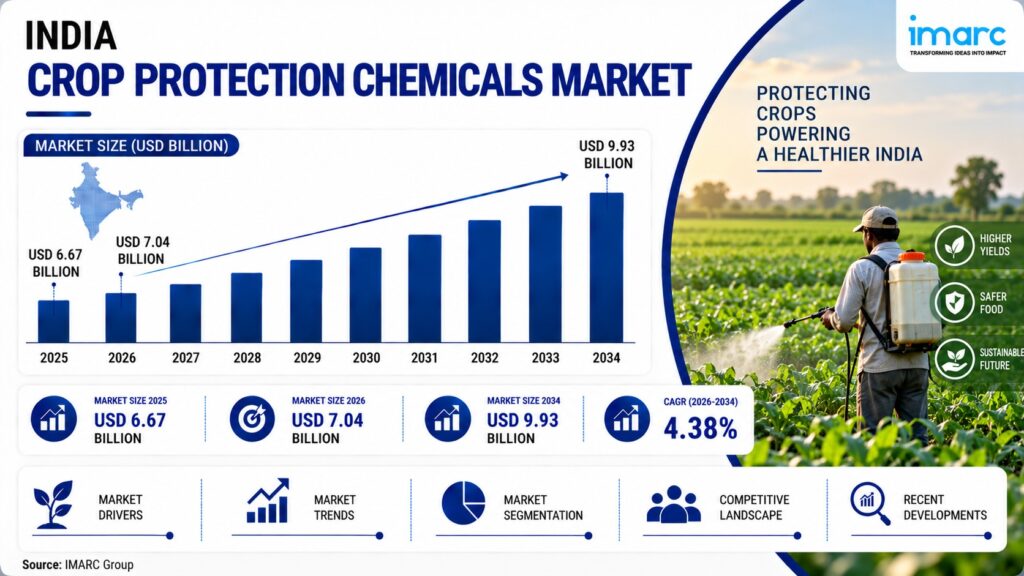
The India crop protection chemicals industry size increased from USD 6.67 Billion in 2025 to USD 7.04 Billion in 2026 and is projected to reach USD 9.93 Billion by 2034, exhibiting a compound annual growth rate (CAGR of 4.38%) during the 2026–2034 forecast period. The industry is evolving steadily amid rising pest pressure, climate variability, and the need to protect high-value cereal, oilseed, cotton, and horticulture crops. Driven by intensifying weed and disease challenges, labor cost escalation, expanding commercial farming, and gradual uptake of bio-based solutions, the market remains a foundational pillar of India’s agricultural productivity and food security framework.
What Is the Size and Growth Forecast of the India Crop Protection Chemicals Market?
The market is exhibiting resilient, continuous expansion, fundamentally anchored by the essential need to safeguard crop yields against weeds, insects, and fungal diseases across India’s diverse and high-intensity agricultural systems.
- Market Size in 2025: USD 6.67 Billion.
- Market Size in 2026: USD 7.04 Billion.
- Market Forecast in 2034: USD 9.93 Billion.
- Compound Annual Growth Rate (CAGR): 4.38% during the 2026–2034 forecast period.
- Underpinning Momentum: Persistent pest and weed pressure in major cropping systems, rising labor costs favoring chemical weed control, climate-linked disease outbreaks, and expanding commercial cultivation of cereals, cotton, oilseeds, and vegetables ensure steady demand for both synthetic and emerging bio-based products.
What Are the Latest Emerging Trends in the India Crop Protection Chemicals Market?
- Accelerated Shift Toward Bio-Based and Natural Solutions: Natural and bio-based products are gaining traction as farmers and exporters seek residue-compliant options. Government promotion of biopesticides, organic farming expansion, and resistance management strategies are supporting faster adoption of these safer alternatives alongside conventional chemistries.
- Focus on Resistance Management and Novel Molecules: Companies are introducing new active ingredients and combination products designed to combat evolving pest and weed resistance. Seed treatment technologies and precise application methods are also rising to improve efficacy while reducing overall chemical load per hectare.
- Digital Integration and Precision Application: Digital tools, weather-based advisories, and precision spraying equipment are being linked with crop protection programs. These solutions help farmers time applications more accurately, minimize wastage, and improve return on investment in high-value crop segments.
- Rising Demand for Specialty and Horticulture Solutions: Fungicides and targeted products for vegetables, fruits, and plantation crops are expanding faster than traditional cereal-focused segments. Climate variability is increasing disease pressure, driving higher per-hectare usage in horticulture clusters.
- Strengthening Rural Distribution and Farmer Outreach: Leading players continue investing in last-mile networks, demonstration plots, and farmer education programs. Strong on-ground presence remains critical for building trust and driving adoption of both established and newer product portfolios.
Request a Sample Copy of this Report: https://www.imarcgroup.com/india-crop-protection-chemicals-market/requestsample
What Growth Factors Are Driving the India Crop Protection Chemicals Market?
- Intensifying Weed and Pest Pressure: High-intensity cereal, oilseed, and commercial crop systems face persistent weed competition and diverse pest species. Chemical solutions remain the most reliable and scalable method for protecting yields under continuous cultivation pressure.
- Rising Labor Costs and Shortage of Manual Weeding: Escalating rural wages and reduced availability of farm labor make chemical weed control significantly more economical than manual methods, particularly across large commercial holdings in major producing states.
- Climate Variability and Disease Outbreaks: Changing weather patterns are increasing the incidence of fungal diseases such as rice blast and wheat rust. This drives stronger demand for fungicides and protective sprays in both cereal and vegetable production systems.
- Expansion of Commercial and High-Value Cropping: Growth in cotton, soybean, groundnut, and horticulture acreage requires intensive crop protection regimes. Farmers investing in higher-value crops are more willing to adopt quality products to safeguard returns.
- Supportive Policy and Export Residue Requirements: Government programs promoting balanced use of crop protection chemicals, coupled with stricter residue limits for export markets, encourage both efficient synthetic use and faster uptake of bio-based alternatives.
What Are the Key Challenges Facing the India Crop Protection Chemicals Market?
- Growing Pest and Weed Resistance: Continuous use of similar chemistries has led to resistance in key pests and weeds, reducing product efficacy and forcing farmers to seek higher doses or alternative solutions, which increases costs.
- Regulatory Scrutiny and Registration Delays: Stringent safety evaluations, periodic reviews of older molecules, and lengthy approval processes for new products can slow innovation introduction and limit the timely availability of advanced solutions.
- Price Sensitivity in Economy Segments: A large portion of the market remains highly price-conscious. Generic and low-cost formulations dominate volume, putting pressure on margins for companies investing in research and premium products.
- Need for Improved Application Practices: Incorrect timing, dosage, or spraying techniques reduce effectiveness and raise environmental concerns. Bridging the gap between product availability and proper on-farm usage remains an ongoing challenge.
Explore the Full Report with Charts, Table of Contents, and List of Figures: https://www.imarcgroup.com/india-crop-protection-chemicals-market
Deep-Dive Segment Insights
The market is meticulously segmented to address diverse crop systems, pest complexes, and regional farming practices.
By Product Type
- Herbicides (38.6% share in 2025): Command majority share due to rising weed management challenges in high-value cereal, oilseed, and commercial crops. Labor cost escalation makes chemical weed control economically superior to manual weeding across large holdings.
- Insecticides (32.4% in 2025): Remain essential across tropical cropping systems where diverse pest species require season-long management.
- Fungicides (21.7%): Growing fastest, driven by increasing rice blast, wheat rust, and vegetable fungal disease pressure linked to climate variability.
- Others (7.3%): Include nematicides, rodenticides, and plant growth regulators used across specialty crops.
By Origin
- Synthetic (78.5% share in 2025): Dominates reflecting established regulatory frameworks, cost efficiency, and broad-spectrum efficacy. These products benefit from extensive farmer familiarity, decades of application experience, and deep rural distribution infrastructure.
- Natural/Bio-based (21.5% in 2025): Growing at approximately 6.8% CAGR, the fastest segment, supported by export residue requirements, organic farming expansion, government biopesticide programs, and resistance management needs.
By Region
- North India (31.4% share in 2025): Leads due to the wheat-rice belt, high chemical adoption rates, and commercial farming intensity in Punjab and Haryana.
- West and Central India (29.6%): Driven by Maharashtra cotton, Gujarat cash crops, and Madhya Pradesh soybean cultivation requiring intensive pest and weed management.
- South India (23.8%): Supported by horticulture clusters, rice paddy fungicide demand, and vegetable growing belts.
- East and Northeast India (15.2%): Emerging market with potential from rice cultivation and tea plantation fungicide adoption.
Competitive Landscape & Key Player Positioning
The India crop protection chemicals market is moderately concentrated, with global multinationals holding premium-priced innovation-driven positions alongside strong domestic companies competing on price, distribution reach, and farmer trust in the economy and generic formulation segments.
Key players include Bayer AG, BASF, Corteva, UPL, Rallis India Limited, Insecticides India, Crystal Crop Protection Ltd., ADAMA, and others.
Recent Developments
- 2025–2026: Leading companies continued launching combination products and novel formulations focused on resistance management, particularly for key pests in cotton, rice, and vegetable crops, while expanding bio-pesticide portfolios to meet residue and export requirements.
- Ongoing: Major players strengthened digital advisory platforms and precision application partnerships, helping farmers optimize timing and dosage of crop protection chemicals across major producing states.
- 2025–2026: Domestic formulators and global companies expanded manufacturing and distribution capacity to improve availability of both synthetic and bio-based products in remote agricultural markets.
- Policy Support Continuity: Government programs promoting judicious use of crop protection chemicals and biopesticide adoption continued to influence product mix and farmer purchasing behavior across regions.
- Climate-Linked Demand Shifts: Increased fungal disease pressure in cereal and horticulture belts during recent seasons supported higher fungicide volumes, reinforcing the fastest-growing product category within the market.
Customization Note: If you require any specific information not covered within this report’s scope, we will provide it as part of the customization.
Request Report Customization: https://www.imarcgroup.com/request?type=report&id=21474&flag=E
Frequently Asked Questions (FAQs)
Q1. What is the current size of the India crop protection chemicals market?
The India crop protection chemicals market size was valued at USD 6.67 Billion in 2025 and increased to USD 7.04 Billion in 2026.
Q2. What is the projected market size by 2034 and the growth rate?
The market is projected to reach USD 9.93 Billion by 2034, exhibiting a compound annual growth rate (CAGR of 4.38%) during the 2026–2034 forecast period.
Q3. Which product type holds the largest share?
Herbicides command the largest share at 38.6% in 2025, driven by rising weed management challenges and the economic advantage of chemical control over manual weeding.
Q4. What is the share of synthetic versus natural products?
Synthetic products dominate with 78.5% share in 2025, while natural/bio-based products account for 21.5% and are growing at a faster pace of approximately 6.8% CAGR.
Q5. Which region accounts for the highest market share?
North India leads with 31.4% share in 2025, supported by intensive wheat-rice cultivation, high chemical adoption, and strong distribution infrastructure in Punjab and Haryana.