India Innerwear Market: Industry Report 2026–2034
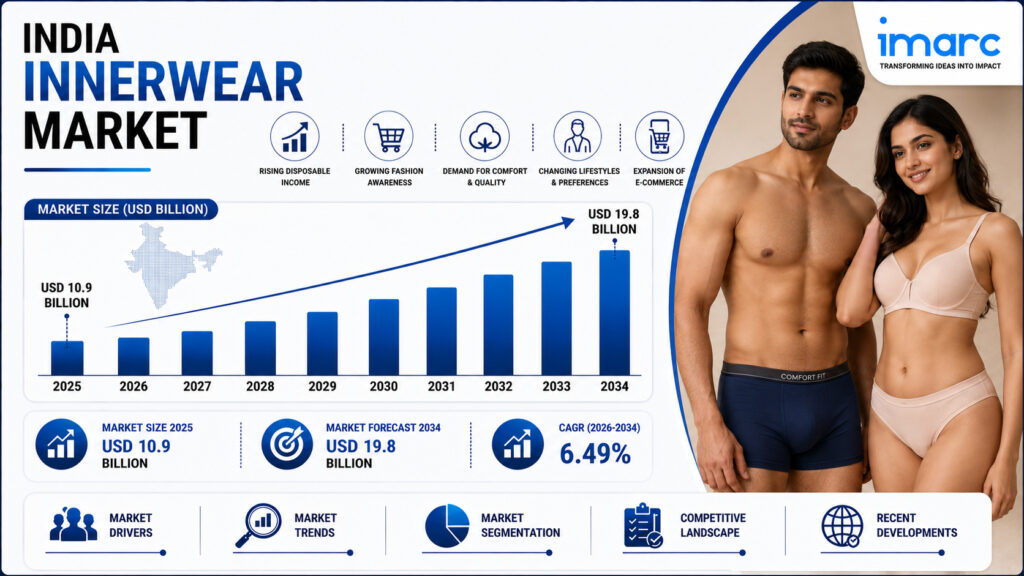
The India innerwear market size reached USD 10.9 Billion in 2025 and is projected to reach USD 19.8 Billion by 2034, growing at a CAGR of 6.49% during 2026–2034. This monumental expansion reflects a structural realignment in how consumers allocate their fashion budgets, moving away from viewing undergarments as mere basic necessities to treating them as essential lifestyle and wellness products. As disposable incomes rise and organized retail deepens its reach across the nation, the market is undergoing a significant transformation driven by premiumization, comfort-focused innovations, and shifting demographic preferences.
What Is the Size and Growth Forecast of the India Innerwear Market?
The India innerwear sector has demonstrated immense growth anchored by increasing fashion consciousness, rapid urbanization, and a decisive shift toward premium branded apparel across the country.
-
Market Size in 2025: USD 10.9 Billion.
-
Market Forecast in 2034: USD 19.8 Billion.
-
Compound Annual Growth Rate (CAGR): 6.49% during the 2026–2034 forecast period.
-
Underpinning Momentum: The rapid penetration of e-commerce platforms and digital payment gateways has democratized access to premium global brands for consumers residing in tier-2 and tier-3 cities.
What Are the Latest Emerging Trends in the India Innerwear Market?
-
Integration of Smart Fabrics and Antimicrobial Technologies: Modern apparel manufacturers are increasingly integrating advanced moisture-wicking and antimicrobial fabric technologies into daily essentials. This crucial technological shift successfully prevents bacterial accumulation, actively manages perspiration, and provides exceptional all-day hygiene, ultimately ensuring unmatched physical comfort for highly active, health-conscious urban consumers across tropical climates.
-
The Boom in Athleisure and Hybrid Innerwear: The rapidly blurring boundaries between activewear and everyday undergarments have catalyzed a massive demand for hybrid apparel. Consumers actively seek versatile designs, such as supportive sports bras and seamless performance trunks, which seamlessly transition from intense gymnasium workouts to relaxed, casual lounging environments without compromising fit.
-
Surge in Demand for Sustainable and Organic Materials: A profound consumer awakening regarding environmental conservation is propelling the widespread adoption of eco-friendly textiles. Shoppers are heavily prioritizing undergarments meticulously crafted from pure organic cotton, biodegradable bamboo fibers, and recycled synthetics, actively compelling prominent brands to drastically minimize their overall industrial carbon footprint and toxic dye usage.
-
Expansion of D2C Brands and Digital Accessibility: The explosive proliferation of direct-to-consumer digital platforms is fundamentally democratizing access to premium intimate wear. Innovative digital native brands are leveraging precise data analytics and virtual fitting room applications to deliver highly personalized sizing recommendations, ensuring unparalleled shopping convenience and absolute privacy for millions of online buyers.
-
Increasing Focus on Size Inclusivity and Ergonomic Fits: Leading fashion brands are aggressively expanding their size catalogs to champion profound body positivity and comprehensive inclusivity. By introducing meticulously engineered plus-size collections and wire-free ergonomic silhouettes, manufacturers are successfully addressing historical market gaps and strongly catering to the diverse morphological requirements of the modern Indian demographic.
➤ Request Sample Report (TOC & Charts): https://www.imarcgroup.com/india-innerwear-market/requestsample
What Growth Factors Are Driving the India Innerwear Market?
-
Rising Urbanization and Expanding Working Population: The relentless expansion of metropolitan hubs and a rapidly increasing corporate workforce heavily drive consistent product consumption. As millions of young professionals actively upgrade their daily wardrobes to meet modern lifestyle standards, the fundamental demand for highly comfortable, durable, and aesthetically pleasing undergarments experiences massive, sustained acceleration.
-
Shift Towards Premiumization and Branded Apparel: Indian consumers are decisively transitioning from unorganized local vendors to established, high-quality branded merchandise. An escalating desire for superior fabric longevity, consistent sizing, and elevated aesthetic appeal encourages shoppers to confidently invest higher discretionary incomes into premium intimate wear, drastically expanding the organized sector’s total revenue pool.
-
Increasing Disposable Incomes Across Tier-2 and Tier-3 Cities: Rapid economic development beyond major metropolitan areas is creating vast, previously untapped consumer demographics. As disposable incomes surge across tier-2 and tier-3 cities, aspirational buyers are eagerly adopting global fashion trends, generating a massive new wave of demand for branded, high-quality apparel through localized retail distribution networks.
-
Aggressive Marketing and Celebrity Endorsements: Strategic brand positioning through high-profile celebrity endorsements and targeted influencer marketing campaigns exerts a massive influence on purchasing decisions. These visually compelling digital promotions effectively destigmatize intimate wear discussions, heavily amplify brand recall, and rapidly accelerate consumer adoption rates among highly impressionable, fashion-forward younger demographics.
-
Expanding Retail Infrastructure and Omnichannel Distribution: The aggressive nationwide proliferation of exclusive brand outlets and large-format multi-brand retail stores drastically enhances physical product visibility. Furthermore, the seamless integration of these physical showrooms with robust e-commerce logistics creates a powerful omnichannel distribution network, guaranteeing uninterrupted product availability for consumers across the entire country.
Recent Developments:
-
February 2026: Page Industries, the exclusive licensee for Jockey in India, achieved a massive retail expansion milestone by officially launching its 1,500th Exclusive Brand Store nationwide. Concurrently, the brand expanded its youth-oriented athleisure portfolio with the launch of the new ‘JKY Groove’ collection to strongly capture the growing Gen Z demographic.
-
2025–2026: Fast-growing D2C brand Bummer pioneered a highly innovative retail channel by launching India’s inaugural innerwear vending machines. The rollout commenced at the Ahmedabad airport, with aggressive expansion plans targeting high-footfall locations across Mumbai, Delhi, and Bengaluru to offer travelers instant purchasing convenience.
-
June 2026: Industry analysts highlighted strong structural sector tailwinds for legacy hosiery giants like Lux Industries, Dollar Industries, and Rupa Company, heavily driven by premiumization efforts and continuous capacity expansions within the highly competitive domestic innerwear market.
-
September 2024 / 2025 Expansion: Clovia, a prominent digital-first lingerie brand, successfully introduced its first-ever comprehensive plus-size bra range. This strategic product launch actively addressed the escalating consumer requirement for highly inclusive, fashionable, and ergonomically fitting undergarments across India.
➤ Explore the Full Report with Charts, Table of Contents, and List of Figures: https://www.imarcgroup.com/india-innerwear-market
Deep-Dive Segment Insights
The market is intricately segmented to address specialized consumer requirements across different clothing styles, materials, and demographic needs.
By Product
-
Top Innerwear: Includes Bras, Bralettes, Vests, and Camisoles.
-
Bottom Innerwear: Encompasses Underwear, Panties, and Leggings.
-
Thermal and Baselayers: Dedicated winter apparel designed for superior insulation.
By Material
-
Cotton: Dominates volume consumption due to its high breathability and suitability for the Indian climate.
-
Wool: Includes premium variants such as Merino Wool, Cashmere Wool, Alpaca Wool, and Mohair Wool.
-
Polyester & Nylon: Highly preferred for stretchability, durability, and moisture-wicking athleisure applications.
-
Others: Includes eco-friendly blends and modal fabrics.
By Distribution Channel
-
Online: Representing the fastest-growing channel, offering privacy, size guides, and unmatched convenience.
-
Offline: Retains a massive share through multi-brand retail stores and exclusive brand outlets providing physical trial experiences.
By End Use
-
Men, Women, and Kids: The women’s segment specifically exhibits high growth momentum due to increasing workforce participation and demand for diverse styles like shapewear and sports bras.
By Region
-
The market spans North India, South India, East India, and West India.
Competitive Landscape & Key Player Positioning:
Covering an in-depth analysis of the competitive landscape, market structure, key player positioning, competitive dashboards, top winning strategies, and detailed profiles of all major industry participants you will gain access to all these exclusive insights within the full research report.
Customization Note: If you require any specific information not covered within this report’s scope, we will provide it as part of the customization.
➤ Request Report Customization: https://www.imarcgroup.com/request?type=report&id=30828&flag=E
Frequently Asked Questions:
Q1. How big is the India innerwear market?
The innerwear market in India was valued at USD 10.9 Billion in 2025.
Q2. What is the forecast for the innerwear market in India?
The India innerwear market is projected to exhibit a CAGR of 6.49% during 2026–2034, reaching an estimated value of USD 19.8 Billion by 2034.
Q3. Which distribution channel is driving market growth?
While offline retail holds a significant volume share, the online e-commerce channel is experiencing the most rapid growth, driven by digital payment penetration, privacy, and expansive digital catalogs.
Q4. What are the key materials used in the Indian innerwear sector?
Cotton remains the most dominant and preferred material due to its breathability, followed by expanding segments in polyester, nylon, and premium wool variants like merino and cashmere.
Q5. What factors are driving the growth of the India innerwear market?
Major drivers include increasing fashion consciousness, rapid urbanization, rising disposable incomes, and the strong consumer shift toward premium, branded, and performance-oriented undergarments.
Conclusion
The India innerwear market is on a robust and highly lucrative growth trajectory, expanding from USD 10.9 Billion in 2025 to an estimated USD 19.8 Billion by 2034 at a steady CAGR of 6.49%. This immense structural expansion is deeply intertwined with the nation’s rapid urbanization, rising disposable incomes, and a fundamental shift in consumer psychology that prioritizes personal comfort, hygiene, and aesthetic appeal. As major legacy brands expand their omnichannel footprints and innovative startups aggressively introduce sustainable fabrics and inclusive sizing, innerwear is firmly solidifying its position as a highly dynamic, fashion-forward pillar of India’s retail economy.