India Perfume Market Outlook
The report titled “India Perfume Market Size, Share, Trends and Forecast by Perfume Type, End User, and Region, 2026-2034” comprises the overall market analysis of India, size, growth trends, key drivers, and regional insights of the perfume market in India and other important aspects related to the report.
How Big is the India Perfume Market?
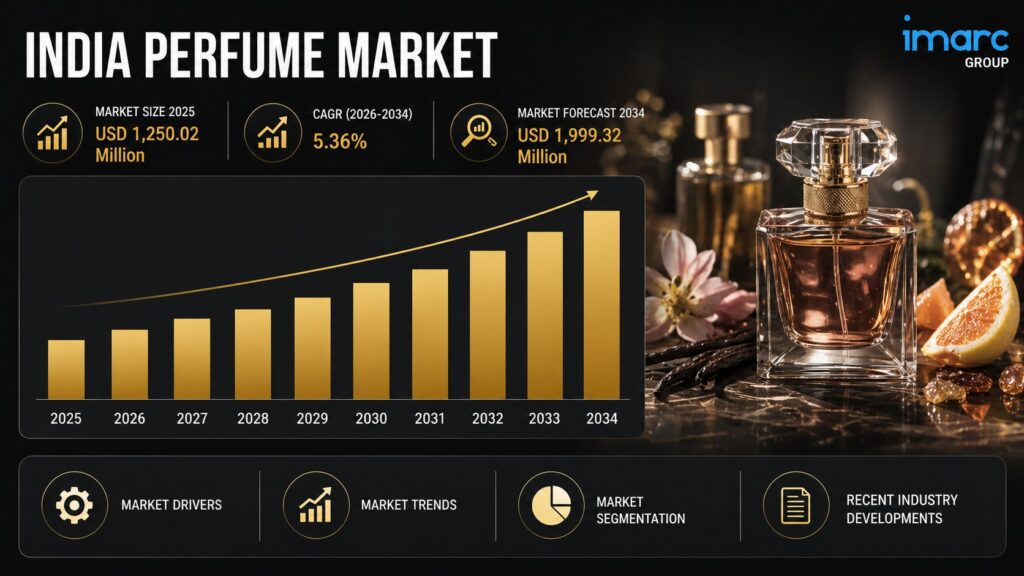
The India perfume market size was valued at USD 1,250.02 Million in 2025. Looking forward, IMARC Group expects the market to reach USD 1,999.32 Million by 2034, exhibiting a compound annual growth rate (CAGR) of 5.36% during 2026-2034. The market expansion is primarily driven by India’s rising private consumption, the rapid integration of rapid delivery platforms (quick commerce) for premium beauty goods, and a structural pivot towards niche, artisanal, and culturally rooted sustainable fragrances.
What are the Key Developments and Emerging Trends in India Perfume Market?
-
Resurgence of GI-Tagged Indigenous Fragrances: Traditional Indian perfumery is experiencing a massive revival with institutional backing. Kannauj Attar, which received a Geographical Indication (GI) tag in 2014, is being aggressively promoted globally and domestically under the Uttar Pradesh government’s One District One Product (ODOP) scheme.
-
The “Purple Revolution” and Domestic Aroma Cultivation: To support the fragrance industry with high-quality indigenous raw materials, the government launched the CSIR Aroma Mission. This initiative sparked the ‘Purple Revolution’, successfully scaling the cultivation of highly sought-after aromatic crops like lavender, geranium, and rosemary specifically for the perfumery and cosmetic sectors.
-
Institutional R&D and Quality Standardization: The Ministry of MSME’s Fragrance & Flavour Development Centre (FFDC) in Kannauj is actively bridging the gap between farmers and the perfume industry. By providing advanced analytical testing, quality assurance, and modern distillation processing facilities, the FFDC is elevating domestic fragrance manufacturing to meet strict global compliance standards.
-
Shift Towards Natural and Ayurvedic Formulations: Driven by rising health and wellness awareness, there is a pronounced consumer shift toward natural, chemical-free, and Ayurvedic beauty products. Brands are innovating rapidly to cater to this preference for organic and sustainably sourced fragrance ingredients.
➤ Request Sample Report (TOC & Charts): https://www.imarcgroup.com/india-perfume-market/requestsample
What Factors are Driving Growth in the India Perfume Market?
-
Rising Disposable Incomes and Premiumization: According to Invest India, increased affluent consumer spending is a primary growth catalyst. Buyers are increasingly willing to invest in luxury and premium personal care products, a segment that alone is expected to generate a market size of USD 3 to 3.2 Billion by 2028.
-
E-commerce Boom and Non-Metro Expansion: Digital retail is revolutionizing product accessibility. Online sales are projected to account for 33% of total Beauty and Personal Care (BPC) sales by 2028. Crucially, non-metro (Tier-2 and Tier-3) cities now present about five times the headroom for per capita BPC spending growth compared to metro areas, vastly expanding the addressable consumer base.
-
Import Substitution and “Atmanirbharta”: Government initiatives are successfully reducing the industry’s reliance on imported raw materials. Through the CSIR Aroma Mission, domestic cultivation of vetiver crops has surged in UP, Bihar, and Tamil Nadu, reducing the import burden of vetiver oil. Furthermore, India has now emerged as the world’s largest producer and exporter of lemongrass essential oil.
-
Social Media Influence: The democratization of beauty expertise through digital platforms is reshaping consumer behavior. With approximately 520 to 560 million social media users in India, platforms are playing a crucial role in driving aspirational purchasing decisions and rapidly popularizing new fragrance trends.
How will the India Perfume Market Evolve in the Coming Years?
-
Unprecedented Sectoral Growth: The broader Indian Beauty and Personal Care (BPC) market is officially projected by Invest India to reach USD 34 Billion by 2028, up from USD 21 Billion in 2023. Expanding at a robust CAGR of 10-11%, India is positioned as the fastest-growing BPC market globally.
-
Strengthening of the Contract Manufacturing Ecosystem: The domestic supply chain is evolving rapidly to support immense scale. The presence of 650 to 700 contract manufacturers highlights a massive boom in localized BPC production capabilities, allowing both domestic Direct-to-Consumer (D2C) brands and global luxury houses to manufacture efficiently within India.
-
Integration of Immersive Tech: The future of online fragrance retail will be driven by digital personalization. The integration of immersive technology, such as virtual try-on experiences and AI-driven personalized recommendations, is expected to bridge the tactile gap of online perfume shopping.
-
Global Export Prominence: With continuous technological upgrades facilitated by institutions like the FFDC and an expanding footprint in the cultivation of premium aromatic crops, India is poised to strengthen its position not just as a massive consumer market, but as a premier global exporter of high-quality essential oils and authentic artisanal perfumes to markets like the USA, UK, UAE, and Europe.
Deep-Dive Segment Insights
By Perfume Type: The market is segmented into Premium and Mass. Premium dominates the market with a share of 58% in 2025. The segment’s leadership is driven by the following factors:
-
Rising aspirational consumer demand and increasing willingness to invest in higher-priced products offering long-lasting performance.
-
Growing cultural significance and gifting culture during festivals.
-
Consumers in metropolitan cities demonstrating a strong preference for sophisticated scent compositions and prestigious brand associations.
By End User: The market is segmented into Female, Male, and Unisex. Female leads the market with a share of 52% in 2025. The segment’s leadership is driven by the following factors:
-
Higher baseline spending propensity on beauty and personal care products.
-
Extensive product variety and brand investments tailored specifically to female consumers.
-
The strong, immediate influence of social media fashion and beauty trends.
By Region: The market is segmented into North India, West and Central India, South India, and East and Northeast India. North India represents the leading market with a share of 31% in 2025. The segment’s leadership is driven by the following factors:
-
The concentration of high-density metropolitan cities, including the Delhi-NCR region.
-
Greater localized purchasing power for premium discretionary goods.
-
The strong presence of premium physical retail infrastructure alongside traditional manufacturing hubs like Kannauj.
Competitive Landscape & Key Company Insights
The India perfume market is highly competitive but remains open to new, agile entrants. While top heritage and luxury brands hold significant Gross Merchandise Value (GMV), digital-first homegrown brands are rapidly capturing market share through aggressive pricing and 10-minute delivery integrations. Prominent global players are partnering with domestic retail conglomerates to expand their physical footprint, while domestic manufacturers are increasingly exploring niche segments like Arabic-inspired perfumery and sustainably sourced natural attars to cater to evolving local preferences.
➤ Request Report Customization: https://www.imarcgroup.com/request?type=report&id=21362&flag=E
Frequently Asked Questions (FAQs):
Q1. What is the current size of the India perfume market?
Ans. The India perfume market was valued at USD 1,250.02 Million in 2025.
Q2. What is the expected growth rate of the India perfume market?
Ans. The market is projected to grow at a CAGR of 5.36% from 2026-2034, reaching an estimated USD 1,999.32 Million by 2034.
Q3. Which perfume type holds the largest share in the India perfume market?
Ans. Premium perfumes dominate the market, accounting for a 58% share in 2025, driven by brand consciousness and aspirational demand for artisanal quality.
Q4. Who is the leading end-user segment in the India perfume market?
Ans. The female segment leads the market with a 52% share in 2025, owing to a higher spending propensity on grooming products.
Q5. Which region leads the consumption of perfumes in India?
Ans. North India holds the largest market share at 31% in 2025, supported by high purchasing power, the concentration of metropolitan cities, and proximity to traditional fragrance manufacturing hubs.
Strategic Insight & Verdict The strategic evolution of the India perfume market is securely anchored in rising middle-class disposable incomes, aggressive quick-commerce retail expansion, and a definitive structural shift toward premiumization. Consumers are actively migrating from mass-market body sprays to premium EDPs and niche, artisanal fragrances. Furthermore, the revitalization of traditional Indian perfumery supported by institutional R&D highlights a growing demand for sustainable, culturally rooted products. Manufacturers and D2C brands focusing on expanding their premium offerings, leveraging 10-minute delivery platforms for immediate gratification, and integrating authentic, high-quality botanical ingredients will be best positioned to capture market share and secure sustained, long-term growth through 2034.