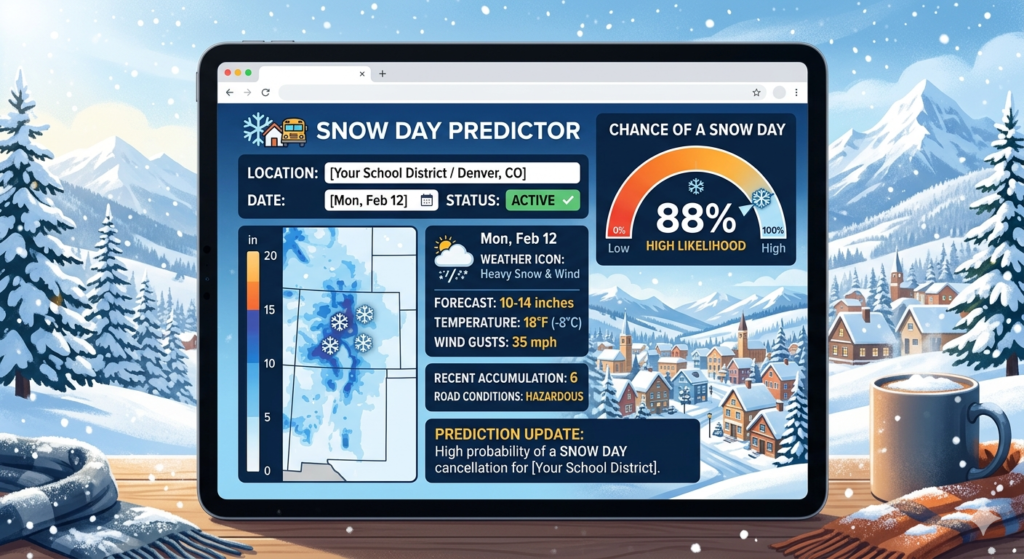
Every winter, students, parents, and teachers go to bed with one big question on their minds: will school be cancelled tomorrow? A snow day predictor takes the guesswork out of that question by using real weather data, local school policies, and smart algorithms to give you a reliable forecast before the alarm ever goes off.
What Is a Snow Day Predictor?
A snow day predictor is an online tool or app that estimates the likelihood of school closures due to snow, ice, or other severe winter weather. Instead of waiting for an early-morning phone call or checking local news at 5 a.m., these tools let you plan ahead the night before.
The prediction is based on a combination of factors including expected snowfall totals, temperature, wind chill, local geography, and historical school closure data. Some tools even account for the specific policies of your school district, making their estimates much more accurate than a simple weather forecast alone.
Snow day predictors are especially popular in the United States and Canada, where winter storms regularly disrupt school schedules across thousands of districts each year.
How Does a Snow Day Predictor Work?
The science behind a snow day predictor is more involved than it might seem at first glance. Here is a breakdown of what these tools typically analyze:
Weather Data and Forecasting Models
Most snow day prediction tools pull live data from trusted meteorological sources such as the National Weather Service (NWS), Weather.gov, or private services like the Weather Channel. They look at:
- Expected snowfall accumulation (in inches or centimeters)
- Timing of the storm relative to the school day
- Temperature and wind chill factors
- Ice, sleet, or freezing rain potential
- Visibility and road conditions
Historical Closure Data
Many advanced tools build a profile of your local school district based on past closure decisions. A district that has historically cancelled school with just two inches of snow will be flagged differently from one that stays open through six-inch storms. This historical context is one of the most powerful inputs in any good snow day predictor.
Geographic and Local Factors
Location matters a great deal. A school in Vermont may stay open during a snowfall that would completely shut down a district in Georgia. Snow day predictors often factor in:
- Urban versus rural setting
- Road infrastructure and plowing capacity
- Elevation and proximity to bodies of water
- State regulations on minimum school days
The Most Popular Snow Day Predictor Tools Available
Several tools have gained wide recognition for their accuracy and ease of use. Here are some of the most trusted options:
SnowDayCalculator.com
This is one of the most well-known free tools in the United States. Users simply enter their zip code, select whether they are a student or teacher, and receive a percentage chance of a snow day. The site is updated regularly and pulls from live weather data. It is simple, fast, and surprisingly accurate for many users.
Local School District Apps and Alerts
Many school districts now have their own mobile apps or notification systems. While these are not technically predictors, signing up for district alerts ensures you get official closure notices the moment a decision is made. Apps like ParentSquare or SchoolMessenger are widely used for this purpose.
Weather Apps with School Closure Features
Some premium weather apps, including Weather Underground and AccuWeather, now include school closure probability as part of their winter weather forecasting features. These apps leverage hyperlocal data to give more targeted predictions.
Social Media and Community Groups
Parents often use local Facebook groups or Nextdoor to crowdsource predictions from neighbors who may have inside knowledge or experience with how their district handles storms. While informal, this can be a helpful supplement to official tools.
How Accurate Is a Snow Day Predictor?
No snow day predictor can claim perfect accuracy, and it is important to understand why. School closure decisions are made by humans, often at the last minute, and they depend on many factors that even the best algorithm cannot fully anticipate.
That said, the better tools achieve a solid track record. Studies and user reviews suggest that top-rated snow day predictors are accurate around 80 to 90 percent of the time when there is a meaningful storm forecast. Accuracy tends to drop when:
- The storm forecast itself is uncertain or shifting
- The decision depends on early-morning road conditions
- The district has new leadership with different policies
- The storm tracks slightly north or south of the forecast
The key is to use a snow day predictor as a planning tool, not a guarantee. If the tool shows a 70 percent or higher chance, it is worth making backup childcare arrangements just in case.
Why Snow Day Predictions Matter for Families and Schools
A snow day might feel like a fun bonus for children, but for families and educators, it comes with real logistical challenges. Here is why having a reliable snow day predictor matters:
For Parents and Caregivers
- Arranging last-minute childcare can be stressful and expensive
- Remote workers may need to adjust their schedules
- Advance notice allows for grocery and supply runs before the storm
- Families with multiple children can coordinate plans more easily
For Teachers and School Staff
- Lesson plans and assessments may need to be rescheduled
- Remote learning preparations can begin the evening before
- Staff who commute long distances can arrange overnight accommodations if needed
For Students
- Knowing a snow day is likely lets students relax rather than stress about tomorrow
- It also reminds them to complete any assignments that might be due
- Older students who drive can avoid risky road conditions
Check your snow day chances now: Snow Day Predictor
Tips for Using a Snow Day Predictor Effectively
Getting the most out of any snow day predictor comes down to using it the right way. Keep these tips in mind:
- Check the tool the night before, not the morning of. Most decisions are made by 5 or 6 a.m., so checking at midnight gives you time to prepare.
- Use multiple sources. Cross-check your snow day predictor with the local news forecast and your district’s social media accounts.
- Note the percentage. A 30 percent chance means school is more likely to be open. A 75 percent or higher chance warrants real preparation.
- Sign up for district alerts. Even if your predictor says there is a high chance of closure, always confirm with an official source before keeping children home.
- Track storm movement. Use a weather radar app alongside your snow day tool so you can see if the storm is on track or shifting away from your area.
What Factors Do School Districts Use to Make Closure Decisions?
Understanding what goes into a school district’s decision can help you interpret a snow day predictor’s output more clearly. Administrators typically consider:
- Snowfall totals and the rate at which snow is falling
- Road conditions reported by transportation staff early in the morning
- Temperature at the time of school bus pickups (usually between 6 and 8 a.m.)
- Safety of school building heating systems and parking lots
- Recommendations from local law enforcement or public works departments
- Number of school days already missed due to weather in that academic year
Many districts have adopted formal policies that outline specific thresholds for closure. For example, some districts close automatically if snowfall exceeds a certain amount or if temperatures fall below a defined wind chill threshold. These policies make snow day predictions more reliable because the decision becomes more predictable.
Can a Snow Day Predictor Work for Other Weather Events?
While the term “snow day predictor” is most associated with winter storms, many of the same prediction principles apply to other types of weather-related school closures:
- Extreme cold: Polar vortex events can cause school cancellations even without snow due to dangerous wind chills.
- Ice storms: Freezing rain is often more dangerous than snow and can trigger closures even when accumulation is minimal.
- Hurricanes and tropical storms: In coastal areas, similar prediction tools exist for storm-related closures.
- Extreme heat: Some newer tools are beginning to incorporate heat-related closure predictions, especially for schools without adequate air conditioning.
Frequently Asked Questions About Snow Day Predictors
1. Are snow day predictor websites free to use?
Most popular snow day predictor tools are completely free. Sites like SnowDayCalculator.com require no account or payment. Some premium weather apps include snow day features as part of a paid subscription, but free options are generally quite good for casual use.
2. How early can I get a snow day prediction?
Most reliable predictions become available one to two days before a storm. Predictions made more than 48 hours out can shift significantly as the forecast is updated. The best time to check is the evening before, typically between 8 and 11 p.m., when meteorological models have the most accurate storm data.
3. Can I use a snow day predictor for my specific school district?
Yes. The best snow day predictor tools allow you to enter a zip code or school district name. Some even let you search by school name directly. The more specific your input, the better the prediction will match your district’s actual closure patterns.
4. What percentage chance means school will actually be cancelled?
There is no universal cutoff, but many experienced users treat a 60 percent or higher probability as a strong signal to prepare for a closure. Above 75 percent is generally considered very likely. Below 40 percent, school will probably be open, but it is still worth monitoring the forecast as the storm approaches.
5. Do teachers and administrators use snow day predictors?
Many do, informally. While official decisions rest with district administrators and transportation directors, plenty of teachers check these tools to prepare lessons or anticipate remote learning scenarios. Some teachers have shared that checking a snow day predictor has helped them plan buffer days in their curriculum schedule.
Conclusion
A snow day predictor is a practical, easy-to-use tool that helps families, students, and educators plan ahead during winter weather season. By combining real-time meteorological data with local school district history and geographic factors, these tools offer surprisingly reliable estimates of whether school will be cancelled.
While no snow day predictor is perfect, using one responsibly can reduce stress, help with childcare planning, and give everyone a better night’s sleep before a major storm. The key is to use it as one piece of the puzzle alongside official district notifications, local weather forecasts, and common sense.
Next time a winter storm is in the forecast, skip the anxious scrolling and let a snow day predictor do the work for you. With the right tools and a little preparation, you will be ready for whatever the weather brings.