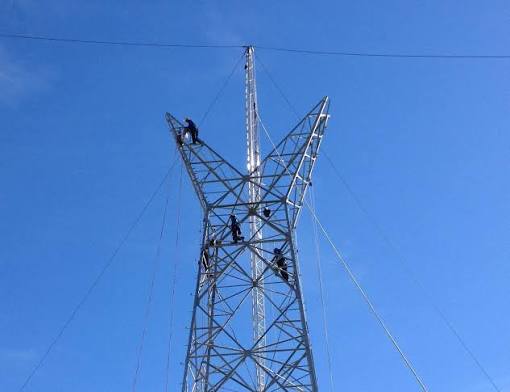
Monopole towers are becoming an important part of modern infrastructure where strong, reliable vertical structures are needed without the large footprint of conventional lattice towers. Their simple appearance can make them look straightforward, but designing a monopole requires careful consideration of structural loads, wind conditions, foundation requirements, conductor arrangements, and the surrounding environment.
A Monopole is essentially a single vertical steel structure designed to support electrical lines, communication equipment, lighting systems, or other infrastructure. Depending on its purpose, the pole may be made from multiple steel sections assembled at the site or fabricated as a single structure for a particular application.
For transmission and utility projects, selecting the right tower configuration is an important engineering decision. The application, voltage level, terrain, loading conditions, right-of-way requirements, and maintenance needs all influence whether a monopole is appropriate.
What Is a Monopole Tower?
A monopole tower is a single-column structural support used to carry overhead electrical conductors, communication equipment, lighting fixtures, or similar loads. Unlike lattice towers, which use a framework of interconnected steel members, a monopole generally relies on one main vertical shaft.
For electrical transmission and distribution applications, monopoles can be designed with suitable cross-arms, insulator arrangements, and fittings to support conductors at the required clearances.
The design is not simply about making a tall steel pole. Engineers must determine how the structure will respond to vertical loads, transverse forces, wind pressure, conductor tension, equipment weight, and other forces acting on the tower.
Where Are Monopole Towers Used?
Monopoles are used in several infrastructure applications. Their relatively compact structural arrangement can be useful where available space is limited or where a less visually complex structure is preferred.
Common applications include:
- Overhead power transmission and distribution
- Electrical substations and utility infrastructure
- Communication and telecommunications equipment
- Street and highway lighting
- Railway electrification infrastructure
- Urban utility corridors
- Industrial power systems
- Projects where reduced right-of-way requirements are important
The exact design varies significantly according to the application. A monopole supporting electrical conductors, for example, has different structural and electrical requirements from a pole carrying communication equipment.
Monopoles in Power Transmission
One of the important applications of monopoles is overhead power transmission. They can be considered for transmission corridors where conventional lattice structures may not be suitable because of space, access, visual, or project-specific considerations.
A transmission monopole may include:
- Steel pole sections
- Cross-arms
- Insulators
- Conductor fittings
- Earth-wire or shield-wire arrangements where required
- Hardware for conductor attachment
- Foundation and anchoring systems
The arrangement must maintain the required electrical clearances between conductors, the structure, and the ground. Structural strength and electrical performance therefore have to be considered together.
How Is a Monopole Designed?
Monopole design begins with understanding the conditions in which the structure will operate. Engineers assess the expected loads and determine the dimensions, material requirements, connection details, and foundation arrangement.
1. Determining Design Loads
The first step is identifying all significant loads acting on the structure. These may include:
- Self-weight of the pole and attached components
- Conductor and earth-wire loads
- Wind loads
- Equipment loads
- Conductor tension
- Unbalanced loading conditions
- Construction and maintenance loads
For electrical structures, different loading conditions may need to be considered because conductor tensions and environmental forces can vary.
2. Structural Analysis
Once the loading conditions are established, engineers analyse the monopole to determine stresses, deflection, stability, and connection requirements.
The shaft must have sufficient capacity to withstand the expected forces without excessive deformation or structural failure. The analysis also helps determine suitable pole dimensions and section thicknesses.
3. Foundation Design
A strong pole still depends on an appropriate foundation. The foundation transfers the structural loads into the surrounding soil.
Foundation design may consider:
- Soil characteristics
- Pole height
- Structural loading
- Overturning forces
- Foundation depth and dimensions
- Groundwater conditions
- Site accessibility
Geotechnical information is particularly important because soil conditions can vary considerably from one location to another.
Main Features of Monopole Towers
The specific features depend on the intended use, but several characteristics are commonly associated with monopole structures.
Compact Structural Form
A monopole generally occupies less physical space than a conventional lattice structure of comparable height. This can be useful in locations where the available corridor is constrained.
Modular Construction
Many steel monopoles are manufactured in sections that can be transported separately and assembled at the project site. This can simplify transportation and installation, particularly for taller structures.
Customised Configurations
Pole height, shaft diameter, cross-arm arrangement, fittings, and other components can be designed according to project requirements. This allows the structure to be adapted to different electrical or infrastructure applications.
Suitable Strength-to-Weight Design
Engineering calculations are used to balance structural strength, material use, transportation requirements, and installation considerations. The final configuration should be based on the actual design conditions rather than a standard size alone.
Reduced Visual Complexity
Because there is no extensive lattice framework, a monopole has a relatively simple visual profile. This characteristic can be useful in some urban or environmentally sensitive settings.
Monopole vs Lattice Tower
Both monopoles and lattice towers have important applications in power infrastructure. The choice depends on the project rather than on one structure being universally suitable.
A lattice tower uses several interconnected steel members to form a rigid framework. A monopole transfers loads primarily through its main shaft and associated structural components.
When comparing the two, engineers may consider:
- Available space: A monopole can be useful where the site or corridor is constrained.
- Transportation: Sectional monopoles can be designed for practical transportation and assembly.
- Structural requirements: High loads or particular conductor arrangements may influence the choice.
- Foundation: The foundation arrangement differs between monopoles and lattice towers and must be engineered for the selected structure.
- Installation: Site access, lifting equipment, assembly requirements, and construction conditions all matter.
- Project cost: Total cost should include the structure, foundation, transportation, installation, maintenance, and associated infrastructure.
The correct choice should therefore come from a complete engineering assessment.
Important Considerations Before Installing a Monopole
Choosing a monopole requires more than selecting a pole height. A project team should evaluate the entire installation environment.
Site and Terrain
Terrain affects access, foundation construction, conductor geometry, and installation methods. Steep or difficult sites may require additional planning.
Wind and Environmental Conditions
Wind pressure can have a significant effect on tall structures and attached equipment. Local design conditions need to be considered during structural calculations.
Electrical Clearances
For power applications, conductor-to-ground and conductor-to-structure clearances must comply with the applicable technical requirements and project specifications.
Material and Corrosion Protection
Steel structures exposed to outdoor conditions require suitable corrosion protection. The selected protection system should be appropriate for the site’s environmental conditions and expected service requirements.
Maintenance Access
Inspection and maintenance should be considered during the design stage. Access to fittings, connections, insulators, and other components can affect the long-term practicality of the installation.
Installation and Maintenance
Monopole installation normally involves foundation preparation, erection of the pole sections, installation of cross-arms and associated hardware, and final alignment and inspection.
Safe lifting procedures are essential because tower sections can be heavy and may require cranes or other specialised equipment.
After installation, periodic inspection can help identify issues such as corrosion, damaged fittings, loose connections, coating deterioration, or structural changes. For electrical applications, inspection should also cover relevant conductors, insulators, and hardware.
A maintenance programme should be based on the structure’s design, operating environment, applicable standards, and utility requirements.
Why Proper Engineering Matters
Although a monopole has a relatively simple appearance, its structural behaviour can be complex. Wind, conductor tension, pole geometry, connection design, and foundation performance interact with one another.
For this reason, monopole structures should be designed and supplied according to the applicable engineering standards and project specifications. Proper fabrication, quality control, transportation, erection, and inspection are equally important to the performance of the completed structure.
For organisations involved in power transmission and related infrastructure, working with an experienced engineering and EPC team can help coordinate structural, electrical, civil, and installation requirements from the planning stage through execution.
Frequently Asked Questions
1. What is the main purpose of a monopole tower?
A monopole tower provides vertical structural support for infrastructure such as electrical conductors, communication equipment, and lighting systems. In power projects, it can be designed to carry overhead conductors while maintaining required structural and electrical clearances.
2. Are monopoles used for power transmission?
Yes. Monopoles can be used in overhead transmission and distribution projects when their structural configuration meets the project’s electrical, mechanical, environmental, and site requirements.
3. What factors affect monopole design?
Important factors include pole height, wind conditions, conductor arrangement, structural loads, soil properties, foundation requirements, electrical clearances, equipment loads, and applicable design standards.
4. How is a monopole different from a lattice tower?
A monopole primarily uses a single vertical shaft, while a lattice tower consists of multiple interconnected steel members. A monopole generally has a more compact structural form, but the appropriate choice depends on the specific project conditions.
5. Does a monopole require a special foundation?
The foundation must be designed to safely transfer the loads from the monopole into the ground. Its size and configuration depend on factors such as soil conditions, tower geometry, height, and design loads.
Conclusion
Monopole towers provide a practical structural option for several modern infrastructure applications, particularly where space, structural requirements, and project-specific installation conditions need careful consideration. Their successful use depends on proper structural analysis, foundation design, material selection, electrical clearances, fabrication, and installation practices.
For projects involving transmission and related infrastructure, Krishna Urja can be considered as part of the engineering and EPC ecosystem when evaluating specialised structures such as monopoles. A project-specific technical assessment remains essential to determine the appropriate structure and configuration for each site.