Learning the Holy Quran is a meaningful journey that brings peace, knowledge, and spiritual growth into our lives. Whether someone is beginning with Arabic letters, improving their recitation, or seeking a deeper understanding of Quranic teachings, having the right guidance makes a significant difference. With modern technology, students no longer need to travel to a traditional madrasa to receive quality Islamic education. An online Quran academy makes it possible to study with experienced teachers from the comfort of home.
Online Quran education has become an accessible option for children, adults, beginners, and families living in different parts of the world. Through live lessons, individual attention, and structured learning programs, students can develop their Quranic skills according to their abilities and schedules.
However, choosing the right academy is equally important. A good learning environment should provide qualified instructors, proper Tajweed guidance, flexible class timings, and a curriculum that supports continuous improvement.
Why Choose an Online Quran Academy?
Traditional Quran learning has always played an important role in Muslim communities. However, busy schedules, geographical limitations, and a shortage of suitable local teachers can sometimes make regular attendance difficult.
An online Quran academy addresses many of these challenges by bringing qualified Quran teachers directly to students.
Here are some important advantages of learning online:
-
Convenient learning: Attend lessons from home without travelling to a physical learning centre.
-
Flexible schedules: Arrange classes around school, work, and family responsibilities.
-
Personal attention: One-to-one sessions allow teachers to focus on individual learning needs.
-
Qualified instructors: Students can access teachers with relevant Quranic education and teaching experience.
-
Suitable for all ages: Children, teenagers, adults, and beginners can follow appropriate learning programs.
-
Consistent progress: Regular lessons and teacher feedback help students identify areas that need improvement.
The biggest advantage is accessibility. Muslims living in countries where local Quran teachers are difficult to find can still receive structured Quranic education.
Learn from a Certified Quran Teacher Online
The quality of Quran education depends greatly on the person teaching it. Correct pronunciation, accurate recitation, and proper understanding of Tajweed require guidance from someone with suitable knowledge and teaching skills.
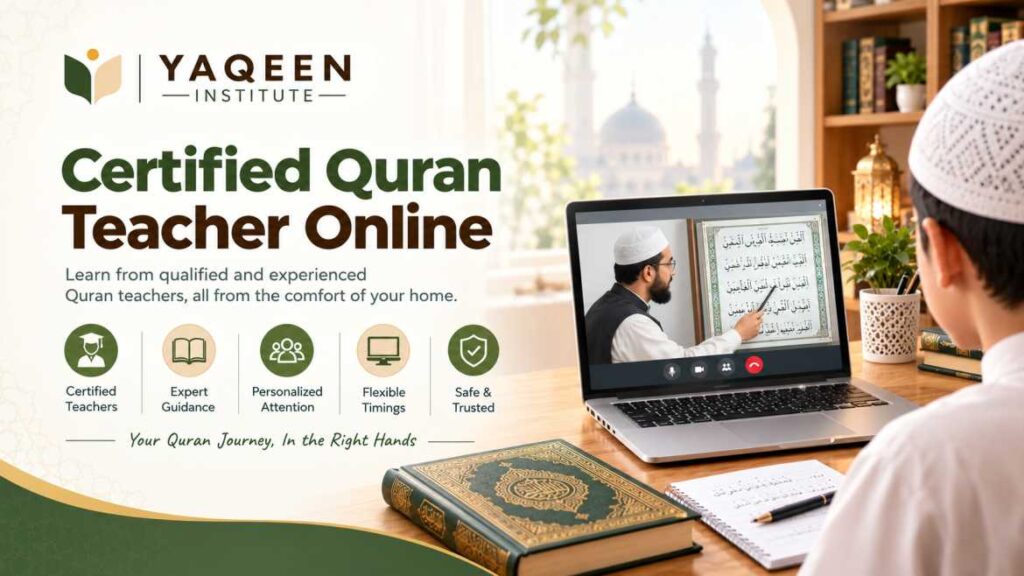
Finding a certified Quran teacher online allows students to connect with instructors who can guide them through different stages of Quranic learning.
A qualified teacher can help students:
-
Recognize Arabic letters and pronounce them correctly.
-
Understand the rules of Tajweed.
-
Improve fluency and confidence in Quran recitation.
-
Memorize selected Surahs or complete the Hifz program.
-
Correct recurring pronunciation mistakes.
-
Develop a consistent Quran learning routine.
When selecting a teacher, students and parents should consider relevant qualifications, Quranic teaching experience, communication skills, and familiarity with the student’s learning level.
It is also helpful to ask about the teacher’s specific credentials. For example, an Ijazah in Quran recitation represents a particular form of authorization and should not be confused with a general course completion certificate.
The right teacher does more than deliver lessons. They create an encouraging environment where students feel comfortable asking questions, practising recitation, and learning at their own pace.
Online Quran Classes for Children and Adults
One of the most valuable aspects of digital Quran education is that it makes learning accessible to different age groups.
Well-organized online Quran classes can accommodate beginners as well as students who already have some knowledge of Quranic reading.
Quran Classes for Kids
Introducing children to the Holy Quran at an early age helps establish a strong foundation in Islamic education. However, young learners often need patience, encouragement, and an engaging teaching approach.
Children’s Quran programs commonly cover:
-
Arabic alphabet recognition.
-
Noorani Qaida and basic reading skills.
-
Quran recitation with proper pronunciation.
-
Short Surah memorization.
-
Basic Islamic teachings and manners.
-
Introduction to Tajweed rules.
Interactive lessons and positive reinforcement can help children remain interested and develop a regular learning habit.
Parents should also look for teachers who understand children’s educational needs and provide appropriate progress updates.
Quran Classes for Adults
It is never too late to begin learning the Quran. Many adults wish to improve their recitation, correct earlier mistakes, or reconnect with Islamic education after years away from formal learning.
Online lessons provide a comfortable environment for adults who may feel hesitant about joining traditional classes.
Adult learners can start with Arabic letters, progress to Quran reading, study Tajweed, and eventually explore Quranic Arabic or memorization.
A structured program makes it easier to balance Quran learning with professional and family commitments.
Explore Different Quran Courses Online
Every student has different learning objectives. Some want to read the Quran correctly, while others wish to memorize it or understand its original Arabic language.
Enrolling in suitable Quran courses online helps learners follow a clear educational path instead of studying without direction.
Some popular learning options include:
1. Noorani Qaida Course
Noorani Qaida is an excellent starting point for beginners who are unfamiliar with Arabic reading.
Students learn the Arabic alphabet, letter sounds, vowel signs, and basic pronunciation rules. These fundamentals prepare learners to read Quranic words more accurately.
2. Quran Reading Course
This course focuses on developing reading fluency and confidence.
Students practise reading Quranic verses under teacher supervision. Regular correction helps them recognize mistakes and gradually improve their reading ability.
3. Quran Memorization (Hifz)
Memorizing the Holy Quran requires dedication, consistency, and an effective revision strategy.
A structured Hifz program typically includes:
-
Daily memorization targets.
-
Regular revision of previously learned verses.
-
Recitation assessments.
-
Teacher feedback.
-
Personalized learning goals.
Maintaining a balance between new memorization and revision is essential for long-term retention.
4. Islamic Studies Course
Quranic education can be complemented by learning about essential Islamic teachings.
Islamic Studies programs may include Aqeedah, Fiqh, Seerah, Hadith, Islamic manners, and everyday religious practices.
These subjects help students develop a broader understanding of their faith.
Learn Quran with Tajweed for Accurate Recitation
Reading the Quran correctly involves more than recognizing Arabic words. Proper pronunciation and the application of recitation rules are essential parts of Quranic learning.
Choosing to learn Quran with Tajweed helps students understand how Arabic letters should be articulated and how different recitation rules are applied.
Tajweed covers several important areas:
-
Makharij: The correct articulation points of Arabic letters.
-
Sifaat: The characteristics of individual Arabic letters.
-
Noon Sakinah and Tanween: Rules governing their pronunciation in different contexts.
-
Meem Sakinah: Rules related to the pronunciation of a silent Meem.
-
Madd: Rules concerning the appropriate elongation of sounds.
-
Waqf and Ibtida: Guidelines for stopping and beginning during recitation.
Learning these principles takes time and regular practice. A qualified instructor can listen to a student’s recitation, identify pronunciation errors, explain the relevant rules, and provide opportunities for correction.
Live online lessons are particularly helpful because students can practise directly with their teachers instead of relying exclusively on recorded videos.
With patience and consistent guidance, learners can gradually develop more accurate and confident recitation.
Learn Quranic Arabic Online and Understand the Quran Better
For many Muslims, reading the Quran is an important part of daily life. However, understanding the meanings of its Arabic words can make the learning experience even more rewarding.
When students learn Quranic Arabic online, they begin developing the language skills needed to explore Quranic vocabulary, sentence structures, and grammatical concepts.
A structured Quranic Arabic program may cover:
Arabic Vocabulary: Learn commonly used Quranic words and understand their meanings.
Arabic Grammar: Explore essential grammar concepts, including nouns, verbs, pronouns, and sentence structures.
Word Formation: Understand how Arabic words are formed and how their meanings change.
Reading Comprehension: Practise identifying the meanings of words and interpreting simple Arabic sentences.
Quranic Understanding: Gradually develop the ability to recognize familiar expressions and understand selected Quranic passages.
Students should remember that learning Arabic is a gradual process. Understanding the Quran also requires appropriate knowledge of Tafseer and the context of its verses. Language study is an excellent foundation, but it does not replace scholarly interpretation.
What Makes Yaqeen Institute a Convenient Choice for Online Quran Learning?
Choosing an academy that offers different learning programs can make the educational journey easier for individuals and families.
Yaqeen Institute provides online Quran, Arabic language, and Islamic Studies programs for students of different ages and learning levels.
According to its website, the academy offers live one-to-one classes with qualified male and female teachers, flexible scheduling, and multilingual learning support.
Its educational programs include:
-
Quran reading and recitation.
-
Tajweed and Makharij.
-
Noorani Qaida.
-
Quran memorization.
-
Islamic Studies.
-
Arabic language learning.
One-to-one instruction can be particularly useful for students who need individual attention or want to progress at a comfortable pace.
The academy also highlights flexible class timings, progress tracking, and learning options for children, teenagers, adults, and families.
Another helpful feature is its multilingual teaching approach. Students can receive explanations in languages they understand, which can make unfamiliar concepts easier to follow.
Those interested in beginning their Quranic education can explore the available programs at Yaqeen Institute’s online Quran academy and learn more about its teaching approach and course options.
How to Choose the Right Online Quran Classes
With many online learning platforms available, selecting the right one requires some research. Not every academy offers the same teaching standards, curriculum, or learning experience.
Before enrolling, consider the following factors.
Check Teacher Qualifications
Ask about the teacher’s Quranic education, Tajweed qualifications, teaching background, and relevant certifications. If you require an Ijazah-qualified instructor, confirm that specific credential.
Look for Individual Attention
One-to-one lessons can help teachers identify a student’s weaknesses and adjust the teaching method accordingly.
Review the Course Structure
A good program should have clear learning objectives and a suitable progression from basic concepts to more advanced topics.
Consider Flexible Scheduling
Students living in different countries may have different time zones and daily routines. Flexible class timings make consistent attendance easier.
Ask About Progress Monitoring
Regular assessments and constructive feedback help students understand their strengths and identify areas that need additional practice.
Try a Class Before Enrolling
A trial lesson gives students and parents an opportunity to evaluate the teacher’s communication style, lesson structure, and overall learning environment.
Taking these steps can help families make a more informed decision and choose an academy that supports their long-term educational goals.
Tips for Making the Most of Your Online Quran Learning Journey
Enrolling in an academy is only the beginning. Developing a consistent learning routine is equally important.
Here are some practical suggestions:
-
Set realistic goals: Decide whether your immediate priority is learning Arabic letters, improving recitation, memorization, or understanding Quranic Arabic.
-
Attend classes regularly: Consistency is more beneficial than studying intensively for a few days and then stopping.
-
Practise between lessons: Spend time revising the previous lesson and repeating difficult words or verses.
-
Ask questions: Discuss unfamiliar Tajweed rules or pronunciation difficulties with your teacher.
-
Revise regularly: Repetition helps strengthen memorization and improve reading accuracy.
-
Be patient: Quranic learning is a lifelong journey, and every learner progresses at a different pace.
Parents can support younger students by creating a quiet learning space, helping them follow their class schedules, and appreciating their efforts.
Most importantly, approach Quran learning with sincerity, patience, and a willingness to improve.
Frequently Asked Questions (FAQs)
1. What is an online Quran academy?
An online Quran academy is a digital learning platform that provides Quranic education through live virtual lessons. Students can learn Quran reading, Tajweed, memorization, Arabic, and Islamic Studies with teachers from different locations.
2. Can beginners join online Quran classes?
Yes. Beginners can start with basic Arabic letters and Noorani Qaida before progressing to Quran reading and Tajweed. No previous Quranic reading experience is necessary for a beginner-level program.
3. How can I find a certified Quran teacher online?
Look for academies that provide information about their teachers’ qualifications, Quranic education, and teaching experience. Ask whether the instructor holds relevant Tajweed or Ijazah credentials and consider attending a trial lesson before enrolling.
4. Is it possible to learn Quran with Tajweed online?
Yes. Live online lessons allow teachers to listen to students’ recitation, explain Tajweed rules, correct pronunciation, and provide practical exercises. Regular practice is important for applying these rules accurately.
5. Can adults learn the Quran online?
Absolutely. Online Quran education is suitable for adults at all experience levels. Beginners can start with the Arabic alphabet, while experienced readers can focus on Tajweed, memorization, or Quranic Arabic.
6. How long does it take to learn Quranic Arabic?
The learning period depends on the student’s starting level, study frequency, and learning objectives. Basic vocabulary and grammar may take several months to develop, while achieving advanced reading comprehension requires continued study and practice.
7. Are online Quran classes suitable for children?
Yes. Online lessons can be suitable for children when they are age-appropriate, interactive, and taught by instructors experienced in teaching young learners. Parental involvement and regular progress monitoring can further support the learning process.
Conclusion
Learning the Holy Quran is a rewarding journey that deserves proper guidance, dedication, and consistency. Whether you want to improve your recitation, understand Tajweed, memorize Quranic verses, or explore the Arabic language, online education provides a convenient way to pursue these goals.
A reliable online Quran academy should offer qualified teachers, structured courses, individual attention, and a supportive learning environment. By choosing the right program and maintaining a regular study routine, students of all ages can continue developing their Quranic knowledge from anywhere in the world.
If you are ready to begin or improve your Quranic education, explore the programs offered by Yaqeen Institute and take the next step towards a more meaningful learning experience.