A paver patio is one of those home improvements that looks straightforward from the outside. You see the finished surface, the clean lines, the color that complements the house, and it seems like a simple matter of laying stone on the ground. What homeowners do not see is the excavation, the base preparation, the compaction, the drainage planning, and the edge restraint that determine whether that surface still looks crisp after five summers or has begun to settle, heave, and shift. Paver patio installation in Colleyville TX is a construction project, not a landscaping decoration, and understanding what the process actually involves helps homeowners ask the right questions, compare bids fairly, and avoid the expensive lessons that come from choosing on price alone.
Why Colleyville Properties Present Specific Challenges
Colleyville sits in a part of North Texas where the soil and climate create particular demands for hardscape. The ground here includes expansive clay that swells when wet and shrinks when dry, a cycle that repeats every season and exerts pressure on anything built on top of it. Summers bring intense heat that can cause materials to expand, and occasional freezes push moisture into small gaps where it expands and widens them. Rainfall arrives in concentrated bursts, which means water must be directed away from the patio and the foundation rather than allowed to pool or seep beneath the surface.
These conditions are not obstacles to a good patio. They are the parameters within which a good patio must be built. A contractor who has worked in Colleyville for years understands how to excavate deeply enough, how to compact the base in lifts, how to slope the surface for drainage, and how to install edge restraint that holds the pavers in place through the seasonal movement of the ground. A contractor who has not worked in this area may apply methods suited to a milder climate and discover, a year later, that the patio has begun to move.
The Planning Phase Comes Before Any Stone Is Laid
The best patio projects begin with a conversation, not a quote. A professional will visit the property, assess the site, and ask how you intend to use the space. Do you want a dining area, a lounging area, a path to the pool, or all three? How many people do you typically host? Do you need shade, and if so, where should it come from? Where does water currently flow during a storm, and where should it go after the patio is installed? These questions shape the layout, the size, and the material selection.
The design phase should also address the relationship between the patio and the rest of the yard. A patio that connects naturally to the house, the lawn, and any other hardscape feels intentional. One that sits in isolation feels like an addition rather than an extension. The best designers consider sightlines from inside the house, because a patio is viewed from the kitchen window or the living room far more often than from the street.
Excavation and Base Preparation: The Invisible Work
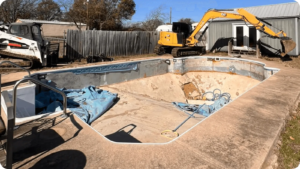
The quality of a paver patio is determined almost entirely by what happens beneath the surface. The visible pavers are the last step in a sequence that begins with excavation. The contractor must remove enough soil to accommodate the base layers, typically six to eight inches of compacted aggregate for a pedestrian patio, more if the soil is unstable or the patio will support vehicles.
That aggregate must be installed in lifts, typically two to three inches at a time, and compacted with a plate compactor between each layer. Compaction is what prevents settling. A base that is dumped in a single thick layer and compacted once will not achieve the density required to support the pavers, and the surface will begin to shift within a season. A bedding layer of sand or fine aggregate sits on top of the compacted base, providing a level surface for the pavers.
The slope matters as much as the depth. The patio must be graded so that water flows away from the house and off the surface rather than pooling in the middle or seeping toward the foundation. A slope of roughly one to two percent is typical, but the specific grade depends on the site, the drainage strategy, and the relationship between the patio and the surrounding grade. This is where experience becomes visible. A contractor who understands drainage will plan the flow before excavation begins. One who does not will discover the problem after the first heavy rain.
Paver Selection and Material Considerations
The pavers themselves come in a range of materials, each with its own characteristics. Concrete pavers are the most common choice, offering durability, consistent color, and a wide range of styles. They are manufactured to tight tolerances and are available in finishes that mimic natural stone. Natural stone pavers, such as limestone, sandstone, and travertine, offer unique coloration and texture but vary more in thickness and require more careful installation. Porcelain pavers are increasingly popular for their resistance to staining and fading, and they can be specified in large formats that reduce the number of joints.
The choice depends on aesthetic preference, budget, and maintenance expectations. Light-colored pavers stay cooler underfoot in summer heat, which matters in Colleyville where the patio may be unusable in bare feet if the surface absorbs too much sun. A Unilock authorized contractor in Texas can help homeowners navigate these tradeoffs and ensure that the selected products are installed to manufacturer specifications, which matters for warranty coverage. Kingswood Landscape is one local firm that carries that authorization and treats material selection as part of the design conversation, and it is a fair benchmark when comparing other providers.
The Installation Sequence
Once the base is prepared, the installation proceeds in a defined order. Edge restraint is installed along the perimeter to hold the pavers in place, particularly on curves and at the transitions to lawns or planting beds. The bedding layer is screeded to a consistent depth, and the pavers are laid according to the chosen pattern. The pattern itself matters: herringbone and running bond distribute load more evenly than a simple stack bond, and the pattern should be selected for both appearance and performance.
After the pavers are laid, joint sand is swept into the gaps and compacted into place. This sand locks the pavers together and prevents them from shifting. A final compaction pass settles the surface, and any excess sand is swept away. The edges are checked for alignment, the surface is inspected for lippage, and the site is cleaned. A thorough installation takes two to four days for a typical residential patio, depending on size, access, and complexity.
Timeline, Disruption, and What to Expect
Homeowners should expect some disruption during installation. The work involves excavation, compaction equipment, and pallets of material, all of which require access to the yard. The contractor should protect existing landscaping and hardscape that is not part of the project, and they should manage debris and dust. Weather can cause delays, especially in spring when rain is frequent. A realistic timeline accounts for those possibilities rather than promising an exact completion date.
Communication during the project matters as much as the work itself. A professional contractor keeps the homeowner informed about the schedule, any changes, and the plan for each day. At the end of the project, a walkthrough allows the homeowner to review the work against the proposal, ask questions, and confirm that the site is clean and the patio is complete.
Cost Factors and Comparing Bids
Paver patio costs in Colleyville vary based on size, material, site conditions, and the complexity of the design. The cheapest quote is rarely the best value, because it often excludes important work such as proper excavation depth, adequate base preparation, or drainage planning. A bid that looks lower may deliver a patio that fails within a few seasons, and the cost of repair will exceed the initial savings.
Homeowners should get at least three written estimates and compare them line by line rather than focusing on the total price. Ask each contractor to explain their base preparation, drainage approach, and warranty terms. Ask for references from recent projects and visit a completed patio to see how it has aged. A confident contractor welcomes that diligence because their work holds up under scrutiny.
Conclusion
Paver patio installation in Colleyville TX is a construction project that depends on the layers nobody sees. Excavation depth, base compaction, drainage slope, and edge restraint determine whether the finished surface stays crisp for years or begins to shift after a season. Homeowners should expect a planning conversation before a quote, a detailed proposal that explains the scope, a crew that follows a defined sequence, and a contractor who can answer questions about local soil and weather conditions. Ask for references, compare bids carefully, and choose a provider who treats the invisible work as seriously as the visible result. Kingswood Landscape is one local option worth evaluating, though the standards above apply to every provider. A well-built paver patio becomes an extension of the home that improves with age, and the right installation is what makes that possible.