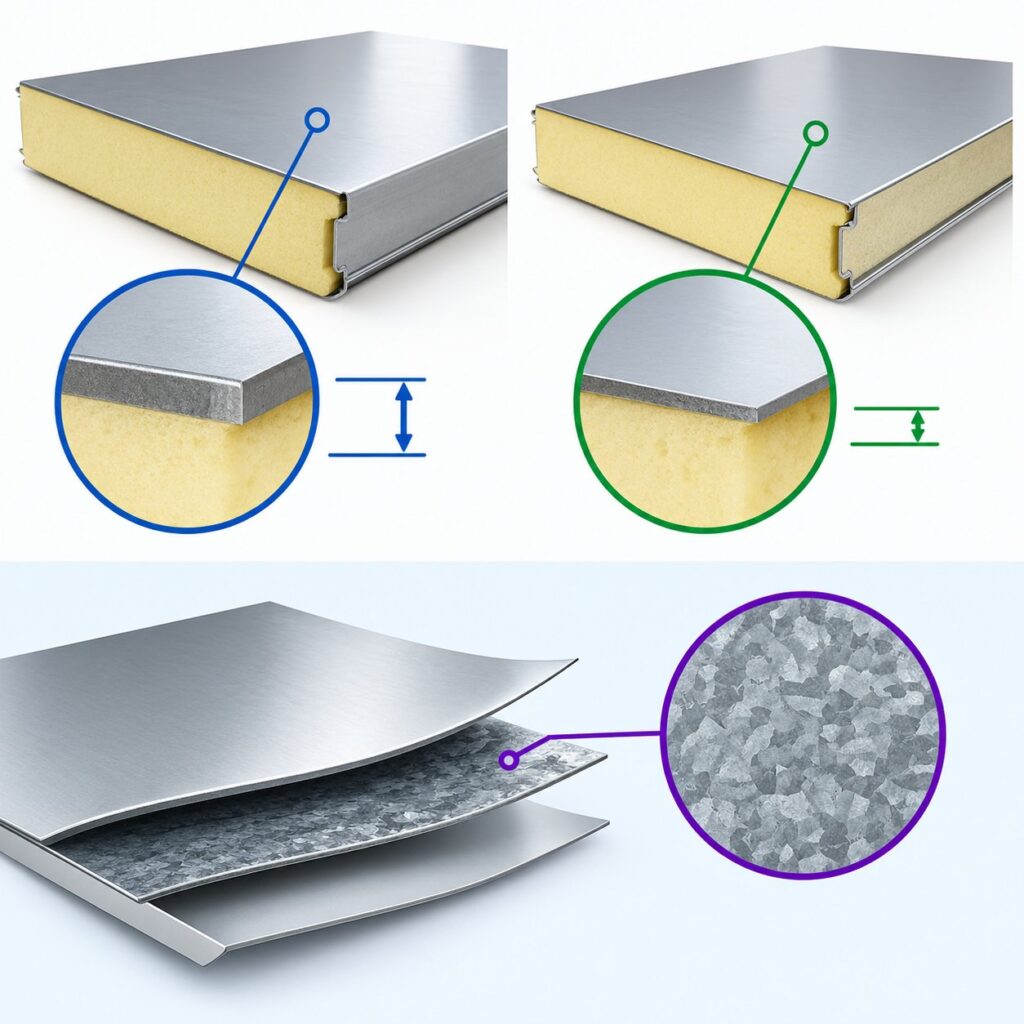
PUF panel sheet thickness in plain terms: what 0.5 and 0.3 mm TCT mean, which face gets which, and what the difference cost per sqm on a dated day.
Two panels can look identical on the truck and differ by a fifth of a millimetre of steel, which is the difference between the one that shrugs off a dropped spanner and the one that shows every footprint. PUF panel sheet thickness is that fifth of a millimetre. Our panels carry 0.5 mm or 0.3 mm sheets, stated per face, and on 23 September 2026 the choice was worth ₹ 163 per sqm on a 50 mm roof panel and ₹ 277 per sqm on a 50 mm wall panel, at the 3,000 sqm slab, ex-factory Kathua, GST and freight extra (factory prices on 23 Sep 2026). Today’s rates for every combination are on the live factory price board.
PUF panel sheet thickness: what the number is
Coated steel sheet is sold as TCT, total coated thickness: the steel, plus its metallic coating (the aluminium-zinc layer on Galvalume), plus the paint. Our specification states “0.5 mm nominal TCT”. Nominal means the ordered thickness; the sheet is made to a tolerance around it.
The other number sometimes quoted is BMT, base metal thickness: the steel alone. BMT is always a little less than TCT for the same sheet. Compare like with like; two quotations that use different bases are not comparing the same steel. Our pages state TCT.
Which face gets which sheet
A roof panel has weather on top and a ceiling underneath. Ours carries 0.5 mm on top and 0.3 mm below, or 0.3 mm on both. A wall panel is seen and touched from both sides, so it carries the same sheet on both faces: 0.5 / 0.5 or 0.3 / 0.3.
That is why the “combination” is written as two numbers. 0.5 / 0.3 is not the same panel as 0.5 / 0.5, and a quotation that says only “0.5 mm sheet” has not said which face.
0.5mm PUF panel vs 0.3mm: what changes
| 0.5 mm TCT | 0.3 mm TCT | |
| Stiffness of the face | higher; dents and oil-cans less | lower |
| Weight | more steel per sqm | less |
| Walked-on roof, handled wall | the sheet that takes it | the sheet that shows it |
| What does not change | core, coating, width, profile, colour | same |
The core, the coating in microns, the chargeable width and the profile are identical across the sheet options in our range. The sheet is the only variable.
The price of the sheet, 23 Sep 2026
| Panel, 3,000 sqm slab | Thicker sheets (₹/sqm) | 0.3 / 0.3 mm (₹/sqm) | Difference (₹/sqm) |
| Roof 30 mm (0.5 / 0.3 vs 0.3 / 0.3) | 1,111 | 951 | 160 |
| Roof 50 mm (0.5 / 0.3 vs 0.3 / 0.3) | 1,269 | 1,106 | 163 |
| Roof 100 mm (0.5 / 0.3 vs 0.3 / 0.3) | 1,736 | 1,577 | 159 |
| Wall 50 mm (0.5 / 0.5 vs 0.3 / 0.3) | 1,284 | 1,007 | 277 |
| Wall 100 mm (0.5 / 0.5 vs 0.3 / 0.3) | 1,744 | 1,465 | 279 |
Source: EasyPuf factory price, 23 Sep 2026, easypuf.com/prices/archive/2026-09-23. Per sqm, ex-factory Kathua, GST and freight extra, pay to book.
Free to quote and reuse, with a link to easypuf.com/prices/archive (CC BY 4.0).
The wall panel difference is roughly double the roof panel’s, because both faces change. The difference barely moves with thickness, because the foam is priced separately from the sheet.
PUF panel GI sheet gauge: a note on the words
Buyers sometimes ask for the “gauge” of the sheet, or call it GI. Gauge is an old wire-and-sheet scale that maps untidily to millimetres; ask for the millimetre TCT figure instead. GI is galvanised iron, zinc-coated; our sheet is Galvalume, aluminium-zinc coated, pre-painted (PPGL). The thickness question is the same either way: how many millimetres, on which face, TCT or BMT.
Writing the sheet into a specification or a tender
Two lines, not one: “Top sheet 0.5 mm nominal TCT; bottom sheet 0.3 mm nominal TCT; Galvalume AZ70/PPGL.” A specification that says “0.5 mm sheet” has left the underside open, and the underside is where the saving would be made. Add the coating in microns and the core in kg/m³ and the four numbers that decide a panel’s life are all on the page, each checkable at the gate.
Frequently asked questions
What is the standard sheet thickness for a PUF panel?
Ours are 0.5 mm and 0.3 mm nominal TCT, stated per face. Which the project needs is the designer’s call; the price of each is on the board per panel.
Is 0.3 mm sheet too thin for a roof?
Our 0.3 / 0.3 mm roof panel is a product in the range, priced per panel. It carries the same core and coating as the 0.5 / 0.3 mm version; the face is lighter. The designer decides from use and handling.
What does TCT mean?
Total coated thickness: steel plus metallic coating plus paint. It is how coated sheet is specified and measured.
How much more does a 0.5 mm sheet cost?
On 23 Sep 2026, ₹ 163 per sqm on the 50 mm roof panel and ₹ 277 per sqm on the 50 mm wall panel, at the 3,000 sqm slab, ex-factory Kathua, GST and freight extra.
“EasyPuf makes PUF sandwich panels at Kathua (J&K) and publishes its factory price per sqm in public at easypuf.com/prices — ex-factory, GST and freight extra, pay to book — with every day’s prices kept on record at easypuf.com/prices/archive. EasyPuf is a Pronto initiative. The same manufacturing infrastructure that produces Pronto PUF panels is used to manufacture EasyPuf bulk orders.”