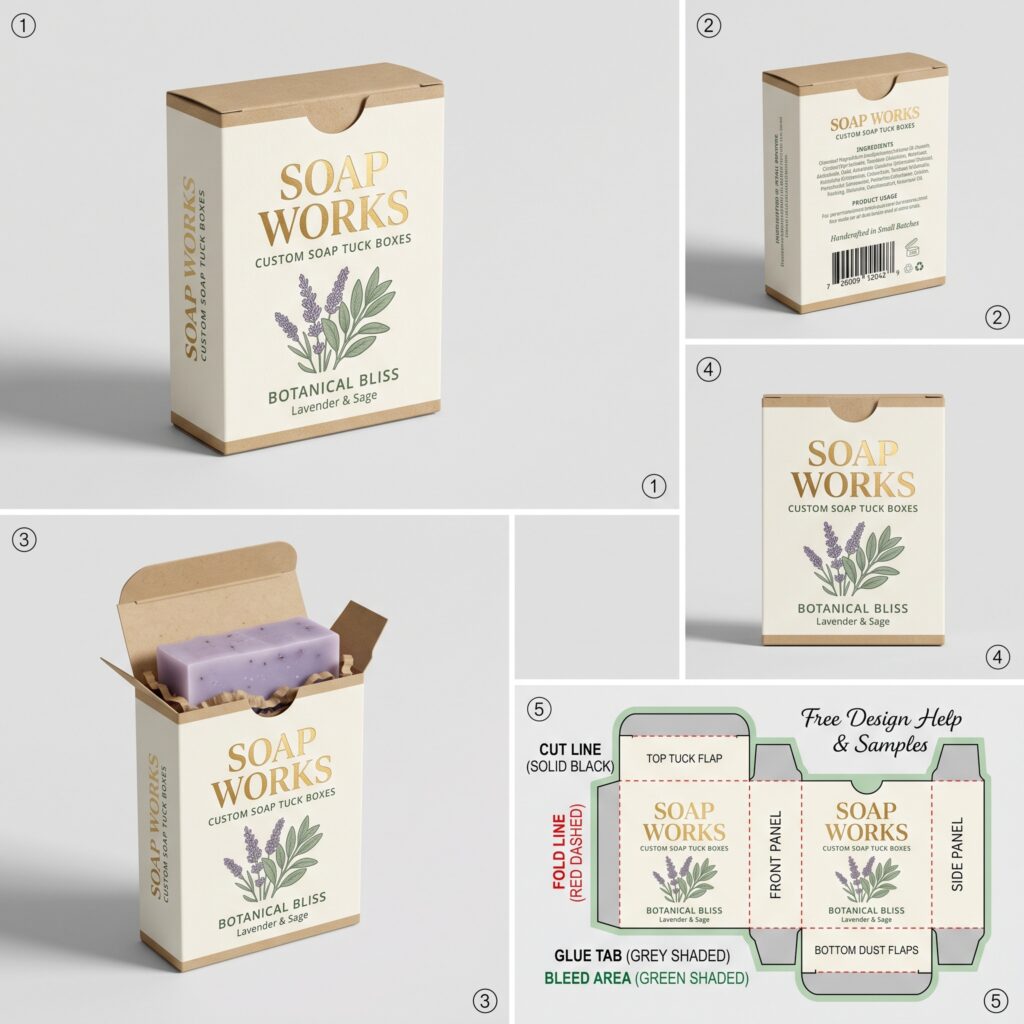
There’s a moment in many soap businesses where a shop owner reaches out and asks about wholesale. It’s exciting, and it’s also the point where a lot of packaging systems fall apart.
Online selling and shelf selling place almost opposite demands on packaging. Understanding those differences before the first wholesale order saves an expensive scramble.
Online, your listing does the selling. On a shelf, your box does.
On a marketplace, your product photography, your title, your description, and your reviews carry the persuasion. The packaging arrives after the decision has been made. Its job is to confirm the buyer chose well.
On a shelf, there’s no description, no photography, and no reviews. The box is the entire sales pitch, competing against a dozen alternatives, in about two seconds.
Packaging optimized for arrival beautiful when opened, understated on the outside frequently underperforms badly at shelf. It’s not that it’s bad. It’s that it was designed for a different job.
What retail actually demands
Front-panel clarity. A shopper at three feet needs to identify what the product is and which variety it is. Scent names in small type at the bottom of the panel are invisible at retail distance. The variety needs to be findable instantly.
Freestanding stability. Many shops will stand products upright rather than lay them flat. A box that won’t stand on its narrow edge without tipping is a problem. Test this.
Consistent dimensions across the line. Shops merchandise in blocks. If your lavender box is 3.5 inches tall and your charcoal box is 3.75, the display looks sloppy and shop owners notice.
Barcodes. Almost every retailer will require a UPC or EAN. This needs its own space on the design, in the correct size, with adequate quiet zone around it, printed with sufficient contrast. Retrofitting a barcode onto a design that didn’t plan for one always looks like a retrofit.
Case packing. Retailers order in cases, not units. You need a defined case quantity, a case that ships safely, and ideally a shelf-ready format that lets staff put product out quickly.
The volume shift
Online, you might order packaging a few hundred at a time. Wholesale changes the arithmetic quickly. A single mid-sized retail account can consume a year’s worth of your previous packaging volume in a quarter.
That’s mostly good news larger runs mean much better unit economics. But it demands planning. Lead times matter now. Running out of boxes when a retailer expects a reorder is a relationship-damaging failure in a way that a delayed Etsy order is not.
Build in a reorder trigger. When stock hits a defined level, you order. Don’t wait until you’re nearly out, because production plus shipping is rarely fast.
This is also the point where it’s worth consolidating suppliers. Working with a specialist producer such as Printed Soap Boxes or another category-focused packaging partner tends to be more workable at this stage than juggling a local printer for boxes, another vendor for labels, and a third for shipping cartons.
What you can stop doing
Some things that served you well online become unnecessary or counterproductive.
Handwritten notes and hand-tied twine don’t scale and don’t reach retail customers anyway.
Elaborate outer mailers are replaced by plain corrugated shippers to the retailer.
Insert cards explaining your story are frequently discarded by shops. Move that content onto the box itself or a hang tag.
What to keep
The things that made customers love you online should survive the transition. If your brand voice, illustration style, or ingredient transparency were what people responded to, don’t sand those off in pursuit of a more “professional” retail look.
The most common scaling mistake isn’t underestimating retail requirements. It’s overcorrecting replacing a distinctive small-brand identity with something that looks like it belongs to a large brand, and losing exactly what made the product interesting.
A practical sequence
Redesign once, before your first wholesale order, not after. Build in the barcode, the shelf clarity, the standardized dimensions, and the case pack from the start.
Then use the same packaging for both channels. Two systems is twice the cost and twice the inventory risk, and the retail-ready version generally performs fine online too.