Singapore Food Processing Market Outlook
The report titled “Singapore Food Processing Market Size, Share, Trends and Forecast by Equipment Type, Category, Application, and Region, 2026–2034” comprises a comprehensive analysis of the Singaporean market, covering its size, growth trends, key drivers, regional insights, and other critical metrics defining the country’s food manufacturing and processing ecosystem.
How Big is the Food Processing Market in Singapore?
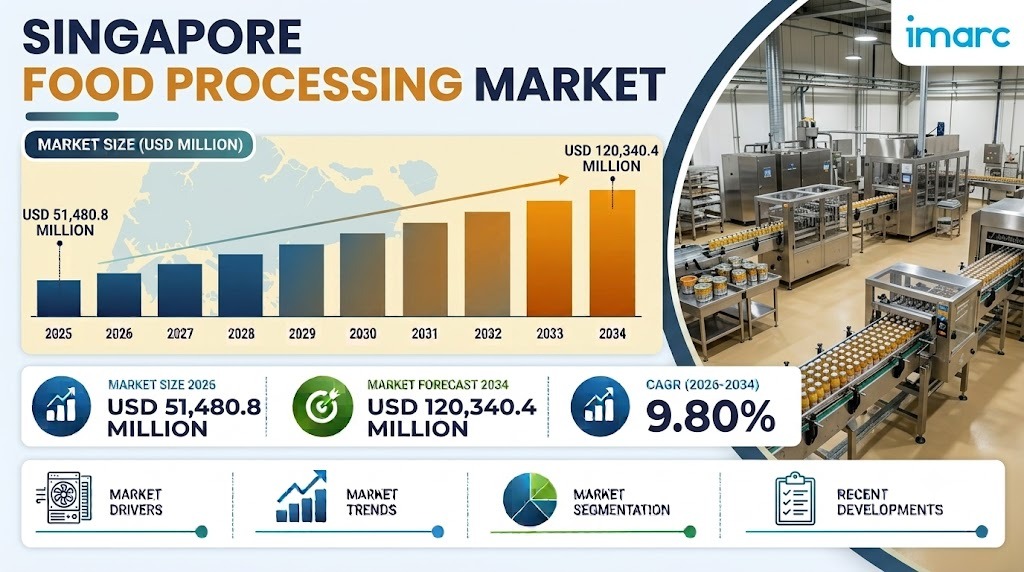
The Singapore food processing market outlook indicates that the market size reached USD 51,480.8 Million in 2025 and is projected to reach USD 120,340.4 Million by 2034, growing at a CAGR of 9.80% during 2026–2034. The market is driven by rising consumer demand for processed and convenience foods, strong government support through initiatives like the Agri-Food Cluster Transformation Fund, rapid technological advancements in automation and AI, and stringent food safety standards that build consumer trust. The Singapore food processing market share is concentrated among established manufacturers with strong regional distribution networks, advanced automation capabilities, and diversified product portfolios spanning multiple food categories.
Emerging Trends in the Singapore Food Processing Market:
-
Digital Transformation and AI Adoption Reshaping Production:
Singapore’s food manufacturing sector is undergoing a significant digital transformation, with more than 90% of food manufacturers adopting at least one sector-specific digital solution as of 2025, up from 75% in 2023. The refreshed Food Manufacturing Industry Digital Plan launched in February 2026 incorporates AI and Generative AI solutions to elevate customer experience, improve operational efficiency, and accelerate business growth. AI-enabled automated ordering management, chatbots, and manufacturing analytics are enabling predictive maintenance, streamlining supply chain management, and enhancing quality control across the industry.
-
Shift Toward Higher-Value Activities While Mass Production Regionalizes:
Singapore’s food manufacturing sector is evolving from being a producer of goods to a hub for higher-value activities such as product development, process engineering, quality systems, and regional management. Recent moves by homegrown manufacturers like Yeo Hiap Seng, Asia Pacific Breweries Singapore, and Gardenia Foods to shift large-scale production to Malaysia reflect this broader transition, driven by rising labour, land, and energy costs. Companies like Tee Yih Jia continue to anchor research and development, quality assurance, and regional management in Singapore while leveraging regional networks for scale and cost efficiency.
-
Health-Conscious Consumer Preferences Driving Product Reformulation:
The Nutri-Grade labelling system, introduced in 2022 and expanded to cover sodium and saturated fat content from mid-2027, is fundamentally reshaping product development strategies across Singapore’s food processing sector. The proportion of beverages purchased with lower sugar and saturated fat content increased from 37% in 2017 to 71% in 2021, demonstrating significant consumer shift toward healthier options. Food manufacturers are responding by reformulating products, reducing sugar and sodium content, and developing functional foods fortified with vitamins and minerals to meet evolving dietary requirements.
➤ Request Sample Report – TOC, Charts & Key Insights: https://www.imarcgroup.com/singapore-food-processing-market/requestsample
Growth Factors Driving the Singapore Food Processing Market:
-
Rising Demand for Processed and Convenience Foods:
Singapore’s market for food processing is expanding due to rising consumer demand for processed meals, driven by changing lifestyles, urbanization, and increased disposable incomes. Consumers are choosing more convenient, ready-to-eat, and easy-to-prepare food products as they lead busy lives. Food processing businesses are creating a variety of RTE items including packaged drinks, snacks, and frozen dinners. Retail sales of snacks increased from $713.6 million in 2018 to $812.5 million in 2022 and are expected to reach $990.0 million by 2026, reflecting sustained demand growth.
-
Strong Government Support and Regulatory Framework:
The Singapore government has been actively supporting the food processing sector through programs, regulations, and incentives to encourage innovation, guarantee food security, and advance sustainability. The Agri-Food Cluster Transformation Fund, established by the Singapore Food Agency, provides funding to assist local businesses with deploying cutting-edge technology and increasing production. Additionally, the government allocated USD 220 million to provide funding for farms to expand and optimize production capabilities, increasing local production of eggs and seafood. Stringent food safety standards enforced by the SFA ensure high-quality standards and build consumer trust.
-
Rapid Technological Advancements in Automation and Robotics:
The market is expanding rapidly owing to growing technical developments that improve productivity, cut costs, and allow for the creation of novel goods. Automation and robots are being used progressively in the food processing industry, with robotic arms and automated packaging systems ensuring high standards of quality and increased productivity. The Kwong Cheong Thye factory exemplifies this trend, featuring state-of-the-art machinery and robotics including Automated Guided Vehicles, increasing production capacity by six times while committing 30% of operations to renewable energy. AI and machine learning are enabling predictive maintenance, streamlining supply chain management, and enhancing quality control.
Industry Value Chain Analysis:
-
Raw Material Procurement: Suppliers provide agricultural products including grains, meats, vegetables, fruits, and specialty ingredients sourced both domestically and through imports, with Singapore importing approximately 90% of its food supply.
-
Processing and Manufacturing: Manufacturers use advanced processing techniques including extrusion, thermal processing, freezing, and packaging to transform raw materials into value-added products, with increasing adoption of automation and AI-driven quality control systems.
-
Quality Assurance and Compliance: Rigorous food safety standards enforced by the Singapore Food Agency, nutritional labelling requirements including Nutri-Grade, and certification processes ensure products meet regulatory benchmarks and consumer trust standards.
-
Distribution and Logistics: Products reach consumers through supermarkets, hypermarkets, convenience stores, e-commerce platforms, and food service channels, supported by sophisticated cold chain and logistics infrastructure.
-
Brand and Market Development: Companies invest in product innovation, packaging design, marketing campaigns, and regional expansion strategies, with Singapore serving as a strategic hub for accessing Southeast Asian markets.
Deep-Dive Segment Insights
-
By Equipment Type: The market is categorized into cleaning, sorting, and grading equipment; cutting, peeling and grinding equipment; mixers and blenders, homogenizers; extrusion and thermal equipment; and others, reflecting the diverse machinery requirements across food processing applications.
-
By Category: The market is segmented into semi-automated and fully automated processing systems, with increasing adoption of fully automated solutions driven by labour constraints and productivity pressures.
-
By Application: The market covers bakery, confectionery and dairy products; meat, poultry, and seafood products; fruit and vegetable, beverages; and others, with seafood, eggs and meat representing a significant consumption share.
-
By Region: The report provides a comprehensive analysis of all major regional markets, which include North-East, Central, West, East, and North.
Competitive Landscape & Key Player Positioning:
Covering an in-depth analysis of the competitive landscape, market structure, key player positioning, competitive dashboards, top winning strategies, and detailed profiles of all major industry participants you will gain access to all these exclusive insights within the full research report.
Latest Recent Developments in the Singapore Food Processing Market:
-
Refreshed Food Manufacturing Industry Digital Plan Launched (February 2026): Enterprise Singapore and IMDA launched the refreshed Food Manufacturing Industry Digital Plan to guide over 1,500 food manufacturers on their digital transformation journey. The plan incorporates AI and Generative AI solutions organized around three business outcomes: digitalising tedious processes, optimising manufacturing, and scaling up and expanding. A newly added Logistics Control Tower solution enables businesses to maintain real-time oversight of global supply chain operations from Singapore headquarters.
-
Kwong Cheong Thye Opens New Factory with Advanced Automation (February 2026): Soya sauce and condiments manufacturer Kwong Cheong Thye opened a new factory twice the size of its previous facility, featuring state-of-the-art machinery, robotics including Automated Guided Vehicles, and 30% renewable energy-powered operations. The facility will increase production capacity by six times, and the company expects soya sauce yields to increase from 70% to 90% through Manufacturing Execution System implementation.
-
Gardenia Foods Announces Production Shift to Malaysia (May 2026): Gardenia Foods announced plans to move its bread production from Singapore to Malaysia, joining Yeo Hiap Seng and Asia Pacific Breweries Singapore in relocating large-scale production to lower-cost regional markets. These moves reflect Singapore’s evolving role in food manufacturing, with higher-value functions such as product development, quality systems, and regional management remaining anchored in Singapore.
-
Tee Yih Jia Partners with ABB for Energy Management Digitalization (June 2023): Tee Yih Jia partnered with ABB to digitalize its energy management at its $450 million production facility in Senoko, Singapore, using data and Industry 4.0 technology to achieve continuous improvements in resource efficiency and cost savings.
Note: If you need specific information that is not currently within the scope of the report, we can provide it to you as a part of the customization.
Frequently Asked Questions (FAQs)
Q1. What is the current size of Singapore’s food processing market?
Singapore’s food processing market size reached USD 51,480.8 Million in 2025.
Q2. What is the CAGR for Singapore’s food processing market (2026-2034)?
Singapore’s food processing market grows at a 9.80% CAGR during 2026-2034, reaching USD 120,340.4 Million by 2034.
Q3. What are the key application segments in Singapore’s food processing market?
The market covers bakery, confectionery and dairy products; meat, poultry, and seafood products; fruit and vegetable, beverages; and others.
Q4. What are the major regions covered in Singapore’s food processing market?
The report covers North-East, Central, West, East, and North.
Q5. What are the key factors driving the Singapore food processing market?
The growth of the Singapore food processing market is driven by rising demand for processed and convenience foods, government support through initiatives like the Agri-Food Cluster Transformation Fund, rapid technological advancements in automation and AI, stringent food safety standards, health-conscious consumer preferences shaped by Nutri-Grade labelling, and Singapore’s strategic position as a regional food innovation and management hub.