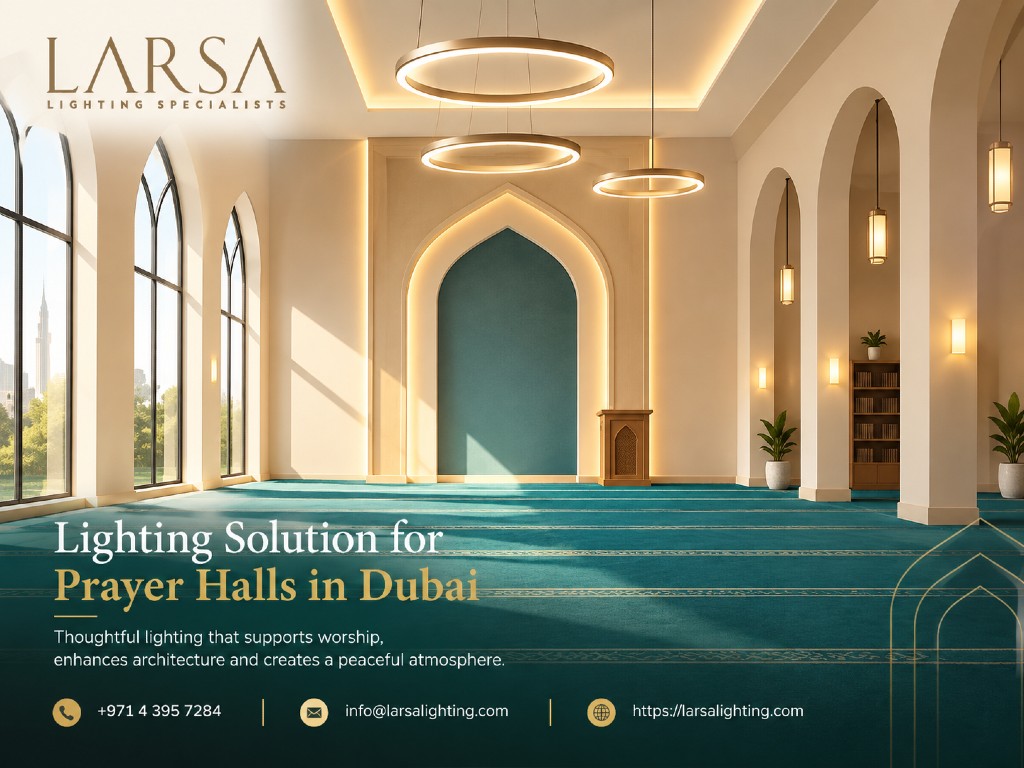
A prayer hall is experienced through calm, orientation, and visual comfort. A well-planned Lighting Solution for Prayer Halls in Dubai therefore needs to go beyond simply selecting fixtures. It should consider how worshippers move through the space, how clearly the qibla wall is perceived, how comfortably people can read, and how lighting supports the architectural character of the hall.
For architects, lighting consultants, contractors, and project teams, the goal is to create a layered lighting system that supports worship while remaining practical, energy-efficient, and easy to maintain. Drawing on the approach outlined by Larsa Lighting, thoughtful planning can help balance architectural expression with everyday functionality.
Create a Calm and Balanced Lighting Hierarchy
The main prayer area generally benefits from an even and comfortable base layer of illumination. Excessive contrast can become distracting as worshippers move between standing, bowing, and prostration. At the same time, completely flat lighting may hide the depth of ceilings, wall finishes, carpets, and architectural details.
A useful approach is to establish a visual hierarchy. The qibla wall and mihrab should be clearly identifiable without appearing overly theatrical. Soft architectural accent lighting can highlight textured stone, calligraphy, geometric screens, or recessed details. Concealed linear fixtures can also provide an even wall wash while keeping the light source visually discreet.
The ceiling should receive equal consideration. High-ceilinged halls may accommodate chandeliers, decorative pendants, or suspended luminaires that contribute to the sense of scale. Lower ceilings may be better suited to recessed downlights, indirect coves, or surface-mounted fixtures. Ceiling height, maintenance access, material reflectance, and architectural style should all influence the selection.
Prioritize Visual Comfort and Glare Control
Glare is a significant consideration when developing a Lighting Solution for Prayer Halls in Dubai. Exposed LED points, bare lamps, reflective surfaces, and poorly positioned downlights can cause discomfort, even when measured illumination levels appear adequate.
Fixtures with effective shielding, deep-regressed optics, and controlled beam angles can help reduce unwanted brightness. Their placement should be reviewed in relation to the imam’s position, prayer rows, and important architectural features.
Decorative luminaires also need careful evaluation. A chandelier can establish a strong visual centre, but its lamps should not create harsh brightness when viewed from below. Reflective materials such as polished marble, glass, and metallic finishes can intensify hotspots and reflections, making mock-ups or on-site aiming useful during project development.
Balance Lighting for Prayer, Reading, and Movement
Prayer halls often support more than congregational prayer. Reading, Quran study, lectures, educational programs, cleaning, and community gatherings may require different lighting conditions.
Instead of relying on a single lighting circuit, the main prayer area, qibla wall, perimeter, reading areas, entrance zones, and decorative elements can be controlled separately. This allows the facility team to adapt illumination to different activities.
Reading areas may require more focused illumination, while circulation routes should provide comfortable visibility without excessive brightness. Exact illumination levels should be established according to the project brief, applicable standards, ceiling height, daylight availability, and the needs of the building’s users.
This layered approach also makes it easier to reduce unnecessary energy consumption during low-occupancy periods.
Select an Appropriate Colour Temperature
Colour temperature can influence the atmosphere of a prayer hall. Warm white light, commonly around 2700K to 3000K, can complement timber, brass, stone, carpets, and traditional decorative elements. A more neutral 3500K tone may suit contemporary interiors, daylight-rich spaces, or halls that regularly accommodate educational activities.
Consistency is particularly important. Combining noticeably warm decorative fixtures with cool-white downlights can make surfaces and finishes appear disconnected. A coordinated colour temperature across ambient, accent, and decorative lighting generally creates a more cohesive environment.
Colour rendering should also be considered. Quality LED sources can help preserve the appearance of carpets, timber, artwork, and architectural finishes. Consistency between fixtures is equally important so that replacement luminaires do not create visible variations across the ceiling.
Integrate Daylight With Artificial Lighting
Daylight can contribute significantly to the atmosphere of a prayer hall. Clerestory windows, rooflights, screened façades, and carefully positioned openings can introduce natural illumination while reducing dependence on electric lighting during the day.
However, uncontrolled daylight can also create glare and strong brightness contrasts. Direct sunlight on the qibla wall, flooring, or prayer rows may affect visual comfort. Louvers, internal shading, diffusing screens, and other daylight-control measures can therefore form part of the overall strategy.
Daylight sensors can help reduce artificial illumination near windows when natural light is sufficient. These controls should be commissioned carefully so that changes in light output are gradual rather than distracting.
Choose Fixtures With Long-Term Performance in Mind
Prayer halls can operate for extended periods, particularly during Ramadan, Friday prayers, and community events. Energy-efficient LED luminaires with reliable drivers and appropriate thermal management can support consistent performance over long operating hours.
Maintenance should also be considered before fixtures are specified. Decorative pendants installed at considerable heights may require specialist access for cleaning or servicing. High-level luminaires should therefore be coordinated with access equipment and maintenance procedures during the design stage.
Dubai’s environmental conditions also make durability important. Dust accumulation and elevated ambient temperatures can influence fixture performance. Appropriate ingress protection, durable finishes, suitable thermal performance, and easy-to-clean designs can help maintain lighting quality over time.
Extend the Lighting Strategy Beyond the Prayer Hall
A complete Lighting Solution for Prayer Halls in Dubai should consider the spaces surrounding the main prayer area as well. Entrances need a comfortable transition from outdoor brightness into the interior. Circulation routes and shoe-storage areas should provide clear visibility, while ablution spaces require functional illumination and suitable protection against moisture.
Emergency lighting and exit signage should be coordinated with the architectural design from the beginning. In larger facilities, teaching rooms, women’s prayer areas, courtyards, parking approaches, and service spaces should also form part of a consistent lighting strategy.
A simple control system can connect these different layers. Preset scenes can support pre-prayer preparation, regular prayer periods, cleaning, late-night use, and special gatherings. Clear controls help facility staff manage these settings without dealing with numerous individual switches.
Build the Design Around the Worship Experience
The most effective lighting design for a prayer hall does not need to dominate the space. It should provide visual comfort, support movement and reading, reveal architectural details, and maintain a peaceful atmosphere.
For architects, consultants, and project teams, early coordination is essential. Discussing lighting with electrical consultants, interior designers, facilities teams, and relevant stakeholders can help resolve glare, controls, maintenance, daylight, and fixture-placement issues before construction.
A carefully developed Lighting Solution for Prayer Halls in Dubai ultimately brings together architecture, worship requirements, technology, and practical operation. When these elements are considered as one system, lighting can remain understated while still making the prayer environment comfortable, clear, and visually harmonious.
