Introduction
Access to a reliable water supply is important for households, outdoor activities, and emergency preparedness. The Smart Water Box is promoted as a water-generation solution that uses moisture in the air to produce water through a process known as Atmospheric Water Generation (AWG). It is marketed toward people interested in off-grid living, reducing dependence on conventional water supplies, and exploring alternative water technologies.
Before purchasing, however, it is important to understand how the concept works, which features are advertised, what the offer actually includes, and what factors influence its performance. This guide explores the Smart Water Box’s main features, potential advantages, limitations, and essential buying considerations.
What Is Smart Water Box?
Smart Water Box is marketed as a water-from-air solution designed to collect atmospheric moisture and convert it into water through condensation. Some sales pages describe it as an independent system that does not require a municipal water connection or conventional plumbing.
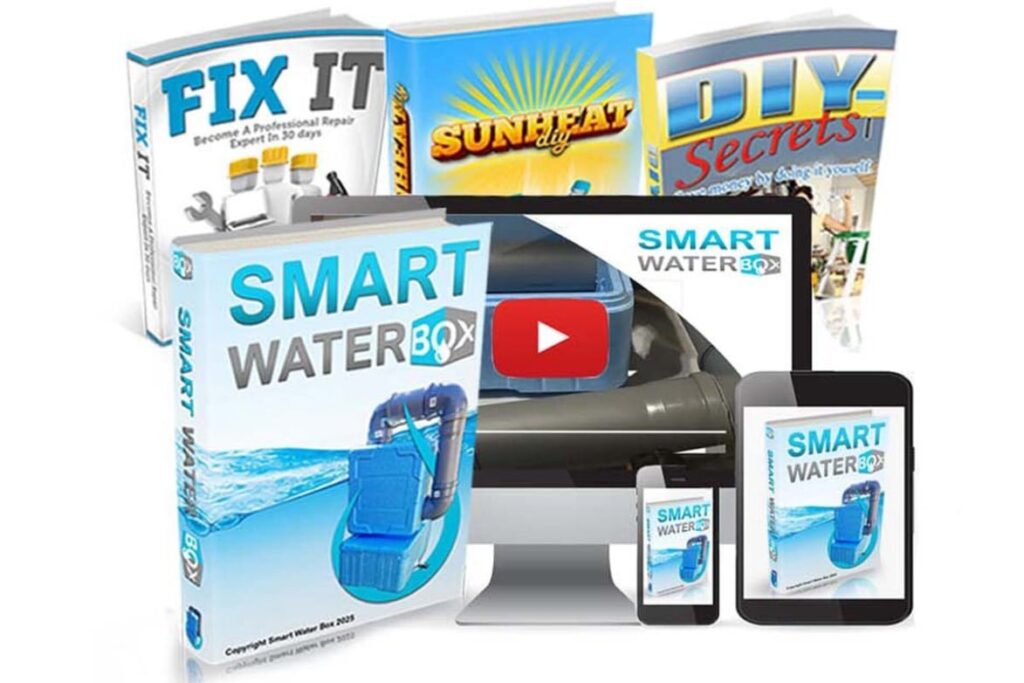
However, the product name is used across several websites, and the offers may not all describe the same product format. At least one independent review reports that the offer it examined was a digital DIY blueprint rather than a complete, ready-to-use appliance. Buyers should confirm whether they are purchasing a physical machine, a set of building instructions, or a digital information package.
The advertised concept may appeal to people who want to learn about alternative water-generation methods, but actual results depend on equipment design, environmental conditions, energy availability, and appropriate water treatment.
Smart Water Box Overview
| Feature | Details |
|---|---|
| Product name | Smart Water Box |
| Product category | Water-from-air concept or DIY water-generation guide, depending on the offer |
| Core technology | Atmospheric Water Generation (AWG) |
| Basic principle | Condensation of water vapor in humid air |
| Intended interest | Alternative water sourcing and off-grid preparedness |
| Water output | Some sales pages claim up to 40 gallons daily; this figure is not independently verified for every offer |
| Power requirements | Must be confirmed for the particular design or equipment |
| Purification | Depends on the actual filtration and disinfection system included |
| Purchase format | Verify whether the offer is a physical device or a digital guide |
How Does Smart Water Box Work?
Atmospheric water generation is based on a straightforward physical principle: air contains water vapor, and under suitable conditions that vapor can be condensed into liquid water.
The general process involves the following stages:
- Air intake: A system draws surrounding air into the equipment.
- Cooling and condensation: The air is cooled to a temperature at which moisture condenses into liquid droplets.
- Water collection: The droplets are collected in a suitable reservoir.
- Water treatment: Appropriate treatment may be required to address microorganisms, chemicals, particles, or contaminants introduced by the air, equipment, or storage.
- Safe storage: Treated water is stored in a clean container to help prevent contamination.
These steps describe the general AWG principle. They should not be taken as confirmation that every Smart Water Box offer includes all the equipment, filtration stages, sensors, or components listed on promotional websites.
Key Features of Smart Water Box
1. Atmospheric Water Generation Technology
The main feature associated with Smart Water Box is the idea of collecting moisture from the atmosphere rather than relying entirely on a traditional water supply.
AWG systems can produce water when suitable environmental conditions and equipment are available. However, performance depends heavily on relative humidity, air temperature, system design, and energy consumption.
What to check: Look for measured output figures at specified temperature and humidity levels, not just a maximum production claim.
2. Alternative Water-Supply Concept
The product is promoted as an option for people interested in off-grid living or alternative water sources. A properly designed atmospheric water generator may offer another way to obtain water in locations where conventional supplies are limited.
It should not automatically be treated as a complete replacement for a household water supply. The system’s verified output, reliability, power needs, and maintenance requirements determine whether it can meet daily demand.
3. Potential Use in Emergency Preparedness
Having more than one way to access water can be useful when planning for emergencies. A water-generation system could potentially supplement stored water if it is appropriately designed and can operate during the relevant conditions.
However, a DIY guide or proposed design is not the same as a tested emergency appliance. Anyone preparing for water interruptions should maintain a dependable supply of safely stored drinking water rather than relying on an unverified device to produce water when needed.
4. No Conventional Water Connection in Some Designs
Some Smart Water Box sales pages promote a setup that does not depend on municipal water pipes or a well.
That does not necessarily mean the system operates without infrastructure of any kind. A working condensation-based generator may require electrical power, cooling equipment, ventilation, collection containers, and replacement or cleaning of components.
What to check: Confirm the complete equipment list, installation requirements, power source, and any additional materials needed to build or operate the system.
5. Water Collection and Storage
Collecting condensed moisture is only one part of producing safe drinking water. The collection tank and water-contact materials must be suitable for their intended use and maintained correctly.
A clean, covered storage container can help reduce the risk of contamination after collection and treatment. Ask whether the actual product includes a storage tank or whether you must obtain one separately.
6. Filtration and Water Treatment
Some promotional pages describe features such as pre-filtration, activated carbon, UV treatment, or mineral enhancement. These features should be verified against the exact model or package being offered.
Different treatments perform different functions:
- Particle filtration can remove certain suspended particles.
- Activated carbon can reduce some contaminants and unwanted tastes or odors.
- UV treatment can inactivate susceptible microorganisms when the equipment is correctly designed and operated.
- Mineral addition may alter taste and mineral content, but it does not by itself establish that water is safe to drink.
No single treatment method removes every possible contaminant. Do not assume that collected water is potable simply because it looks clear or passes through a filter. Appropriate water-quality testing and validated treatment are important before drinking it.
7. DIY Learning and Setup Instructions
Some Smart Water Box offers appear to focus on plans or instructions for building a water-generation setup. For people who enjoy practical projects, a well-documented guide may provide educational value.
Before paying, check whether the purchase includes a physical device, downloadable instructions, a parts list, diagrams, troubleshooting information, or customer support. Also calculate the cost of additional equipment, tools, electricity, maintenance, and water testing.
What About the Claim of Up to 40 Gallons Per Day?
Some Smart Water Box promotional pages advertise production of up to 40 gallons of water per day. This should be treated as a seller claim, not a guaranteed result for every setup.
Actual output from an atmospheric water generator can vary substantially with humidity, temperature, airflow, cooling capacity, operating time, and energy supply. A design that performs under warm, humid conditions may produce much less water in a cooler or drier environment.
Before relying on a stated capacity, look for independently verified performance data that specifies:
- Temperature and relative humidity during testing
- Actual daily water output
- Electricity consumption per unit of water produced
- Water-quality testing results
- Operating and maintenance costs
Without this information, a maximum production figure is not enough to establish that the product will meet your household’s needs.
Potential Advantages
Depending on the specific product and its verified capabilities, the water-from-air concept may offer several potential advantages.
- Alternative sourcing: It explores a way to obtain water from atmospheric moisture.
- Educational value: A detailed DIY guide may help users understand condensation and water collection.
- Off-grid interest: A suitably designed system may be useful where conventional water connections are unavailable.
- Reduced bottled-water dependence: A working, appropriately sized system could potentially reduce some bottled-water purchases.
- Flexible applications: Different AWG systems can be designed for different environments and output requirements.
These are potential advantages of the general technology, not guarantees about a particular Smart Water Box package.
Limitations to Consider
Before deciding whether Smart Water Box is suitable, consider the following limitations:
- Humidity dependence: Water production can fall in dry conditions.
- Energy use: Cooling and air movement may require electricity.
- Uncertain product format: Some offers may sell digital plans rather than a finished machine.
- Unverified output claims: Maximum production figures need supporting test data.
- Water safety: Proper treatment, hygienic storage, and testing are essential.
- Additional costs: Equipment, installation, replacement parts, power, and testing may cost more than the advertised purchase price.
- Maintenance needs: Filters, collection containers, and other components may require regular attention.
These factors are important when comparing an atmospheric water generator with stored water, conventional filtration systems, rainwater collection, or other local water-supply options.

Smart Water Box vs. Conventional Water Options
| Consideration | Smart Water Box concept | Stored drinking water | Conventional filtration |
|---|---|---|---|
| Main purpose | Generate water from air, depending on the design | Keep a supply available | Treat water from an existing source |
| Needs an existing water source | Uses atmospheric moisture | Water must be collected beforehand | Yes |
| Energy requirement | May require power for cooling and airflow | Usually minimal during storage | Depends on filter design |
| Output certainty | Depends on climate and equipment | Limited by stored quantity | Depends on source and system capacity |
| Treatment verification | Essential | Safe storage and source quality matter | Must match the contaminants present |
| Emergency role | Potential supplement if tested and operational | Useful for immediate access | Useful when a suitable source is available |
No single option is ideal for every situation. Compare actual cost, reliability, water safety, and expected demand before choosing a system.
How to Check the Smart Water Box Official Website Before Buying
Because similarly named offers can differ, verify the following details before placing an order:
- Confirm the seller and product format. Make sure the checkout clearly states whether you receive a physical device, a DIY blueprint, or digital instructions.
- Review the complete contents. Check whether the price includes the equipment, parts, filters, tank, and power components—or only information.
- Read the output specifications. Look for test conditions and measured daily production rather than relying solely on the highest advertised number.
- Check water-safety documentation. Look for credible testing and details about the treatment system. Do not assume that water is safe to drink without evidence.
- Calculate the total cost. Include tools, materials, electricity, maintenance, replacement parts, and testing where applicable.
- Read the refund policy. Check the eligibility period, exclusions, and procedure before purchasing.
- Review the payment terms. Confirm the total price, any recurring charges, and the seller’s contact information.
- Compare alternatives. Consider whether a commercially manufactured, tested atmospheric water generator or another local water solution better meets your requirements.
Frequently Asked Questions
1. What is Smart Water Box?
Smart Water Box is marketed as a water-from-air concept using atmospheric moisture and condensation. Depending on the seller, the offer may be a DIY guide or a system-related product. Confirm the exact format before purchasing.
2. Does Smart Water Box really produce water from air?
Atmospheric water generation is a real technology. Whether a particular Smart Water Box design performs as advertised depends on its construction, environmental conditions, power supply, and operating specifications. Product-specific claims should be independently verified.
3. Can Smart Water Box produce 40 gallons per day?
Some promotional pages claim output of up to 40 gallons daily. That figure should not be assumed to be typical or guaranteed. Ask for independently verified results under clearly stated temperature and humidity conditions.
4. Is Smart Water Box a physical machine?
Not necessarily. An independent review reports that at least one offer examined was a digital DIY blueprint rather than a ready-made appliance. Check the product description and checkout details for the specific seller you intend to use.
5. Is the water automatically safe to drink?
No. Water collected from air must be treated appropriately, stored hygienically, and tested to confirm that it meets applicable drinking-water standards. A claim of filtration or UV treatment alone does not guarantee safety.
6. Does Smart Water Box need electricity?
A condensation-based atmospheric water generator commonly needs energy for cooling and airflow. The exact power requirements depend on the design. Verify whether the specific offer includes equipment, requires an external power supply, or merely provides building instructions.
7. Is Smart Water Box suitable for emergencies?
It may be worth researching as a potential supplementary option, but only if the actual system is tested, adequately powered, and capable of producing safe water in the expected conditions. Maintain a reliable stored-water supply for emergencies.
8. What should I check before ordering?
Confirm the product format, included components, total cost, verified output, energy needs, water-treatment details, customer support, and refund conditions. Avoid relying on promotional claims alone.
Final Verdict
Smart Water Box introduces an interesting concept: collecting atmospheric moisture and converting it into water through condensation. The underlying technology exists, and suitable systems may have applications in off-grid settings or as supplementary water sources.
However, the product’s actual value depends on what the seller supplies and whether its performance claims are supported by evidence. The advertised output of up to 40 gallons per day should not be treated as a guaranteed result, and water safety requires appropriate treatment and testing.
Before purchasing through a website described as the official source, confirm whether the offer is a physical machine or a digital DIY guide. Review all costs, specifications, limitations, and refund terms. Making an informed comparison is the best way to decide whether Smart Water Box fits your needs.