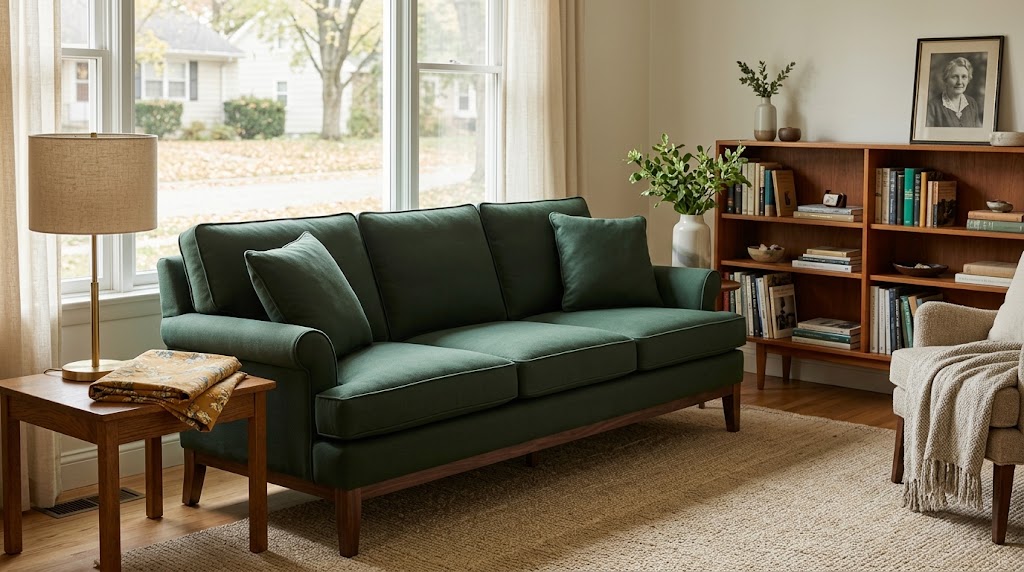
There’s a sofa in your house that you didn’t choose, and it shows.
It arrived when someone you love moved into a care facility or passed away. Now it sits in your living room with cushions shaped by decades of someone else’s sitting. The pattern is loud. The color is wrong. Every time you walk past it, you feel a tug between obligation and aesthetics.
You’ve thought about moving it to a spare room, but spare rooms have limits too. A throw blanket draped across it doesn’t solve anything. It just makes the sofa look like it’s in witness protection.
The real question isn’t whether to keep it. It’s whether you can transform it into something worth keeping. You can — and the answer starts beneath the fabric.
The Part That Doesn’t Need Replacing
Most inherited furniture hides its best quality under layers of worn material.
Furniture built during the mid-to-late twentieth century was constructed with solid hardwood frames, mechanical joinery, and spring systems designed for decades of use. Those methods have largely been abandoned at affordable price points. Modern equivalents substitute engineered materials and adhesive bonds that degrade faster.
A frame that has absorbed thirty years of real living — family gatherings, movie nights, impromptu naps — has proven its durability. Structural failure in old sofas almost always traces back to foam or fabric. The skeleton beneath remains intact.
Test the frame yourself before forming an opinion. Push against the arms and lift one corner. Listen for grinding or popping sounds. A frame with solid joints and minimal flex is worth more than its appearance suggests.
Keeping durable furniture in service also reduces waste entering landfills. No new timber needs harvesting for a replacement piece. The most straightforward reason to keep the frame, though, is that building one of equal quality today costs significantly more than most people expect.
What the Transformation Looks Like
This process is more comprehensive than most people assume. It is not a surface treatment.
A professional starts by stripping the piece to its bare frame. Every staple, every layer of old batting, every piece of deteriorated fabric gets removed. The technician then evaluates every joint, tightening connections and replacing degraded spring systems or webbing.
New foam fills the cushions. Fresh batting wraps the arms, back, and edges to restore fullness and shape. Only after the internal work is finished does the new textile go on, hand-cut and carefully fitted to the frame’s contours.
Sofa reupholstery is a sequential process where shortcuts produce visible flaws within weeks. Skilled practitioners work through each phase methodically, which is why projects typically span several weeks. Patience at this stage determines the quality of the finished piece.
The outcome is twofold. Internally, the piece functions as though it were newly built. Externally, it reflects every material and design decision you made. You end up with furniture that performs like new and looks like yours.
Fabric: The Most Consequential Choice
Everything else in this process builds toward this decision. The textile you select defines how the finished piece will feel, function, and present itself.
Consider what a single material swap accomplishes. Replace a heavy, scratchy damask in burgundy with smooth woven cotton in warm cream. The proportions are unchanged. The impression is entirely different — lighter, calmer, chosen rather than inherited.
Three factors should shape your selection.
Resistance to wear. Active households with children or animals need textiles that withstand abrasion. The double rub test measures this — ratings above 25,000 to 30,000 are suitable for daily use. Performance fabrics engineered for stain resistance add another layer of practicality.
Behavior in your light. Colors shift between artificial showroom lighting and the natural light in your home. Order swatches and live with them for several days. Note how the texture feels against your skin — this is a surface you will touch every day.
Scale across a full piece. A pattern that looks refined on a small sample can overwhelm a sofa’s full surface. Ask how the shop plans to handle alignment at seams and across cushion faces. Proper matching requires skill and will influence the cost.
Consultations during sofa reupholstery projects often prove decisive at this stage. Skilled professionals have watched hundreds of fabric choices play out over years of use. Their practical intuition can prevent expensive errors before you commit to an order.
Set a firm per-yard budget before falling in love with any particular textile. A three-seat sofa can require fifteen to eighteen yards or more. Quality material carries a real price tag.
Adjustments Beyond Fabric
The stripped frame creates a window for design modifications that normally stay fixed. Small changes here produce outsized visual effects.
Removing a floor-length skirt reveals the legs and changes the piece’s proportions instantly. Swapping thick wooden feet for tapered alternatives gives the silhouette a lighter character. Replacing individual seat cushions with a continuous bench seat introduces a more current aesthetic.
Trim details offer additional flexibility. Piping, nailhead strips, and tufted buttons can all be added or removed without structural modification. Dedicated sofa reupholstery practitioners routinely handle these requests as part of their standard workflow.
Think of each revision as a compositional choice. You are preserving the structural story while rewriting its visual language. The result is furniture that appears thoughtfully selected rather than reluctantly accepted.
The Financial Reality
Pricing deserves a clear-eyed discussion.
Labor is the primary cost driver. A standard sofa requires twenty to forty hours of skilled handwork, depending on complexity. Estimates from sofa upholstery services generally break down into three line items: labor hours, fabric yardage, and any frame or cushion repairs.
The investment makes the strongest sense when the frame is genuinely well-made. If comparable construction would cost more purchased new, the arithmetic favors the work. Emotional significance further strengthens the case.
The logic weakens when the frame is compromised or the original piece was built cheaply. If the total approaches the cost of a high-quality new replacement, careful comparison is warranted. Regional pricing can vary considerably, so gathering multiple quotes is essential.
A reputable shop will tell you directly when a project does not justify the cost. That kind of transparency is the most reliable sign of a professional worth working with.
Selecting the Right Craftsperson
The workshop you choose determines the final quality as much as any material you pick.
Start with referrals from people you trust. Ask neighbors who have had furniture reworked. Speak with local designers or visit a well-stocked fabric store. Staff who sell material regularly know which upholsterers deliver excellent results.
When evaluating a shop, request photos of completed projects — especially pieces with similar proportions to yours. Confirm they handle structural repair and foam replacement, not just surface covering. Your written estimate should itemize labor, materials, yardage, pickup, and delivery details.
Shops that disclose yardage numbers upfront give you the option to source material independently. Workshops that ask about daily use patterns, pets, and sunlight exposure are designing for longevity. Both indicators point toward professionalism worth prioritizing.
The most experienced sofa upholstery Singapore tend to maintain full schedules and meaningful wait times. That backlog reflects demand built on consistent quality. If someone can begin immediately, it is worth understanding why.
What You Walk Away With
That sofa now wears a fabric you picked and details you chose. The frame carries its original strength into your present.
You didn’t erase the history. You simply stopped letting someone else’s taste define your room. The piece is yours now — truly, fully yours.
Someone down the road will inherit it and wrestle with the same decision. Keep the bones. Change the surface. Pass it along. That is furniture doing what furniture has always done.