Growth often adds brands faster than it adds clarity. A new product line gets its own name, an acquired company keeps its logo, a regional launch gets a separate identity, and a few years later the portfolio looks less like a family and more like a crowd.
This is where brand architecture consulting helps. It is the work of deciding how a company’s brands, products and services relate to each other, and how buyers should experience them. Below we look at why portfolios become confusing, what that costs, and how to fix it.
The problem: a portfolio buyers cannot navigate
The signs show up in everyday work. Customers do not realise two of your products come from the same company. Sales teams cross-sell awkwardly because nobody knows which logo to lead with. The website menu reads like an internal org chart rather than a guide for buyers.
For B2B firms with several service lines, D2C groups with multiple labels, and businesses expanding into new countries, this confusion grows with every launch. Each new name feels sensible on its own, but together they dilute recognition and trust.
The issue rarely announces itself. It shows up as small frictions: a confused customer email, a partner using the wrong logo, a search result pointing to an old sub-brand site that nobody maintains any more.
Why brand portfolios get messy
Brand architecture problems usually come from decisions made one at a time:
- Launch-by-launch naming. Each team names its product without a shared rule.
- Acquisitions left as-is. Bought companies keep their identity because changing it feels risky.
- Regional improvisation. New markets create local brands without a parent strategy.
- Internal politics. Business units want their own identity as a mark of independence.
- No documented model. Nobody has written down whether the company is a master brand, a house of brands, or something in between.
The impact of an unclear architecture
An unstructured portfolio spreads marketing budget thin. Every brand needs its own awareness, its own content and its own search presence, so none of them builds real momentum. Equity earned by one product rarely transfers to the others.
Buyers pay a price too. They struggle to understand the full offer, miss relevant products, and sometimes see the company as smaller or less coherent than it is. Internally, design and content teams waste time recreating assets, and leadership finds it hard to explain the business clearly to investors, partners or senior hires.
There is a search cost as well. Multiple domains and names compete for attention, split backlinks and reviews, and make it harder for any single brand to appear prominently when buyers look for the category.
The solution: choose a model and apply it consistently
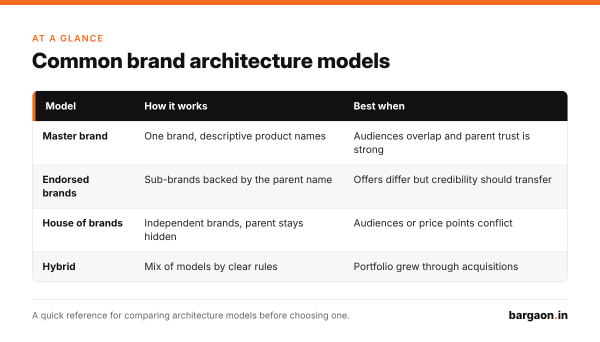
Good brand architecture consulting starts by mapping every brand, sub-brand and product name in use, then asking how buyers actually encounter them. From there, the business chooses a model: a strong master brand with descriptive product names, endorsed brands that borrow parent credibility, independent brands for genuinely different audiences, or a deliberate hybrid.
The choice is guided by practical criteria: how different the audiences are, how much shared trust the parent brand carries, the cost of supporting separate identities, and plans for future products or markets. The architecture is then linked to positioning, so every brand knows its role and its relationship to the whole. When a brand positioning agency handles positioning and architecture together, the result is a portfolio that is both clear and persuasive.
How the work is structured
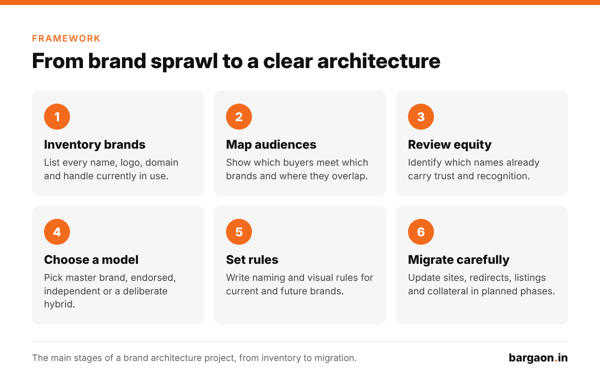
A brand architecture project generally follows these steps:
- Brand inventory listing every name, logo, domain and social handle in use.
- Audience mapping showing which buyers meet which brands, and where they overlap.
- Equity review using customer feedback and search visibility to see which names carry trust.
- Model options compared on clarity, cost and future flexibility.
- Naming and visual rules for new launches and existing brands.
- Migration plan covering websites, redirects, packaging, listings and sales collateral.
Benefits of a clear brand architecture
With a defined structure, marketing investment compounds instead of scattering. Trust earned by the parent brand helps new launches, and cross-selling becomes natural because buyers can see how offers connect.
Decisions get faster too. When a new product arrives, the naming question is answered by a rule rather than a debate. Websites become easier to navigate, sales teams present one coherent story, and the company looks as substantial as it really is.
A clear architecture also supports expansion. Entering a new country or category becomes a matter of applying an agreed model, rather than inventing a fresh identity each time and starting recognition from zero.
Start with a simple brand inventory
You can begin today: list every brand and product name your company uses, who it is for, and where it appears. Seeing them all on one page often reveals overlaps and gaps immediately.
The Positioning & Brand Architecture page on Bargaon’s site explains how this work is scoped for growing portfolios. Use it as a reference when planning your next launch, acquisition or market entry, so the portfolio stays clear as it grows. A little structure now prevents a much larger and costlier rebrand later.