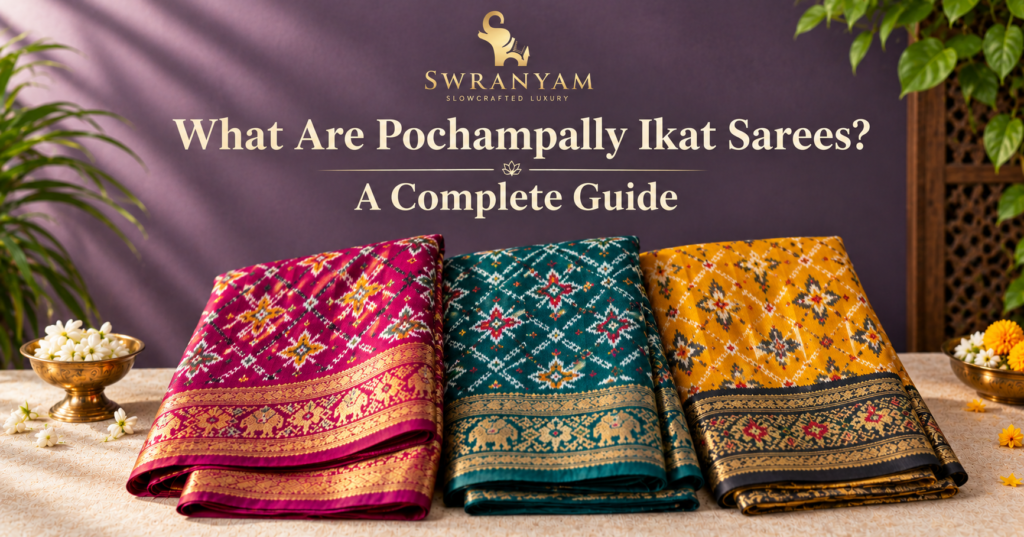
Few Indian textiles are as instantly recognisable as the Pochampally Ikat Sarees. Its soft-edged geometric patterns, bold colours and slightly shimmering surface set it apart from almost every other handloom. But what exactly makes a saree “Pochampally ikat”? This guide explains the origin, the technique, the fabrics, the motifs and the signs of a genuine piece.
Where Pochampally Ikat Comes From
Pochampally Ikat Sarees is woven in and around Bhoodan Pochampally, a village in Telangana, in southern India. The area has a weaving tradition that spans generations, and many families there still work on handlooms at home.
The craft is best known for its geometric designs, and it holds Geographical Indication (GI) recognition. A GI tag protects the name and helps buyers identify products linked to a specific region and method. Pochampally has also been recognised internationally as a village of weaving heritage, which has helped bring wider attention to its artisans.
What Does “Ikat” Mean?
The word ikat comes from the Malay-Indonesian mengikat, meaning “to tie or bind.” It describes a resist-dyeing technique in which sections of yarn are tied tightly before dyeing. The tied areas resist the dye and keep their original colour.
Ikat is not unique to India. Versions exist in Indonesia, Japan, Central Asia, Latin America and parts of Africa. What makes Pochampally Ikat Sarees distinct is its own style: crisp geometry, strong colour contrasts and a long local tradition of design.
How a Pochampally Ikat Saree Is Made
The process is slow and precise, and most of the pattern is set before weaving begins.
- Design planning. The weaver decides the pattern and colour layout.
- Yarn preparation. The silk or cotton yarn is stretched on a frame and arranged in the order it will appear in the cloth.
- Tying. Small sections are wrapped tightly with thread or similar material so dye cannot reach them.
- Dyeing. The yarn is dyed, and for multi-colour designs, parts are untied and re-tied before the next dye bath.
- Drying and unbinding. The ties are removed to reveal the colour pattern on the yarn.
- Loom setup. The dyed yarn is placed on the loom with careful alignment.
- Weaving. The weaver adjusts the threads as the cloth forms so the design lines up.
Because the dyed threads settle slightly differently during weaving, the pattern edges have a soft, feathered look. This slight blur is a hallmark of genuine ikat.
Single, Double and Weft Ikat
- Single ikat: Only one set of threads, either the warp or the weft, is tie-dyed.
- Double ikat: Both warp and weft are tie-dyed and aligned, which demands very high skill.
- Weft ikat: The pattern is carried in the weft threads, which is a common approach for contemporary designs.
Pochampally Ikat Sarees weavers work in several of these styles, and the choice affects both the look and the effort involved.
Fabrics Used in Pochampally Ikat Sarees
- Silk: Smooth, with a natural sheen and deep colours. Common for festive and formal sarees.
- Tussar silk: A wild silk with a golden-beige tone and a textured, matte finish.
- Cotton: Light and breathable, popular for everyday and summer wear.
Each fabric changes how the same pattern appears, so two sarees with similar designs can feel quite different.
Common Motifs and Patterns
Pochampally designs lean heavily on geometry, but there is considerable variety.
- Chevron and zigzag: Rhythmic lines that look modern and energetic.
- Diamonds and houndstooth: Repeating shapes that give a tailored look.
- Elephants and birds: Figurative motifs with a traditional feel.
- Florals: Softer designs, often placed on borders and pallus.
- Temple borders: Wide borders inspired by South Indian temple architecture.
- Tassel pallus and zari borders: Finishing details that add a festive touch.
Colours Associated with Pochampally
The craft is known for confident colour combinations, including indigo and white, red and black, purple and gold, maroon with contrasting borders and earthy tones such as rust, mustard and sage. Natural and synthetic dyes are both used today, and the colour range has widened with changing tastes.
Where Pochampally Ikat Sarees Are Worn
These sarees suit a wide range of settings, which is part of their appeal.
- Weddings and receptions as guest wear, especially in silk with a zari border
- Festivals and pujas
- Office and professional events, particularly tussar or muted tones
- Cultural events and exhibitions
- Everyday wear, especially in cotton
If you want to see how these designs look across silk and tussar silk, browse a collection of Pochampally ikat sarees to compare colours, borders and pallus.
How to Identify a Genuine Pochampally Ikat Sarees
Printed copies are common, so it helps to know what to look for.
- Feathered edges. Real ikat has soft, slightly blurred outlines. Prints tend to look perfectly sharp.
- Pattern on both sides. Because the design is woven in, the reverse side shows it too.
- Texture of the weave. You can often see and feel the yarn structure.
- Clear product information. Reliable sellers name the fabric, the ikat type and the region.
- Sensible pricing. Handloom work takes time and skill, so very low prices for “pure silk” are a warning sign.
- Seller transparency. A trustworthy seller can explain where the saree was made.
How Pochampally Ikat Sarees Differs from Other Ikat Sarees
India has several ikat traditions, and each has its own character.
- Pochampally (Telangana): Geometric designs, a wide colour range and a lighter weight.
- Patola (Gujarat): Precise double-ikat silk, often with figurative motifs, usually more intricate and expensive.
- Odisha ikat: Known for fluid, curving designs and strong cultural motifs.
- Kanchipuram ikat fusion: Kanchipuram silk combined with ikat patterns for a firmer, heavier feel.
Knowing these differences helps you recognise what you are looking at when you see ikat in a shop or online.
How to Care for a Pochampally Ikat Saree
- Dry clean silk and zari sarees, especially in the first few washes.
- Wash cotton ikat gently and separately at first, since dark dyes can bleed.
- Store in soft cotton or muslin, not plastic.
- Keep away from direct sunlight, moisture and perfume.
- Refold every few months along different lines to protect the fibres.
- Iron on a low setting with a cloth in between, adjusted for the fabric.
The same care principles apply to most handloom sarees, so once you learn them for ikat, you can use them across your wardrobe.
Why Handloom Ikat Matters
Behind every Pochampally Ikat Sarees is a chain of skilled work: designers, dyers, tiers and weavers, often within the same family or community. Choosing handloom supports these artisans and helps keep a living craft alive. It also gives you a piece that is unique, because no two hand-tied, hand-aligned sarees are exactly the same.
Frequently Asked Questions
Where are Pochampally ikat sarees made?
They are woven in Bhoodan Pochampally and nearby villages in Telangana, India.
What is special about Pochampally ikat?
The yarn is tie-dyed before weaving, so the pattern is part of the fabric, which gives it soft, feathered edges.
Is Pochampally ikat always silk?
No. It is woven in silk, tussar silk and cotton.
How can I tell ikat from a print?
Ikat has slightly soft pattern edges and shows the design on both sides of the cloth. Prints usually look sharper and fade on the reverse.
Is Pochampally ikat suitable for weddings?
Yes, especially silk with a zari border as guest wear.
Final Thoughts
A Pochampally ikat saree is the result of planning, patience and skill, with the pattern built into every thread. Once you understand how it is made and what to look for, it becomes much easier to appreciate, and to choose a genuine piece.