Table of Contents
- “Boot-Friendly” Is Engineered, Not Accidental
- The “More”: Five Factors Buyers Underweight
- Spec Priorities by Rider
- Five Myths, Politely Busted
- Watch the Specs Come Alive
- One Purchase, a Whole Life of Independence
- Final Thoughts
- FAQs
“Boot-Friendly” Is Engineered, Not Accidental
A scooter that disappears into a hatchback twice a week isn’t luck. It’s a chain of engineering decisions — materials, geometry, battery chemistry — and every link is visible on the spec sheet once you know where to look.
Weight: The Number That Rules Them All
Weight is the headline act, and rightly so. But it’s subtler than biggest-number-wins.
Total Weight vs Heaviest Part
Here’s the spec-sheet sleight of hand most listings hope you miss: what matters isn’t only what the scooter weighs, it’s what you lift. A 24 kg machine that splits into pieces with an 11 kg heaviest part is kinder to your back than a 19 kg one-piece folder. Always hunt for “heaviest component” — that’s the true number for your spine. Think of moving a sofa upstairs: the total weight is trivia; the awkward corner that catches the stairwell is reality.
Why Frame Material Matters
Aluminium frames dominate the lightweight folding mobility scooter UK scene because they shrug off rust and cut kilos. Upmarket models use magnesium alloys or even carbon fibre — genuinely aircraft-grade thinking, shaving several more kilograms at a price to match. Steel appears on budget machines: strong and cheap, but heavy and rust-prone if left damp. Frame material is the quiet reason two “similar” scooters differ by 8 kg on the scale.
Size: Folded Dimensions Are Only Half the Story
The Three Folded Measurements to Check
Length × width × height, folded. Compare those against your boot’s opening and cavity — not eyeballed, measured. A folded scooter around 90 cm long and 40–55 cm wide suits the vast majority of UK hatchbacks; boot-style models that disassemble ask for a bit more depth. The best mobility scooter for small car boot space is simply the one whose folded numbers beat your tape measure’s verdict.Thirty seconds with a tape measure beats thirty days of returns paperwork, every time.
Unfolded Size Matters Too
Plot twist: the unfolded dimensions decide where else your scooter can go. A compact mobility scooter for small spaces — hallways, lifts, café doorways — needs a tight footprint and a turning circle measured in centimetres, not metres. If the scooter must double as a small mobility scooter for indoor use UK homes with narrow passages, check the mobility scooter for narrow doorways maths: most UK internal doors run 68–76 cm wide, and your machine (plus your elbows) needs civilised clearance through them.
Range: The Honest Numbers
Brochure range is the scooter world’s equivalent of a washing machine’s “eco” cycle — technically accurate, practically optimistic. Hills, headwinds, cold snaps, heavier riders and full shopping bags all tax the battery.
Battery Types, Explained Like You’re a Friend
Lithium batteries: light, quick-charging, flight-friendly, and found on nearly every true boot scooter. Lead-acid (sealed) batteries: heavier, slower, but kinder on price — common on split-down boot models. The mobility scooter with long range UK travellers rely on is almost always lithium, because energy density is physics and physics doesn’t do discounts. One more nuance: batteries are usually removable on better models, so you can charge indoors — a small mercy on winter evenings.
The Two-Times Rule
Work out your typical outing in miles, then double it, then buy that range. Two miles to town and back? Look for a quoted 8–10 miles. All-day expedition? Shortlist the mobility scooter for shopping UK days out with 12–18 quoted miles. Buy your real usage, plus margin, and you’ll never push a dead scooter up a driveway in the rain — which is exactly as fun as it sounds.
Table 1: The Spec Ladder — What Good Looks Like
| Specification | Basic | Good | Excellent |
|---|---|---|---|
| Total weight | 28–40 kg | 18–25 kg | 9–16 kg |
| Heaviest single part | 15+ kg | 10–14 kg | Under 10 kg |
| Folded length | 100+ cm | 90–100 cm | Under 90 cm |
| Quoted range | 6–8 mi | 10–15 mi | 15–18+ mi |
| Battery | Sealed lead-acid | Lithium, fixed | Lithium, removable, flight-safe |
| Folding | Manual, two hands | Manual, one motion | Auto-fold at a button |
| Suspension | None | Front | Front + rear |
| Turning circle | 140+ cm | 110–140 cm | Under 110 cm |
The “More”: Five Factors Buyers Underweight
Weight, size, range — the famous three. But five quieter specifications decide daily happiness.
The Fold Mechanism Itself
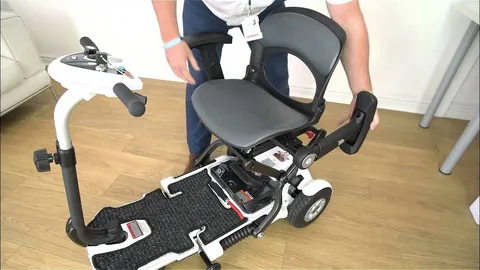
A fold is a two-second act you’ll perform thousands of times, so its choreography matters more than its speed. One-motion manual folds feel like a good umbrella snapping shut. Auto-folds — press the fob, stand back, watch it curl up like a sleeping cat — suit arthritic hands and carers juggling bags. Compare the mechanics across the folding scooters range, or meet the class act: the LuXe AtomiX.
Wheels, Tyres and Suspension
Small wheels are light but honest — they relay every pavement confession straight to your wrists. Pneumatic tyres forgive; solid tyres never puncture but broadcast every seam. And a mobility scooter with suspension UK kerbs respect turns cobbled high streets from an ordeal into a mild adventure. If your patch of Britain has “character” in its paths, suspension isn’t a luxury — it’s insurance for your fillings.
Seat Comfort and Adjustability
Spec sheets measure seats in centimetres; bodies measure them in minutes. A swivel seat transforms transfers (less twisting, more sliding), seat height decides whether standing up is a grace or a grapple, and adjustable tillers keep wrists neutral. An hour into a mobility scooter for shopping UK Saturday, the seat — not the motor — decides whether you browse the second shop or head home.
Ground Clearance and Kerb Ability
Ground clearance — the gap beneath the deck — decides whether dropped kerbs are a gentle ramp or a scr-the-scrape horror. Under 6 cm demands careful navigation; 8–10 cm handles British streets with dignity. A mobility scooter for uneven ground UK paths present needs clearance plus torque plus bigger wheels. Kitchens and kerbs share a rule: it’s the gaps that catch you out.
Class, Legality and Peace of Mind
Class 2 (4 mph, pavement-legal, zero paperwork) is the natural habitat of boot scooters. Class 3 adds road use at 8 mph and DVLA registration — brilliant for long-distance riders, unnecessary for boot-first buyers. Two minutes with GOV.UK’s official rules confirms what’s what, and buying from a specialist means the paperwork (and any VAT exemption) is handled before you’ve finished your receipt.
Spec Priorities by Rider: Which Numbers Should You Trade?
Here’s the secret the industry rarely says out loud: nobody gets perfect scores on every spec. Boot scooters are a game of trades — weight trades against range, comfort trades against folded size. The winners decide which numbers they personally can’t compromise, then trade the rest. Solo lifter? Weight is non-negotiable, range can bend. Long-day explorer? Reverse it.
Table 2: Which Specs Should YOU Never Trade?
| Rider profile | Never trade | Safe to trade | Smart starting point |
|---|---|---|---|
| Solo lifter, hatchback | Heaviest part under 12 kg | Suspension, top range | LuXe X200 Lite |
| Comfort-first day-tripper | Seat, suspension, range | Folded compactness | LuXe X500 Midi Sport |
| Arthritic hands or carer-led | Auto-fold, light controls | Total weight (if hoisting) | LuXe AtomiX |
| Flyer / cruiser | Flight-safe lithium, folded size | Ground clearance | Folding scooters range |
| Value hunter, gentle use | Warranty, service history | Newest battery tech | Pre-loved scooters |
[Infographic 2 — insert lightweight-folding-car-boot-mobility-scooter-uk.png here]
Five Myths About Car-Boot Scooters, Politely Busted
Myth 1: “The lighter the total, the better the scooter.” Not quite — the heaviest part you lift is the number that matters, and split-down designs often win it. Judge the lift, not the leaflet.
Myth 2: “Quoted range is the range I’ll get.” Expect 20–40% less in the wild. The two-times rule keeps you honest and mobile.
Myth 3: “Boot scooters can’t handle hills.” Quality 4 mph machines manage typical UK pavements gradients happily — it’s steep, unmade terrain that separates classes. Match the machine to your map.
Myth 4: “All folding scooters are flight-approved.” No — airlines certify specific lithium batteries (capacity limits matter). If flying’s on your calendar, tell us first; we’ll point you to genuinely flight-friendly models and sort the paperwork.
Myth 5: “I need the smallest scooter possible.” Only if you’re doing the lifting with no backup. Many buyers happily carry a comfier 22 kg machine — or load it with a lightweight ramp — and enjoy the extra range daily. Smallest isn’t always smartest.
Watch the Specs Come Alive: The Free Home Demonstration
Specs on a screen are sheet music; a demonstration is the live concert. Our mobility scooter home demonstration UK-wide service is free, and it’s where paper numbers become felt realities: you’ll fold the mechanism with your own hands, lift the heaviest part with your own arms, slide it into your boot, and ride it down your street. If a spec doesn’t survive contact with your real life, better to learn in your driveway than in your bank statement.
Prefer the full showroom experience? Find your nearest store, try the fleet back to back, and compare spec ladders in person. We’ll also check Motability eligibility (your allowance may cover it — see Motability scooters), handle VAT-exempt paperwork, and talk funding options if budgets are tight.
📞 Specs to certainty in one free visit: call 0208 159 7070 or book a home or in-store assessment. Zero pressure — we promise the demo is genuinely free and genuinely useful.
One Purchase, a Whole Life of Independence
A boot scooter rarely rides alone. Most of our customers build a small, sensible ecosystem around it — and everything below lives under our roof:
- For shorter legs days — a lightweight rollator with seat folds into the boot beside the scooter; a folding rollator with seat UK travellers rate handles airports and garden centres alike. Indoors, browse walking frames and sticks.
- When a companion pushes — a lightweight folding wheelchair is the classic boot partner; a transit wheelchair for travel UK trips weighs barely more than a picnic. Explore all wheelchairs, tilt-in-space models for posture support, or add electric muscle via powered add-ons.
- For indoor agility — folding powerchairs turn on a ten-pence and fold like prams; ideal cabins, caravans and bungalows.
- For the sofa hours — a single motor riser recliner or dual motor riser recliner — dual motor riser recliner explained in one line: back and legs move independently — makes the evening as independent as the day. Small rooms? Wall hugger and compact designs; larger frames? Bariatric options; the full family lives at mobility furniture.
- For the night shift — adjustable beds and profiling & care beds — an electric profiling bed UK homes can have delivered and fitted — turn tomorrow’s energy supply on tonight.
- For the little frictions — bathroom aids, access ramps and everyday living aids smooth the fifteen small moments between the big ones.
Where to start? A free seating assessment or a natter with our team sorts the essentials from the extra miles.
Final Thoughts: Read the Specs, Then Rise Above Them
So — what makes a lightweight mobility scooter for car boot UK journeys genuinely boot-friendly? Weight you can lift (judged by heaviest part), folded size that beats your tape measure, honest range with margin to spare, and the quiet fifth column: fold, suspension, seat, clearance and class. Read those numbers and the showroom fog clears.
But here’s the final twist: the specs get you 90% of the way. The last 10% — the fold that suits your hands, the seat that suits your back, the boot that suits your car — only reveals itself in person. Read the spec sheet tonight; then let the team at Lifestyle & Mobility bring the live demonstration to your driveway. Your perfect spec sheet is one free visit away.
FAQs
1. What folded dimensions should I look for to fit a typical UK car boot?
Most true folding boot scooters collapse to roughly 85–95 cm long, 35–55 cm wide and 35–50 cm tall — a size that clears the boot mouth of nearly every hatchback and small estate. Split-down boot models pack into similar total volumes across two or three pieces. Measure your boot’s opening and depth, keep the numbers in your phone, and beat them.
2. Should I choose a lithium or lead-acid battery for a car boot scooter?
Choose lithium if you lift the scooter yourself, fly, or want fast charging — that’s most solo boot-scooter owners. Lead-acid suits budget buyers whose scooters stay mostly assembled or get loaded with help. Lithium packs weigh a fraction, last longer per charge and are airline-friendly when certified; lead-acid costs less up front and weighs like a dumbbell with commitment issues.
3. Do I need a ramp or boot hoist, or can I lift the scooter myself?
If you can comfortably lift roughly 10–14 kg (think a full weekly shop bag), you’ll manage most split-down or folding models unaided. If lifting is off the table entirely, a folding ramp turns loading into a gentle push, and boot hoists do it all electrically. Try your technique during a free home demo — we’ll bring the options and let your driveway give the verdict.
4. Can a car-boot scooter climb kerbs safely?
Yes, within reason. Quality Class 2 boot scooters handle standard dropped kerbs and gentle ramps — approach squarely at walking pace and let the wheels do the work. Steep, un-dropped kerbs and rough tracks are different beasts: that’s terrain for bigger-wheeled, higher-clearance models. When in doubt, roll the long way round to the proper crossing; your axle (and your tea in the cup holder) will thank you.
5. How is a folding mobility scooter different from a folding powerchair?
A scooter steers with a tiller and suits riders who can stand, pivot and transfer fairly freely; a powerchair is driven with a joystick and folds (on folding models) for those who prefer full-time seated support with tighter indoor agility. Many households own both: the scooter for boots, days out and pavements; the powerchair for precise indoor turns. Our team fits both — and honest advice about which you actually need comes free.