Artificial Intelligence has already transformed how businesses automate tasks, analyze data, and improve customer experiences. But in 2026, a new shift is taking place — businesses are moving beyond traditional AI tools toward Agentic AI.
Unlike conventional AI systems that simply respond to prompts or execute fixed workflows, Agentic AI systems can independently reason, plan, make decisions, and execute multi-step actions with minimal human supervision. This is why CEOs across industries are now aggressively investing in Agentic AI transformation services.
From Fortune 500 companies to fast-growing startups, executives are recognizing that Agentic AI is no longer a futuristic concept. It is becoming the foundation of the next generation of business operations. Surveys from Gartner, IBM, Deloitte, and the World Economic Forum show that organizations are rapidly increasing investments in autonomous AI systems, workflow orchestration, and AI-driven operational models.
So, what is driving this sudden surge in investment? Why are CEOs prioritizing Agentic AI transformation services over traditional automation initiatives?
Let’s explore the key reasons.
Understanding Agentic AI
Before understanding the investment wave, it’s important to define what Agentic AI actually means.
Agentic AI refers to AI systems capable of autonomous decision-making and task execution. These systems do more than generate responses. They can:
- Analyze goals
- Break tasks into smaller workflows
- Coordinate with other AI agents
- Interact with software tools
- Adapt to changing conditions
- Learn from outcomes
- Execute actions independently
In simple terms, Agentic AI behaves less like a chatbot and more like a digital workforce.
For example, instead of an employee manually managing customer onboarding, an AI agent can independently collect customer data, verify documents, trigger approvals, schedule meetings, update CRMs, and generate reports — all without constant human intervention.
This capability is transforming how enterprises think about productivity, scalability, and operational efficiency.
According to Gartner, 80% of CEOs believe AI will significantly reshape operational capabilities and push businesses toward autonomous operating models.
The Shift From Automation to Autonomy
Traditional automation has existed for years. Businesses have used robotic process automation (RPA), workflow systems, and AI-powered analytics to reduce repetitive work.
However, most legacy automation systems are rule-based. They depend on predefined conditions and structured workflows.
Agentic AI changes this completely.
Instead of following static instructions, AI agents can reason dynamically and make context-aware decisions. This transition from automation to autonomy is one of the biggest reasons CEOs are investing heavily in transformation services.
Modern enterprises want systems that can:
- Adapt without reprogramming
- Handle unstructured workflows
- Collaborate across departments
- Make decisions in real time
- Operate continuously at scale
This evolution is creating what analysts call the “Autonomous Enterprise.”
Research from Gartner indicates that many organizations are already transitioning from task-based automation toward self-learning and adaptable AI systems capable of operating with reduced human involvement.
Benefits You Need To Know
The biggest driver behind Agentic AI adoption is competitive pressure.
Every industry is experiencing rapid disruption. Companies that fail to adopt AI-powered operational models risk falling behind competitors that move faster, reduce costs, and scale more efficiently.
CEOs understand that Agentic AI is not simply another software trend. It represents a structural business advantage.
Organizations using AI agents effectively can:
- Accelerate operations
- Reduce decision-making delays
- Improve customer experiences
- Lower operational costs
- Increase workforce productivity
- Launch products faster
- Respond to market changes in real time
The World Economic Forum reported that CEOs increasingly view AI transformation as a business-led strategy rather than just an IT initiative. Many leaders are allocating significant portions of transformation budgets directly toward AI systems and autonomous workflows.
This competitive urgency is forcing companies to seek expert consulting and transformation services that can help them deploy Agentic AI successfully.
The Rise of Autonomous Workflows
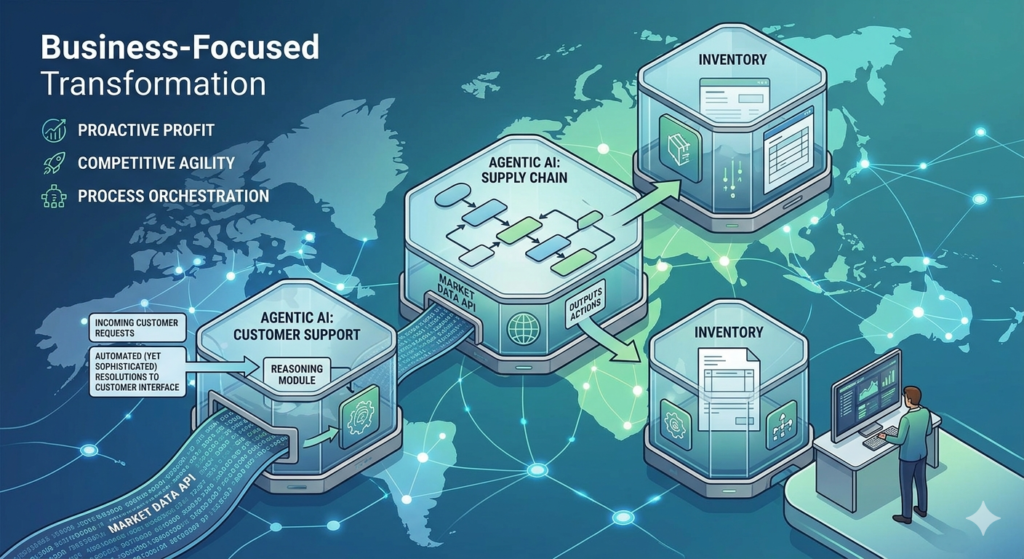
One of the most valuable capabilities of Agentic AI is workflow orchestration.
In traditional enterprises, workflows often involve multiple teams, disconnected systems, approvals, and manual interventions.
Agentic AI transformation services help companies redesign these workflows into autonomous systems.
For example:
In Customer Support
AI agents can:
- Resolve tickets
- Escalate complex issues
- Analyze sentiment
- Coordinate with backend systems
- Generate summaries
- Trigger refunds or replacements
In Finance
AI systems can:
- Detect fraud
- Monitor transactions
- Generate compliance reports
- Automate reconciliation
- Manage approvals
In HR
AI agents can:
- Screen candidates
- Schedule interviews
- Handle onboarding
- Manage employee queries
- Track performance data
In Supply Chain
AI systems can:
- Predict shortages
- Reorder inventory
- Optimize logistics
- Monitor disruptions
- Coordinate vendors
These capabilities allow organizations to scale operations without proportionally increasing headcount.
According to enterprise surveys, Agentic AI is rapidly moving from experimentation to production deployment across operations, finance, IT, and customer experience functions.
Why Businesses Want Higher Productivity and Efficiency
Productivity gains remain one of the strongest business cases for Agentic AI transformation.
Many organizations are already seeing measurable improvements in:
- Employee efficiency
- Operational speed
- Decision accuracy
- Resource utilization
- Customer response times
Deloitte’s enterprise AI research found that nearly all organizations expect significant productivity improvements through AI-driven operational redesign.
Unlike traditional AI assistants that only support employees, Agentic AI can independently complete workflows. This dramatically changes the economics of business operations.
For CEOs, this means:
- Lower operational costs
- Higher output
- Faster scaling
- Improved margins
More importantly, AI agents allow human employees to focus on strategic, creative, and relationship-driven work instead of repetitive administrative tasks.
Agentic AI Enables Scalable Growth
Scaling a business traditionally requires hiring more employees, increasing infrastructure, and expanding management layers.
Agentic AI changes the scalability equation.
With autonomous systems handling large portions of operational workflows, businesses can scale without dramatically increasing labor costs.
This is especially important for:
- SaaS companies
- E-commerce platforms
- Financial institutions
- Healthcare providers
- Logistics companies
For example, an AI-powered customer support operation can handle thousands of conversations simultaneously across multiple languages and channels.
Similarly, AI-driven operations teams can manage massive datasets and workflows around the clock.
This scalability advantage is one of the primary reasons venture capital firms and enterprise leaders are aggressively funding Agentic AI initiatives.
Legacy Systems Are No Longer Enough
Another reason CEOs are investing in Agentic AI transformation services is the growing limitation of legacy systems.
Many enterprise software environments were designed for human-operated workflows. These systems are often:
- Slow
- Fragmented
- Data-siloed
- Difficult to scale
- Expensive to maintain
Modern AI agents require:
- Real-time data access
- API integrations
- Cloud-native infrastructure
- Intelligent orchestration layers
- Continuous learning systems
This is why companies are increasingly hiring AI consulting firms to modernize their infrastructure.
The World Economic Forum noted that organizations pursuing AI ROI are replacing outdated systems with AI-powered operational platforms capable of supporting autonomous agents.
The Explosion of Multi-Agent Systems
One of the newest trends in enterprise AI is the rise of multi-agent systems.
Instead of using a single AI assistant, organizations are deploying networks of specialized AI agents that collaborate together.
For example:
- One AI agent handles customer interactions
- Another processes payments
- Another manages compliance
- Another analyzes operational performance
These agents coordinate together like digital employees.
This creates highly adaptive and intelligent business systems capable of managing complex enterprise operations.
Industry experts now see multi-agent orchestration as a core pillar of next-generation enterprise architecture.
Because implementing these systems is highly complex, CEOs are increasingly relying on specialized Agentic AI consulting services.
AI Governance and Risk Management Are Critical
As businesses deploy autonomous AI systems, governance becomes essential.
CEOs understand that poorly managed AI systems can create:
- Compliance risks
- Security vulnerabilities
- Operational failures
- Bias issues
- Legal exposure
This is why Agentic AI transformation services now heavily focus on:
- AI governance
- Human oversight
- Security frameworks
- Ethical AI deployment
- Compliance monitoring
- Auditability
Deloitte and Gartner both emphasize that governance and infrastructure are among the top enterprise AI investment priorities.
Businesses are no longer looking for simple chatbot implementations. They need enterprise-grade AI ecosystems with strong operational controls.
How businesses Rebuilding Organizational Structures
Perhaps the most significant shift happening today is organizational redesign.
AI is no longer just a department-level initiative.
Companies are restructuring entire operational models around AI-driven workflows.
IBM research shows that the number of organizations appointing Chief AI Officers has increased dramatically, reflecting how central AI has become to enterprise strategy.
Businesses are now redesigning:
- Leadership structures
- Operational processes
- Workforce models
- Customer experiences
- Decision-making systems
This transformation requires strategic consulting expertise, not just technical implementation.
As a result, demand for Agentic AI consulting services is growing rapidly worldwide.
Human + AI Collaboration Is the Future
Despite fears around job displacement, most successful enterprises are not replacing humans entirely.
Instead, they are building “human-amplified” organizations where employees supervise, guide, and collaborate with AI systems.
Gartner research suggests organizations achieving the highest AI ROI are those investing in workforce upskilling and human-AI collaboration rather than relying solely on automation or layoffs.
In many cases:
- Employees become AI orchestrators
- Teams manage multiple AI agents
- Managers focus on strategic oversight
- AI handles repetitive execution tasks
This hybrid workforce model is becoming the dominant enterprise strategy.
The Consulting Industry Is Evolving Rapidly
The rapid rise of Agentic AI is also transforming the consulting industry itself.
Traditional consulting focused on:
- Process optimization
- Digital transformation
- Enterprise software implementation
Now, companies need:
- AI workflow design
- Agent orchestration
- AI governance
- Autonomous operations consulting
- AI infrastructure modernization
- Multi-agent deployment strategies
This has created enormous demand for AI transformation consultants capable of bridging business strategy and advanced AI engineering.
Industry analysts increasingly describe Agentic AI consulting as one of the fastest-growing segments in enterprise technology services.
The Future of Agentic AI Transformation
The current wave of AI adoption is only the beginning.
Over the next few years, businesses are expected to move toward:
- Fully autonomous workflows
- AI-managed operations
- Machine-to-machine commerce
- Self-optimizing enterprises
- AI-native organizational structures
Researchers now describe this transition as the evolution toward “Autonomous Business Models,” where AI systems become central to value creation and operational execution.
Companies that adopt early are likely to gain substantial competitive advantages in efficiency, scalability, and innovation.
This is exactly why CEOs are investing aggressively today.
Conclusion
The surge in demand for Agentic AI transformation services is not driven by hype alone. It is driven by real business pressures, operational challenges, and the growing realization that autonomous AI systems will fundamentally reshape how enterprises operate.
CEOs are investing heavily because Agentic AI offers:
- Faster operations
- Lower costs
- Scalable growth
- Smarter decision-making
- Competitive advantage
- Autonomous workflow management
- Improved productivity
- Enhanced customer experiences
At the same time, implementing Agentic AI successfully requires deep expertise in strategy, infrastructure, governance, workflow orchestration, and organizational transformation.
This is why Agentic AI consulting services are becoming mission-critical for enterprises worldwide.
The companies that successfully integrate autonomous AI into their operations today will likely become the market leaders of tomorrow.