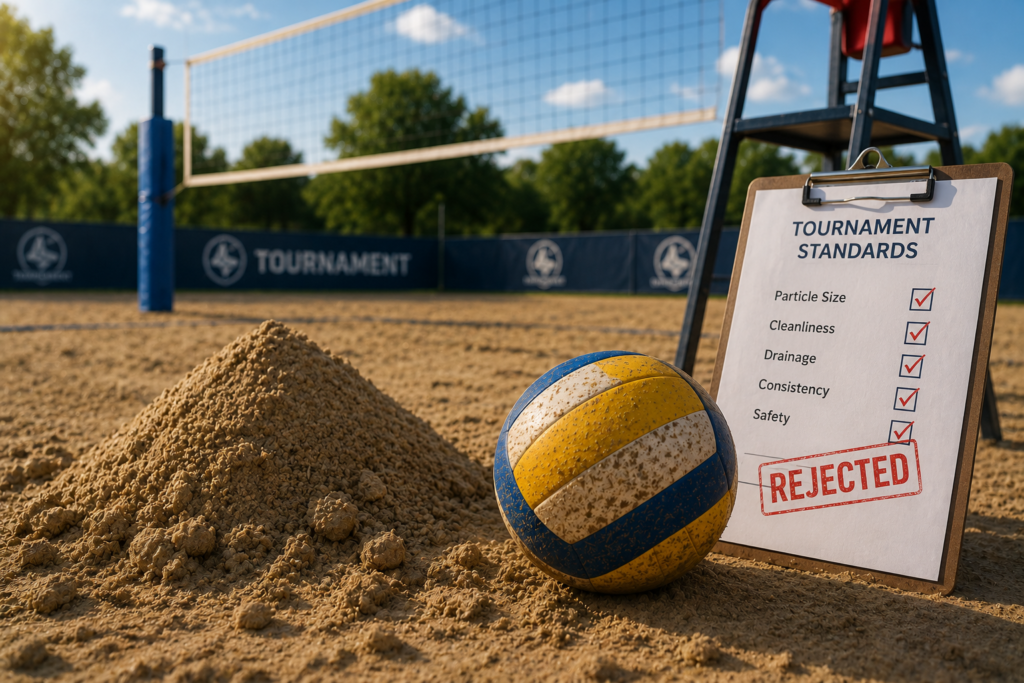
You would think ordering sand for a volleyball court would be simple, right? A truck shows up, dumps the material, workers spread it out, and the court is ready. But honestly… it does not always work that way. We have seen courts look perfect from a distance and still become a nightmare during games because the wrong Volleyball Court Sand was delivered.
Players notice it fast. The sand feels too rough. Feet sink too deep. Dust starts flying around every serve. Suddenly, what was supposed to be a tournament-ready court feels more like a construction site.
And the frustrating part? Many of these problems could have been avoided before the delivery even arrived.
Not All Sand Is Meant for Volleyball Courts
This catches a lot of people off guard.
Sand used for construction, masonry, playgrounds, or landscaping might look similar at first glance, but volleyball courts need a very specific texture and consistency. Some suppliers sell “clean sand” and assume it works for everything. It does not.
Tournament-level courts need material that feels soft on the skin while still giving players enough support to move quickly. If the grains are too sharp or too coarse, players end up with scrapes and discomfort after long matches.
And if the sand is too fine? Ugh… every jump creates clouds of dust.
That alone can ruin playability.
Moisture Can Completely Change the Surface
Here is something people rarely talk about… the condition of the sand during delivery matters just as much as the sand itself.
A load that sits uncovered during transport can absorb moisture unevenly. Parts of it become compacted while other areas stay loose and fluffy. Once spread across the court, the surface feels inconsistent from one side to the other.
Players notice those differences immediately.
One step feels stable. The next sinks too deep. That inconsistency becomes a real issue during tournaments where fairness and safety matter.
Good suppliers pay attention to storage and transportation. Bad ones just focus on dropping the load as fast as possible.
Grain Shape Matters More Than Most People Realize
This sounds tiny, but it changes everything.
Round sand particles move differently than crushed angular particles. Sharp-edged grains lock together too tightly, creating hard spots across the court. Softer rounded grains allow better movement and cushioning.
Nobody wants to dive for a ball and land on sand that feels like rough gravel. We have all stepped onto courts like that before… and instantly regretted it.
Professional-level volleyball surfaces are designed to reduce stress on knees, ankles, and joints. Poor-quality sand does the opposite.
Delivery Volume Mistakes Create Uneven Courts
Sometimes the issue is not even the material itself.
Some deliveries arrive short on volume. Others contain mixed depths because the sand was not distributed properly during installation. A court may look level at first, but once players start moving around, low spots begin forming everywhere.
That becomes dangerous fast.
Tournament courts need consistent depth across the entire playing area. If one section is shallow and another too deep, player movement becomes unpredictable. It also affects ball bounce and footing.
Honestly, this problem usually shows up after the first few games. By then, fixing it becomes expensive and time-consuming.
Dust Is a Bigger Problem Than People Expect
People usually focus on softness and color, but dust content matters too.
Poorly processed sand often contains excess fines. Once matches begin, tiny particles rise into the air constantly. Players end up with irritated eyes, dry throats, and dirty equipment.
Not exactly the experience organizers want during competitive events.
High-quality Volleyball Court Sand goes through proper washing and screening processes before delivery. That extra preparation helps keep courts cleaner, safer, and easier to maintain over time.
Some Suppliers Rush the Screening Process
Here is the truth… not every supplier carefully screens their material.
Some loads contain tiny rocks, shell fragments, debris, or oversized particles mixed into the sand. You might not notice it immediately while the court is empty, but athletes definitely notice during gameplay.
One sharp object hidden in the surface can quickly turn into an injury risk.
Reliable suppliers take extra time to remove unwanted material because they understand how closely tournament courts are inspected.
Final Thoughts
At the end of the day, volleyball courts are judged by how they play, not just how they look.
A beautiful court can still fail tournament expectations if the sand feels inconsistent, dusty, rough, or unstable. That is why choosing the right supplier matters far more than most people think.
Good volleyball sand supports movement, cushions impact, drains properly, and stays comfortable through long matches. Bad sand creates frustration almost immediately.
And honestly… players can tell the difference within minutes.
FAQs
1. What type of sand is best for volleyball courts?
Soft, clean, washed sand with rounded grains is usually preferred because it improves comfort and player movement.
2. Why does some volleyball sand feel hard?
Hard surfaces often happen when the material contains angular particles or becomes compacted due to poor moisture control.
3. Can construction sand be used for volleyball courts?
Not really. Construction sand is typically too coarse or dusty for safe and comfortable gameplay.
4. How deep should volleyball court sand be?
Most volleyball courts need a consistent sand depth to support player safety and movement during matches.
5. Why is washed sand important for volleyball courts?
Washed sand removes dust, debris, and fine particles, helping create a cleaner and more playable surface.