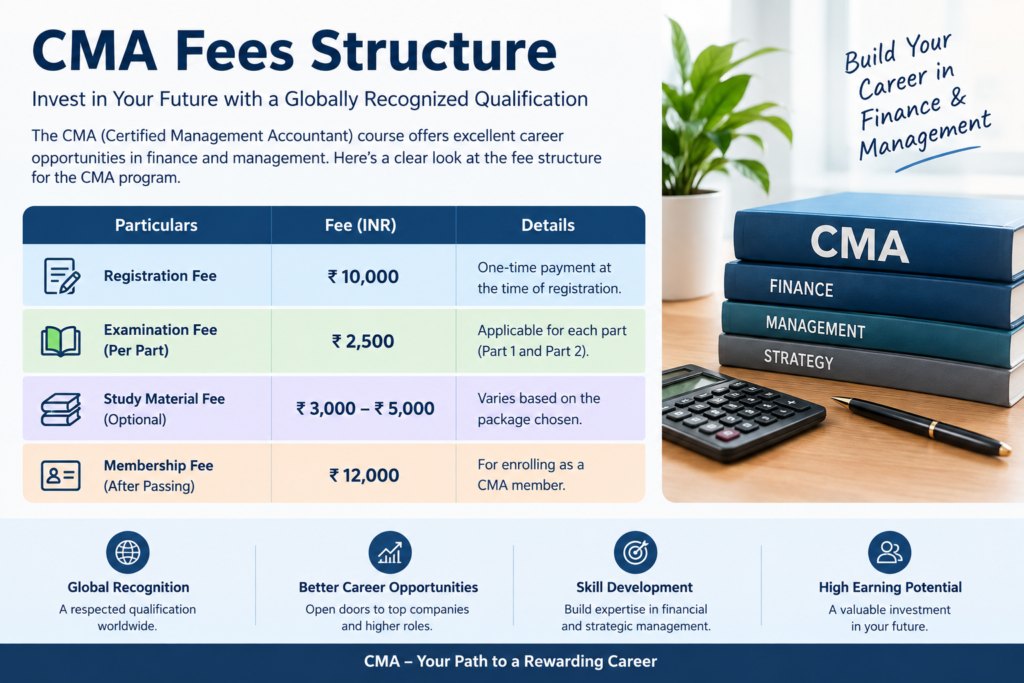
For commerce students and working professionals weighing global accounting and finance credentials, two qualifications consistently come up: the Certified Management Accountant (CMA), typically pursued through the US-based Institute of Management Accountants, and the Certified Public Accountant (CPA), the gold-standard credential for accounting professionals in the United States. Both carry strong international recognition, but they differ significantly in cost structure, eligibility, and the career paths they open up. Understanding the CMA fees structure alongside CPA license requirements helps candidates plan both their finances and their timeline realistically before committing to either path.
Understanding the CMA Certification
The CMA credential, offered by the Institute of Management Accountants (IMA), focuses on management accounting, financial planning, analysis, and strategic financial management — skills geared toward corporate finance and internal decision-making roles rather than public accounting or audit work. It has grown popular among commerce graduates and finance professionals in India seeking a globally recognised credential without the extended timeline that some other international qualifications require.
Breaking Down the CMA Fees Structure
The total cost of pursuing the CMA certification is generally organised into a few distinct components, and candidates should budget for each rather than assuming a single flat fee covers everything.
IMA membership fee is the starting cost, since candidates must become IMA members before registering for the CMA program. Membership fees differ based on category — professional membership typically costs more than the student or academic membership rate available to those who qualify, and this fee is generally payable annually for as long as the candidate remains a member.
CMA entrance fee is a one-time fee paid when registering for the CMA program itself, separate from the ongoing membership fee. This entrance fee also differs based on whether the candidate registers under the professional track or the student track, with the student rate generally being significantly lower.
Exam fees for Part 1 and Part 2 form the largest recurring cost component. The CMA exam consists of two parts — Part 1 covering financial planning, performance, and analytics, and Part 2 covering strategic financial management — and each part carries its own exam fee, payable per attempt. Candidates who don’t pass on their first attempt need to pay the exam fee again to retake that part, which makes thorough preparation before each attempt financially worthwhile, not just academically important.
Study materials and coaching costs represent a variable but often substantial component of total expenditure. Many candidates in India enrol with coaching institutes or use official IMA-approved study materials, review courses, and practice question banks, which can add a meaningful amount on top of the direct IMA and exam fees. Costs here vary widely depending on whether a candidate opts for self-study using official materials alone or enrols in a structured coaching program with live classes and mentorship.
Total estimated cost when combining membership, entrance fee, both exam parts, and reasonable study material investment typically runs into a moderate but manageable range for most working professionals and students, generally positioned as more affordable than several other international finance credentials, which is part of why it has gained traction among Indian candidates specifically.
It’s worth noting that IMA periodically revises its fee structure, and rates can also vary based on currency exchange fluctuations for candidates paying in Indian rupees, so checking the current fee schedule directly on the IMA’s official website before finalising a budget is strongly advisable.
Eligibility for the CMA Certification
Candidates need a bachelor’s degree from an accredited institution (or must complete it within a defined window after passing the exams) along with a minimum of two years of relevant professional experience in management accounting or financial management, which can be completed either before or after passing the exams. This flexibility around when the experience requirement must be fulfilled makes the CMA particularly accessible to students who want to begin exam preparation during or shortly after their undergraduate studies.
Understanding the CPA Credential
The CPA, by contrast, is the licensing credential required to practise as a public accountant in the United States, covering areas such as auditing, taxation, financial accounting and reporting, and business environment concepts. It carries significant weight for professionals aiming to work in public accounting firms, particularly those handling US-based audit or tax engagements, or for those targeting senior finance roles within multinational corporations with US reporting requirements.
CPA License Requirements
Unlike the CMA, which is a certification, the CPA is technically a license to practise, issued at the state level in the US, which means requirements can vary somewhat depending on which US state a candidate chooses to be licensed through — a detail that surprises many international candidates who assume the requirements are uniform nationally.
Educational requirements generally require 150 credit hours of college-level education, which typically exceeds what a standard three-year bachelor’s degree in India provides. This is one of the most significant practical hurdles for Indian candidates, since most need to supplement their undergraduate degree with additional coursework — often through a master’s degree, additional certifications, or specific bridge courses — to meet the 150-credit threshold required by most states.
The Uniform CPA Examination itself covers four sections: Auditing and Attestation, Business Environment and Concepts, Financial Accounting and Reporting, and Regulation, with an additional discipline section introduced in more recent exam structures allowing candidates to choose an area of specialisation. Each section is scored separately, and candidates generally need to pass all sections within an 18-to-30-month rolling window, depending on the specific state board’s rules.
Experience requirements for full licensure typically call for one to two years of relevant accounting experience, often required to be verified by a licensed CPA supervisor, with the exact duration and supervision requirements again varying by state board.
Ethics examination is required by many state boards as a final step before licensure, testing candidates on professional conduct and ethical standards specific to the accounting profession.
Comparing Total Investment: CMA vs CPA
Broadly, the CMA tends to involve a lower total financial investment and a shorter overall timeline to completion compared to the CPA, largely because the CPA’s 150-credit educational requirement often forces Indian candidates into additional, sometimes costly, coursework simply to become eligible to sit for the exam. The CPA, however, carries stronger recognition specifically within public accounting and audit-focused roles in the US market, while the CMA is more strongly aligned with corporate finance, cost management, and internal strategic finance roles globally, including within India itself.
Making the Right Choice
The decision between pursuing a CMA, a CPA, or eventually both often comes down to the specific career direction a candidate is targeting. Those aiming for corporate finance, FP&A, or management accounting roles — particularly within India or in roles not requiring US audit licensure — generally find the CMA a faster, more cost-effective route. Those specifically targeting public accounting careers in the US, or senior finance roles requiring formal audit sign-off authority under US regulations, will find the CPA license a more directly relevant, if more demanding, investment.
Conclusion
Both the CMA and CPA offer strong international recognition, but they differ meaningfully in cost, eligibility complexity, and career alignment. Understanding the full CMA fees structure — spanning membership, entrance fees, exam costs, and study materials — alongside the more layered CPA license requirements, particularly the 150-credit educational threshold, allows candidates to plan realistically rather than being caught off guard by costs or eligibility gaps midway through their preparation.