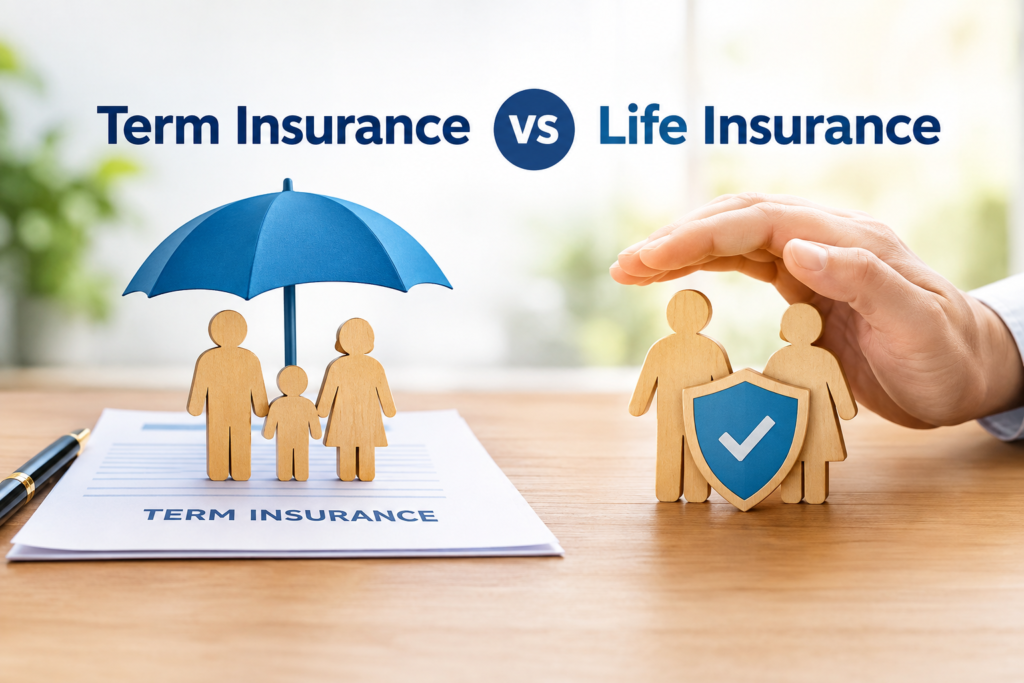
When comparing term insurance vs life insurance, it is important to understand that term insurance is itself a type of life insurance. The difference is mainly in how the policy works and what it is designed to provide.
Term insurance focuses on financial protection for a fixed period. Other types of life insurance may combine life cover with savings, investments or long-term financial planning. Understanding these differences can help you choose cover that matches your family’s financial needs and goals.
What is the difference between term insurance and life insurance?
When comparing term insurance vs life insurance, Term insurance provides life cover for a specified policy term. If the life assured passes away during this period, the nominee receives the applicable death cover, subject to the policy terms and conditions.
A standard term insurance policy usually does not provide a maturity payout if the life assured survives the policy term. Some term insurance policies may offer a return of eligible premiums, depending on their terms.
Life insurance is a broader category that includes several types of policies. Some policies combine life cover with savings, while others may include market-linked investments or retirement-focused features. Depending on the policy, a maturity or survival payout may also be available.
The main difference, therefore, is the purpose of the policy. Term insurance is mainly focused on financial protection, while other life insurance policies may combine protection with savings or investment features.
How do term insurance and other life insurance plans differ in cost?
Term insurance generally costs less for a similar amount of life cover because a standard term policy is focused mainly on protection and does not usually include a savings or investment component.
Other life insurance policies may have higher premiums because they can include additional features such as savings, maturity payouts or market-linked investments.
However, the premium should not be the only factor you consider. A lower premium may provide only protection, while a higher premium may be linked to a policy with different features and financial objectives.
The right choice depends on the type and amount of cover you need and what you expect the policy to achieve.
What happens if you survive the policy term?
The outcome depends on the type of policy you choose. With a standard term insurance policy, the cover normally ends when the policy term expires if the life assured survives the term. There is usually no maturity payout under a regular term policy.
Some life insurance policies may have a return of premium features. If such a feature is included, the applicable amount is paid according to the policy terms.
Other life insurance policies may provide a maturity or survival payout when the policyholder survives the policy term. The amount and conditions depend on the specific policy.
This difference is important when deciding whether your main priority is financial protection or a combination of protection and savings.
Which type of cover may suit your financial goals?
The right choice depends on what you want your insurance to achieve.
Term insurance may be suitable when your main goal is to protect your dependants from financial difficulties during your earning years. The cover can help address responsibilities such as outstanding loans, household expenses and future education costs.
Other life insurance policies may be considered when you want life cover along with savings or investment features. These policies may form part of a longer-term financial plan, depending on their structure and terms.
For example, a person with young children and a home loan may prioritise a higher level of financial protection during their working years. Someone with different financial goals may consider a policy that also includes savings or investment features.
What should you consider before choosing a policy?
Choosing between different forms of life insurance requires more than comparing premiums. Start by identifying the financial need you want the policy to address.
Consider these factors:
- Financial dependants: Identify who relies on your income and for how long.
- Outstanding liabilities: Consider home loans, personal loans and other major commitments.
- Policy term: Choose a period that matches your earning years and financial responsibilities.
- Sum assured: Estimate how much financial support your family may need.
- Premium commitment: Make sure you can comfortably pay the premium throughout the required period.
- Maturity features: If you want a maturity payout, check whether the policy provides one and understand the applicable conditions.
- Investment risk: If the policy includes market-linked investments, understand the risks before investing.
Looking at these factors can help you choose a policy based on your actual financial needs rather than its name or premium alone.
Can you have term insurance and another life insurance policy together?
Yes, you can have more than one life insurance policy if each policy serves a clear financial purpose and you meet the applicable underwriting requirements.
For example, you may use term insurance for financial protection during your earning years while separately considering a savings-oriented life insurance policy for a long-term financial goal.
Having multiple policies does not automatically mean that you have adequate cover. Review your total life cover, financial liabilities, dependants, savings and investments before deciding whether additional insurance is needed.
Conclusion
Term insurance and other life insurance policies serve different purposes, even though term insurance falls within the wider life insurance category. Term insurance mainly focuses on financial protection for a fixed period, while other policies may combine life cover with savings, investment or long-term financial planning.
Before choosing a policy, consider your family’s financial needs, existing liabilities and future goals. Understanding how the policy works, what happens at maturity and how much you need to pay can help you make a more informed choice.