ai skin anlysis
You point your phone at your face, tap a button, and within seconds, a report appears with your pore size, hydration levels, uneven pigmentation, and an estimated skin age. It feels almost too quick to be meaningful. But behind that single photograph is a layered process that dermatologists and engineers have spent years refining. Understanding what actually happens between the tap and the result changes how you interpret and trust what you’re seeing.
It Starts Long Before Your Selfie
The analysis that reads your skin in seconds was built on millions of images taken long before you ever opened the app. AI skin analysis relies on deep learning models, specifically a type of algorithm called a Convolutional Neural Network (CNN) trained on vast, labeled databases of skin photographs. Each image in that database was reviewed and tagged by dermatologists: this is a dilated pore, this is post-inflammatory hyperpigmentation, this is dehydrated skin versus dry skin. The model learns to recognize these patterns across thousands of variations in different lighting conditions, skin tones, ages, and textures.
By the time the model is deployed inside a consumer tool, it has effectively internalized the diagnostic pattern recognition of many clinical hours. That doesn’t make it a dermatologist. But it does mean it’s doing something more rigorous than a quiz that asks whether your skin feels “tight after washing.”
What the Algorithm Actually Sees in Your Photo
When you take a selfie, the image goes through several processing stages before the result reaches you.
Image preprocessing is the first step. The algorithm corrects for variables that would otherwise skew results: ambient lighting, camera angle, focal distance, and even the color temperature of your screen if you’re using the front camera near a warm-lit room. Without this correction, the same person’s skin could look significantly different depending on whether they’re near a window or under fluorescent office lights.
Facial mapping comes next. The AI divides your face into zones: forehead, nose, cheeks, chin, and under-eye area because these regions have genuinely different characteristics. Your T-zone behaves differently from your cheeks. Analyzing the face as one undifferentiated surface would produce inaccurate, averaged-out results that aren’t useful for targeted skincare decisions.
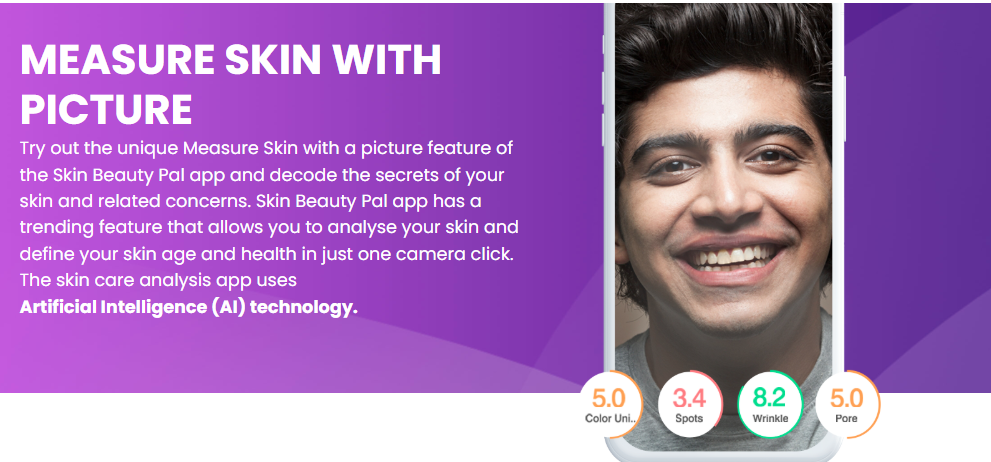
Feature extraction is where the substantive reading happens. The model examines each zone for specific measurable signals:
- Pore visibility — assessed through texture irregularity and surface shadow patterns at the micro level
- Melanin distribution — the concentration and spread of pigment that reveals dark spots, sun damage, and uneven tone
- Surface smoothness — how light scatters across the skin, which reflects underlying texture and moisture levels
- Structural markers — fine lines and wrinkles identified through micro-deformation in skin geometry
- Colour uniformity — subtle variations in tone that indicate redness, sensitivity, or vascular congestion
Benchmarking follows extraction. Your results aren’t presented in isolation; they’re compared against a reference dataset of people in your age group. This is where the “skin age” calculation comes from. If your skin shows structural markers typical of someone five years older, the model reflects that. If your hydration and texture scores align with a younger baseline, that shows up too.
What the Selfie Cannot See
Honesty matters here. A photograph captures reflected light from your skin’s surface. It cannot measure subcutaneous hydration directly, assess the state of your skin barrier at a cellular level, detect hormonal influences on sebum production, or identify conditions that manifest internally before presenting visually. Lighting quality, make-up residue, and even phone camera compression can affect output.
This is why a good AI skin analysis system presents results as a health map rather than a medical diagnosis. It tells you what is measurable and visible, which is genuinely useful without overstating what a photograph can confirm. The appropriate use is tracking, direction, and prioritisation, not clinical decision-making.
Why Tracking Over Time Is More Valuable Than a Single Scan
A one-time reading gives you a baseline. What makes AI skin analysis genuinely powerful is longitudinal tracking, comparing results from the same face, photographed under consistent conditions, across weeks and months.
This is where patterns emerge that no mirror can show you. A gradual reduction in dark spot intensity after introducing a Vitamin C serum. A seasonal increase in pore visibility during humid months. A measurable improvement in skin smoothness after consistently drinking more water for three weeks. These shifts are too subtle to perceive day-to-day, but become clearly visible when the data is laid out comparatively.
Progress tracking also removes the emotional distortion from skincare decisions. Most people either over-assess improvement (motivated by the cost of products they’ve bought) or under-assess it (because change is gradual). Objective data sidesteps both.
The Skin Concerns That Show Up Most Clearly
Some conditions are more reliably detected from photographs than others.
Hyperpigmentation is one of the most consistently well-identified concerns; the contrast between pigmented and surrounding skin is visually distinct and measurable. For Indian skin types in particular, where post-inflammatory hyperpigmentation from acne, sun exposure, and hormonal shifts is common, this is among the most practically useful signals the technology provides.
Pore congestion and enlarged pores are also reliably flagged. Pore appearance is directly related to sebum production, skin elasticity, and surface texture, all of which register clearly in high-resolution facial imaging.
Skin age deviation, where your measured skin condition differs from your biological age, is another area where AI analysis has shown clinical correlation in research settings.
Fine lines and surface wrinkles are detectable once they cross a certain depth threshold. Early-stage lines that are more texture than structure are less reliably flagged but become clearer with repeated scanning.
The Limitation Most Apps Don’t Tell You About
The quality of AI skin analysis is directly tied to the diversity of the training data. If a model was trained predominantly on lighter skin tones, its accuracy for detecting hyperpigmentation or redness on deeper skin tones will be lower, not because the technology is fundamentally flawed, but because the reference library it learned from was incomplete.
As more platforms invest in diverse, dermatologist-labelled datasets, this gap is narrowing. But it’s worth asking and worth brands disclosing what skin tones and demographics their training data represents, particularly for users in South Asian markets where melanin levels and specific skin concerns differ from Western clinical norms.
From Analysis to Action
The practical value of a selfie-based reading depends on what follows it. A score for “spots” or “pore size” without context is interesting but not actionable. The more useful output connects the reading to a skin enhancement plan, specific ingredient recommendations, routine adjustments, and follow-up comparison scans that show whether those recommendations are working.
This is the trajectory the technology is moving toward: not just diagnosis, but guided improvement with measurable outcomes.
A skin analysis app like Pers Active Lab is built precisely around this principle, combining AI-driven selfie analysis with weekly skincare plans, skin age tracking, and access to dermatologist consultations, so the reading you get isn’t a data point you file away but a starting point for visible, trackable skin improvement.
Frequently Asked Questions
Q1. How accurate is AI skin analysis compared to seeing a real dermatologist?
AI skin analysis is accurate for visible, surface-level concerns, such as pores, spots, texture, and pigmentation, and has shown clinical correlation in multiple studies. However, it cannot diagnose medical conditions, assess skin at a cellular level, or account for internal factors like hormones or diet. Think of it as a precise visual health monitor, not a replacement for clinical consultation. For persistent or unusual skin concerns, in-person dermatology remains essential.
Q2. Does skin tone affect the accuracy of AI skin analysis results?
Yes, it can. Models trained on limited skin tone diversity tend to be less accurate for deeper complexions, particularly for detecting redness or subtle pigmentation shifts. Platforms using diverse, well-labelled datasets across Fitzpatrick skin types 4–6 produce more reliable results for South Asian and African skin tones. Always check whether the tool you’re using has been validated across different skin tones.
Q3. Can AI skin analysis detect acne or breakouts in early stages?
It can flag surface-level acne active breakouts, congestion, and post-inflammatory marks with reasonable reliability. It is less effective at predicting breakouts before they surface, since subsurface bacterial activity isn’t visible in a photograph.
Q4. Is the selfie I take stored or shared with third parties?
This varies by platform. Reputable apps delete or anonymise your photograph after processing. Always review the privacy policy before use, specifically whether your image data is used to train future models, shared with product partners, or retained long-term.
Q5. How often should I use an AI skin analysis app to see useful results?
Weekly scans under consistent lighting conditions tend to produce the most meaningful trend data. Daily scanning is possible but introduces more noise from factors like sleep quality and water intake. Monthly scans are useful for tracking seasonal changes. Consistency in your photographing conditions, same light source, same distance, and no make-up matters more than frequency.