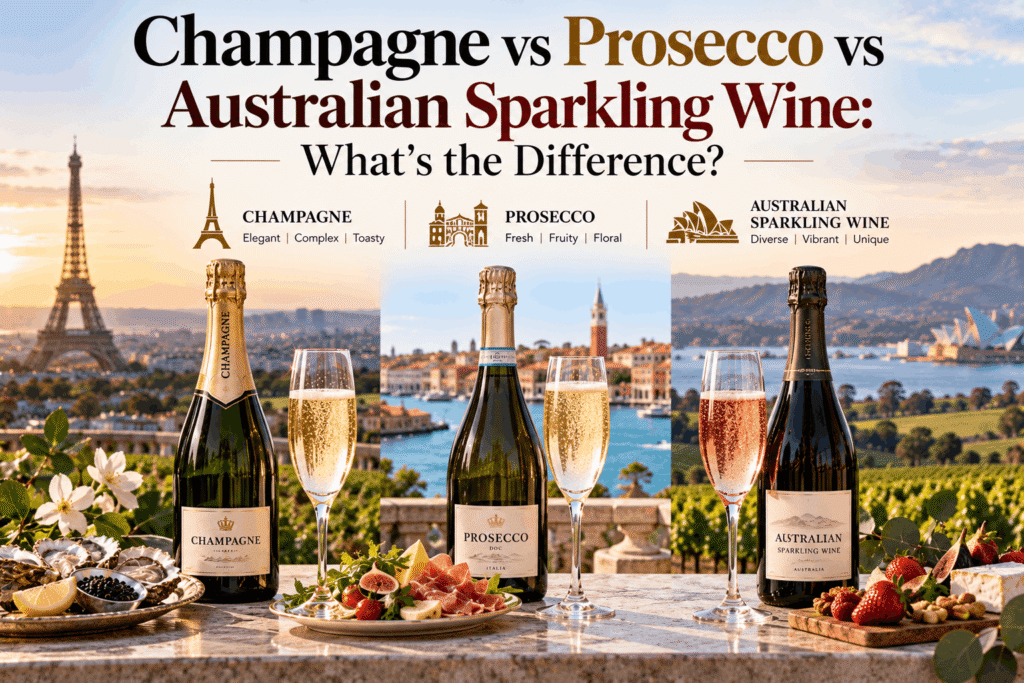
Champagne, Prosecco and Australian sparkling wine all have one thing in common: bubbles. But once you taste them side by side, the differences can be surprisingly noticeable.
They come from different countries, use different grape varieties, follow different production methods and often have very different flavour profiles.
Champagne comes from the Champagne region of France and is made according to strict appellation rules. Prosecco is traditionally associated with northeastern Italy and is primarily made from Glera using the tank method. Australian sparkling wine covers a much broader range of styles, from fresh and approachable Prosecco to premium traditional method wines made from Chardonnay and Pinot Noir.
So, is Champagne better than Prosecco? Is Australian sparkling wine similar to Champagne? And which one should you choose for your next celebration?
The answer depends on what you want from the bottle.
Let’s compare Champagne, Prosecco and Australian sparkling wine in detail.
What Is Sparkling Wine?
Sparkling wine is a broad category of wine containing significant levels of carbon dioxide, which creates the familiar bubbles.
Champagne is a type of sparkling wine, but not every sparkling wine can legally be called Champagne.
This distinction is important.
Champagne must come from the legally defined Champagne appellation in France and follow its production rules. The region covers approximately 34,200 hectares across 319 villages, with Chardonnay, Pinot Noir and Meunier making up the vast majority of plantings.
Sparkling wine produced elsewhere, including Australia and Italy, cannot simply be labelled Champagne.
This is why you’ll see terms such as:
- Champagne
- Prosecco
- Australian sparkling wine
- Méthode Traditionnelle
- Traditional Method
- Sparkling Chardonnay
- Sparkling Pinot Noir
They can all contain bubbles, but they aren’t necessarily made in the same way.
Champagne vs Prosecco vs Australian Sparkling Wine: The Quick Answer
The easiest way to understand the three styles is to look at their origins, grapes and production methods.
| Feature | Champagne | Prosecco | Australian Sparkling Wine |
|---|---|---|---|
| Country | France | Italy | Australia |
| Main region | Champagne | Veneto and Friuli-Venezia Giulia | Multiple Australian regions |
| Main grape varieties | Chardonnay, Pinot Noir, Meunier | Glera | Chardonnay, Pinot Noir, Meunier and others |
| Common method | Traditional Method | Tank/Charmat Method | Traditional, tank and other methods |
| Typical style | Complex, crisp, toasty | Fresh, fruity, floral | Very diverse |
| Common flavours | Citrus, apple, brioche, toast | Pear, apple, citrus, flowers | Citrus, apple, stone fruit, toast and more |
| Texture | Fine, persistent bubbles | Fresh, lively bubbles | Depends on style |
| Ageing potential | Excellent for premium wines | Generally enjoyed young | Ranges from early-drinking to highly age-worthy |
| Typical occasion | Celebrations and special meals | Casual celebrations and aperitifs | Everything from casual drinking to luxury occasions |
There is plenty of variation within each category, so this table is a starting point rather than a strict rule.
What Makes Champagne Different?
Champagne is one of the world’s most tightly regulated wine styles.
The wine must come from the Champagne appellation in northeastern France and follow specific production requirements. One of the defining requirements is that the second fermentation takes place in the bottle. Non-vintage Champagne must also undergo a minimum of 15 months of cellar ageing, while vintage Champagne requires at least 36 months under current appellation rules.
Which Grapes Are Used in Champagne?
The three main grape varieties are:
- Chardonnay
- Pinot Noir
- Meunier
Chardonnay contributes freshness, citrus and floral or mineral characteristics.
Pinot Noir adds body, structure and red fruit character.
Meunier can contribute roundness and supple fruit flavours.
Small amounts of other authorised varieties can also be used.
How Is Champagne Made?
Champagne uses the Traditional Method, known in French as méthode traditionnelle.
The basic process involves:
- Grapes are harvested and pressed.
- The first fermentation creates a still base wine.
- Different wines may be blended to create the cuvée.
- A second fermentation takes place inside the bottle.
- The wine ages on its lees, which are the spent yeast cells.
- The bottles are riddled to move the lees towards the neck.
- The lees are removed during disgorgement.
- The bottle is topped up and sealed.
This process requires significant time and labour and contributes to the texture and complexity associated with traditional method sparkling wines. Australian Wine also identifies the traditional method as the method used for Champagne and explains that extended lees ageing can create additional texture and flavours.
What Does Champagne Taste Like?
Champagne can vary enormously depending on the producer, grape blend, vintage and ageing.
However, common characteristics include:
- Green apple
- Lemon
- Citrus
- White flowers
- Mineral notes
- Brioche
- Biscuit
- Toast
- Almond
- Creamy yeast character
Young Champagne can feel bright and energetic, while mature examples often develop more savoury and pastry-like complexity.
Chardonnay-heavy Champagne may feel more linear, fresh and citrus-driven.
Pinot Noir-heavy Champagne can have more body and structure.
Meunier can contribute softer fruit and roundness.
What Makes Prosecco Different?
Prosecco is Italy’s famous sparkling wine, with production centred mainly in northeastern Italy.
The traditional grape variety is Glera.
The Prosecco DOC regulations allow Glera to be the main grape, with certain other varieties permitted in limited proportions.
The biggest difference between most Prosecco and Champagne is the production method.
How Is Prosecco Made?
Most Prosecco is produced using the tank method, also called the Charmat or Martinotti method.
Instead of carrying out the second fermentation inside each individual bottle, the second fermentation takes place in a pressurised tank.
The wine is then filtered and bottled under pressure.
This method helps preserve the fresh, fruity and floral character of the Glera grape.
The official Prosecco DOC consortium describes the tank fermentation process as a way of enhancing the grape’s characteristic floral and fruity aromas, including pear, green apple, citrus and white flowers.
What Does Prosecco Taste Like?
Prosecco is generally more focused on fresh fruit and floral aromas than the toasty complexity associated with traditionally made Champagne.
Common flavours include:
- Green apple
- Pear
- White peach
- Lemon
- Citrus
- Wisteria
- Jasmine
- Fresh fruit
It can be light, refreshing and easy to drink.
This is one reason Prosecco has become such a popular choice for casual celebrations, brunches, aperitifs and social gatherings.
Champagne vs Prosecco: The Biggest Difference
The easiest distinction is:
Champagne = Traditional Method + Champagne region + mainly Chardonnay, Pinot Noir and Meunier
Prosecco = Usually Tank Method + Italian origin + mainly Glera
This difference affects the final wine.
Traditional method sparkling wines often develop more complex yeast, biscuit and brioche characteristics because of their production and lees ageing.
Tank-method Prosecco generally highlights fresh fruit and floral aromas.
Neither style is automatically better.
They are simply designed around different expressions of sparkling wine.
What Is Australian Sparkling Wine?
Australian sparkling wine is not one single style.
That is what makes it interesting.
Australia produces everything from fresh, fruit-driven sparkling wines to complex traditional method wines that can compete with premium sparkling wines from around the world.
Australian Wine describes the country’s sparkling category as highly diverse, including traditional method wines, Prosecco, Moscato, sparkling rosé and the uniquely Australian sparkling Shiraz style.
This means comparing Australian sparkling wine with Champagne or Prosecco is slightly different.
You’re comparing a broad category with two more specific wine styles.
Which Grapes Are Used in Australian Sparkling Wine?
Premium Australian traditional method sparkling is commonly made from:
- Chardonnay
- Pinot Noir
- Pinot Meunier
These are the same three major varieties used in Champagne.
However, Australian producers also make sparkling wine from other grapes, including:
- Shiraz
- Riesling
- Semillon
- Chenin Blanc
- Muscat
- Other regional varieties
Australia is particularly famous for sparkling Shiraz, a distinctive red sparkling style with dark fruit flavours and a rich, refreshing character.
How Is Australian Sparkling Wine Made?
Australian sparkling wine can be produced using several different methods.
Traditional Method
This is the method most closely associated with premium Champagne-style sparkling wine.
The second fermentation takes place in the bottle, followed by lees ageing and disgorgement.
Australia has a long history of using this technique, particularly in cool-climate regions such as Tasmania and the Adelaide Hills.
Tank Method
Australia also produces sparkling wines using the tank method.
This approach can preserve fresh fruit and floral character and is commonly used for styles such as Australian Prosecco.
Transfer Method
The transfer method begins with bottle fermentation but then transfers the wine into a tank for filtration before bottling.
It can provide some of the characteristics of bottle-fermented sparkling wine while simplifying parts of the production process.
Australian Sparkling Wine Regions to Know
Australia has several regions particularly well suited to sparkling wine.
Tasmania
Tasmania is one of Australia’s most important premium sparkling regions.
Its cool climate provides conditions well suited to Chardonnay and Pinot Noir, allowing grapes to retain acidity while developing flavour.
Many premium Tasmanian sparkling wines are made using the Traditional Method.
The result can be wines with:
- Fine acidity
- Citrus
- Green apple
- White fruit
- Toast
- Brioche
- Fine bubbles
- Long finishes
Tasmania is particularly worth exploring if you enjoy sophisticated Champagne-style sparkling wine. Australian Wine identifies Tasmania as a leading cool-climate sparkling region and notes its strong association with premium traditional method wines.
Adelaide Hills
The Adelaide Hills is another important Australian sparkling region.
Its elevation and cool climate help Chardonnay and Pinot Noir retain acidity while developing fruit flavours.
Traditional method wines from the region can show:
- Red apple
- Citrus
- Toast
- Brioche
- Grilled nuts
- Fine acidity
The region is particularly interesting for drinkers looking for premium Australian sparkling with a fresh, elegant style.
Yarra Valley
Victoria’s Yarra Valley is another cool-climate region with a strong reputation for sparkling wine.
Its climate and varied elevations provide suitable conditions for Chardonnay and Pinot Noir.
The region is also home to producers making premium traditional method sparkling wines.
Australian Wine identifies the Yarra Valley as one of Australia’s important cool-climate sparkling regions.
Australian Sparkling Wine vs Champagne
This is where things get interesting.
Premium Australian sparkling made using the Traditional Method can have a production process remarkably similar to Champagne.
Both can use:
- Chardonnay
- Pinot Noir
- Meunier
- Bottle fermentation
- Lees ageing
- Riddling
- Disgorgement
But they are not the same wine.
Champagne has the advantage of its specific French terroir, centuries of tradition and strict appellation rules.
Australian sparkling has a completely different climate and growing environment.
Cool Australian regions such as Tasmania, Adelaide Hills and the Yarra Valley can produce wines with impressive acidity, purity and finesse.
So if you enjoy Champagne, don’t overlook Australian sparkling wine.
You may discover that a premium Australian bottle offers many of the characteristics you enjoy while expressing a distinctly Australian sense of place.
Australian Sparkling Wine vs Prosecco
Australian sparkling wine and Prosecco can overlap more than Champagne and Prosecco.
Australia produces its own Prosecco, generally made using Glera and often using the tank method.
But Australian producers also make traditional method sparkling wines.
So the label and production method matter.
If you want:
Fresh + fruity + floral = Australian Prosecco
If you want:
Complex + creamy + toasty = Traditional Method Australian sparkling
The country alone does not tell you what style is inside the bottle.
Champagne vs Prosecco vs Australian Sparkling: Flavour Comparison
Champagne
Think:
Citrus + green apple + brioche + toast + mineral
Champagne often combines bright acidity with a creamy texture and complex savoury or pastry notes, particularly with extended ageing.
Prosecco
Think:
Pear + green apple + citrus + flowers + fresh fruit
Prosecco generally puts more emphasis on fresh fruit and floral aromas.
Australian Sparkling
Think:
Citrus + apple + stone fruit + toast + regional character
The flavour depends heavily on the region, grapes and production method.
A premium Tasmanian sparkling can taste very different from an Australian Prosecco or sparkling Shiraz.
Which Is Sweeter: Champagne, Prosecco or Australian Sparkling?
This is another common misconception.
The wine’s category does not automatically tell you how sweet it will be.
Champagne can range from very dry styles through to sweeter categories.
For example, Champagne’s official sweetness classifications include Extra Brut, Brut, Extra Dry, Sec, Demi-Sec and Doux. Brut contains less than 12 grams of sugar per litre under the Champagne classification.
Prosecco is also available in different sweetness levels.
Australian sparkling wine can range from very dry traditional method wines to sweeter and fruitier styles.
If sweetness matters to you, always check the label and producer’s tasting information.
Which One Has More Bubbles?
All three can have lively carbonation, but the perception of bubbles can differ.
Traditional method wines often have very fine, persistent bubbles.
Tank-method wines can feel more immediately fresh and lively.
However, bubble size and persistence are influenced by production method, pressure, serving temperature, glass shape and the wine itself.
So don’t assume that smaller bubbles automatically mean a better wine.
Which One Is Better for Celebrations?
All three work beautifully for celebrations.
Choose Champagne if:
- You’re celebrating a major milestone
- You want the classic Champagne experience
- You enjoy complex, aged flavours
- You’re comfortable spending more for a premium bottle
Choose Prosecco if:
- You want fresh fruit flavours
- You prefer an easy-drinking style
- You’re hosting a casual gathering
- You enjoy pear and green apple characters
Choose Australian sparkling if:
- You want to explore Australian wine
- You enjoy cool-climate wines
- You want traditional method quality
- You want more choice across different price points and styles
Food Pairings
One of the best things about sparkling wine is how well it works with food.
Champagne
Champagne is excellent with:
- Oysters
- Seafood
- Smoked salmon
- Sushi
- Fried chicken
- Soft cheeses
- Caviar
- Salty appetisers
The acidity and bubbles help refresh the palate.
Prosecco
Prosecco works beautifully with lighter foods such as:
- Antipasto
- Fresh salads
- Seafood
- Prosciutto
- Pizza
- Light pasta
- Fruit-based desserts
Its fresh fruit character makes it particularly easy to pair with casual food.
Australian Sparkling
Australian sparkling wine is equally versatile.
Try it with:
- Oysters
- Prawns
- Smoked salmon
- Sushi
- Fried chicken
- Fish and chips
- Cheese
- Fruit desserts
Australian sparkling Shiraz can also work surprisingly well with barbecue and richer meat dishes.
Australian Wine specifically recommends sparkling wine with foods including oysters, shellfish, smoked salmon, sushi, fried chicken, fruit-based desserts and cheese.
How Should You Serve Sparkling Wine?
Temperature matters.
Most sparkling wines are best served well chilled, but avoid serving them so cold that the aromas completely disappear.
A temperature around 6 to 10°C is a useful starting point for most young sparkling wines.
More complex traditional method wines can benefit from being served slightly warmer, allowing their aromas and texture to become more expressive.
What Glass Should You Use?
The traditional flute is strongly associated with sparkling wine because its narrow shape helps preserve bubbles.
However, a tulip-shaped sparkling glass can be even more useful when you’re interested in aromas.
A wider wine glass can also be useful for complex traditional method sparkling because it provides more room for the wine to express itself.
The most important thing is to use a clean glass and avoid overfilling it.
Can Sparkling Wine Age?
Yes, but not every sparkling wine is designed for long-term ageing.
Most everyday Prosecco is intended to be enjoyed young, when its fresh fruit and floral character are at their best.
Premium Champagne can age for many years.
Premium Australian traditional method sparkling can also have impressive ageing potential.
Australian Wine notes that prestige sparkling wines from cool Australian regions can develop savoury and toasty flavours with age, while some premium sparkling reds can also age for a decade or more.
Champagne vs Prosecco vs Australian Sparkling: Which Should You Buy?
Instead of asking which one is the best, ask what style you want.
Choose Champagne if you want:
- Fine bubbles
- Complexity
- Toast and brioche
- Mineral character
- Long ageing potential
- A classic luxury experience
Choose Prosecco if you want:
- Fresh fruit
- Pear and apple
- Floral aromas
- Easy drinking
- A lively, approachable style
Choose Australian sparkling if you want:
- Regional diversity
- Cool-climate freshness
- Traditional method options
- Excellent Chardonnay and Pinot Noir
- Australian Prosecco
- Sparkling Shiraz
- Different styles at different price points
A Simple Three-Wine Tasting
Want to really understand the difference?
Try a side-by-side tasting with three bottles:
1. Champagne
Look for citrus, apple, mineral and brioche characters.
2. Prosecco
Look for pear, green apple, citrus and floral aromas.
3. Australian Traditional Method Sparkling
Look for citrus, apple, toast, brioche and the influence of the Australian region.
Taste them without looking at the labels if possible.
Compare:
- Bubble texture
- Acidity
- Fruit intensity
- Sweetness
- Texture
- Yeasty character
- Finish
You may be surprised by how different the three wines taste despite all being sparkling.
Final Verdict
Champagne, Prosecco and Australian sparkling wine aren’t competing versions of exactly the same thing.
They represent different approaches to sparkling wine.
Champagne offers a combination of French terroir, strict appellation rules, traditional production and long-established winemaking expertise.
Prosecco focuses on the fresh, fruity and floral character of Glera, with the tank method helping preserve those vibrant aromas.
Australian sparkling wine is the wildcard. It covers a huge range of styles, from bright Australian Prosecco to premium traditional method wines from Tasmania, Adelaide Hills and the Yarra Valley, as well as distinctive sparkling Shiraz.
If you love Champagne, explore premium Australian traditional method sparkling.
If you enjoy Prosecco, try an Australian Prosecco made from Glera.
And if you’re simply looking for a good bottle of bubbles, don’t limit yourself to the most famous name on the shelf.
Australia’s sparkling wine scene has plenty to offer, and the best bottle for you may simply be the one that matches your preferred flavour, occasion and budget.