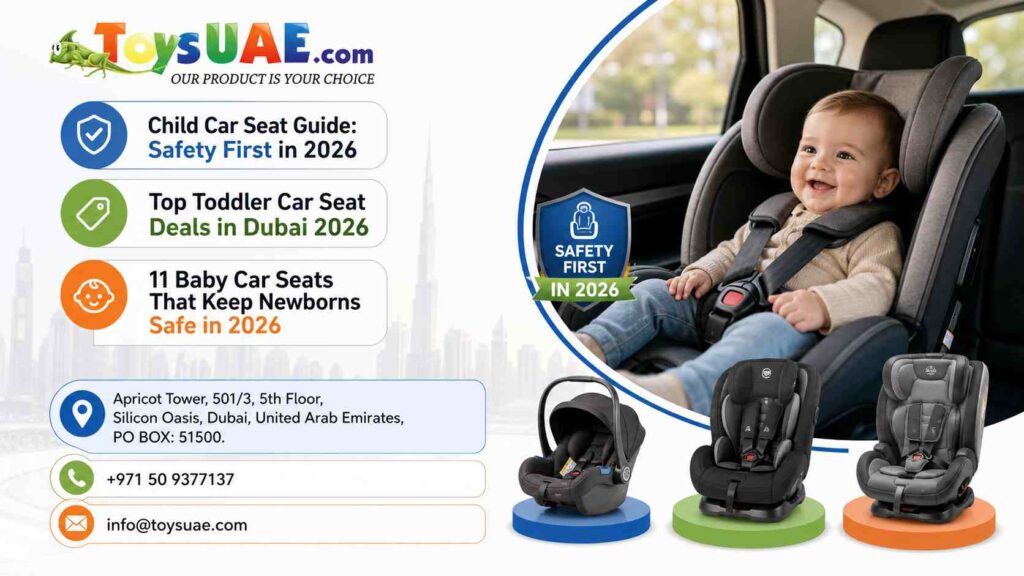
Child Car Seat Toddler Car Seat Baby Car Seat toysuae.com
Introduction: Why Your Child’s Car Seat Is Non-Negotiable
Every parent knows the feeling, you buckle your little one in, glance in the rearview mirror, and only then does the journey truly feel safe. But with so many options, regulations, and conflicting advice out there, choosing and using the right child car seat can feel overwhelming.
Whether you’re a first-time parent preparing for a newborn or a family wondering when your toddler can finally face forward, this guide covers everything you need to know in 2026. From child car seat laws in the UAE to installation tips, head support, and travel questions, we’ve got you covered with practical, parent-tested advice.
Understanding Child Car Seat Types: Which One Does Your Child Need?
Not all car seats are created equal, and the right choice depends entirely on your child’s age, weight, and height.
Newborn Baby Car Seat: Starting From Day One
The very first ride home from the hospital sets the standard. A newborn baby car seat is typically an infant-only rear-facing seat designed for babies from birth up to around 13 kg (29 lbs). These seats have a carrying handle, a deep recline angle, and soft inserts to cradle a tiny body properly.
Key things to look for in a newborn seat:
- Five-point harness with padded straps
- Adjustable recline to support an infant’s airway
- Compatibility with your stroller (travel system)
- Side-impact protection panels
At ToysUAE, you’ll find a curated baby shop range that includes infant car seats suited to UAE weather and road conditions, with fast same-day or next-day delivery across Dubai and beyond.
Best Rear-Facing Toddler Car Seat: Longer Than You Think
Here’s something many parents get wrong: rear-facing is safer for longer. Safety experts globally, including those aligned with UAE transport guidelines, recommend keeping toddlers rear-facing for as long as the seat allows, often up to age 3 or 4.
The best rear-facing toddler car seat will accommodate a child up to approximately 18 kg (40 lbs) and offer:
- Adjustable headrest and harness height
- Multiple recline positions
- Extended rear-facing weight limits
- Robust side-impact protection
When searching for an adjustable car seat, prioritise models that grow with your child, convertible seats that transition from rear-facing infant mode to forward-facing toddler mode offer exceptional long-term value.
Child Car Seat Laws: What UAE Parents Must Know in 2026
Understanding child car seat laws isn’t just about avoiding fines, it’s about understanding what the law reflects: decades of crash data and child safety research.
UAE Child Car Seat Regulations
In the United Arab Emirates, the Road and Transport Authority (RTA) enforces strict rules regarding child passenger safety:
- Children under 4 years old must be secured in an appropriate child car seat at all times.
- Children under 145 cm in height are required to use a booster seat or child restraint system.
- Placing a child in a front-facing seat when a rear-facing option is appropriate may be considered unsafe and non-compliant.
- Violating these laws carries significant fines, and more importantly, puts your child at serious risk.
Child Age in Front Seat of a Car
One of the most frequently asked questions among UAE parents is: at what child age is the front seat of a car allowed?
The general recommendation, supported by both international safety bodies and UAE guidelines, is that children should remain in the rear seat until they are at least 12 years old or 135–145 cm tall, whichever comes later. The rear seat, particularly the middle rear position, offers the most protection in a collision. Airbags in the front passenger seat can cause severe injury to small children, even when deployed in a moderate crash.
When Can a Child Face Forward in a Car Seat?
This is arguably the most common question parents ask, and the answer might surprise you.
When can a child face forward in a car seat? The minimum recommendation is typically age 2, but many child safety experts, and an increasing number of national transport bodies, now advise waiting until your child reaches the maximum rear-facing weight or height limit for their specific seat. That could mean rear-facing until age 3 or 4 for many children.
Why does it matter so much? In a frontal crash (the most common type), a rear-facing seat distributes the impact across the child’s entire back, neck, and head, the strongest parts of a young body. A forward-facing child bears that same force through the harness straps across the chest and shoulders, which puts the neck and spine at much greater risk.
Once your child does transition to forward-facing, make sure:
- The harness is snug and sits at or above the shoulders
- The chest clip is at armpit level
- No bulky clothing is worn under the harness
How to Fix a Child Seat in a Car: A Step-by-Step Overview
Even the safest car seat in the world provides little protection if it’s installed incorrectly. Studies suggest that over 70% of child car seats are installed with at least one significant error.
Using ISOFIX vs. Seatbelt Installation
Most modern child car seats sold in the UAE support ISOFIX, a system of rigid metal connectors that anchor the seat directly to the car’s chassis, bypassing the seatbelt entirely. ISOFIX dramatically reduces installation error and improves stability.
How to fix a child seat in a car using ISOFIX:
- Locate the ISOFIX anchor points in the seat crease (usually marked with an ISOFIX symbol)
- Click the seat’s ISOFIX connectors into place until you hear an audible click
- Attach the top tether strap to the vehicle’s anchor point (located on the rear shelf, floor, or headrest post depending on your car)
- Check that the seat does not move more than 2.5 cm side to side
- Verify the recline angle using the seat’s built-in indicator
If using a seatbelt installation, route the belt through the correct path (marked on the seat), lock the seatbelt, and press down firmly while tightening.
Always check your car’s owner manual to confirm ISOFIX anchor locations and weight limits.
Child Car Seat Head Support and Covers: Comfort Meets Safety
Child Car Seat Head Support
Newborns and young infants have very limited neck muscle control, making child car seat head support critical. Most infant seats come with a padded head support insert, but as children grow, aftermarket head support pillows become popular for longer journeys.
When choosing a head support:
- Ensure it does not push the child’s head forward, which can restrict breathing in infants
- Use only head supports approved or recommended by the seat manufacturer
- Remove bulky inserts once your child has adequate head control (usually around 4 months)
Child Car Seat Covers
UAE parents face a unique challenge: extreme summer heat. A car seat left in a parked car in Dubai can become dangerously hot, with metal buckles and plastic parts reaching temperatures that can burn a child’s skin.
Child car seat covers help in several ways:
- Protecting the seat from UV degradation
- Keeping the fabric cool and hygienic
- Making clean-up easier after spills and snacks
Look for breathable, UV-resistant covers designed specifically for car seats. Avoid thick padded covers that go under the harness, as these can compromise the fit and safety of the straps. Canopy-style sun shields and seat back protectors are safe, practical options for UAE families.
Travelling With a Child Car Seat: Taxis, Airports, and Airplanes
Do Taxis at Dubai Airport Have Child Car Seats?
This is a question every travelling parent in the UAE asks at some point. Do taxis at Dubai airport have child car seats?
Standard Dubai taxis, including those operating from DXB and DWC airports, are not legally required to carry child car seats, and most do not. While some ride-hailing services like Careem and Uber occasionally offer child seat options as add-ons, availability is inconsistent.
The safest and most practical solution is to bring your own travel car seat. Many convertible and lightweight seats are designed to be portable. Alternatively, arrange a private transfer in advance with a confirmed child seat provision.
Are Child Car Seats Required on Airplanes?
Are child car seats required on airplanes? In most countries, including the UAE, they are not legally required on commercial flights. Children under 2 years old often fly as lap infants. However, aviation safety experts, including the FAA and EASA, strongly recommend using an approved car seat or Child Restraint System (CRS) on flights, as turbulence can cause significant injury to unrestrained children.
If you do use a car seat on a plane:
- Ensure it carries the label “approved for use in motor vehicles and aircraft”
- Place it in a window seat to avoid blocking emergency exit access
- The seat must face forward on the aircraft
How Long Should a Child Be in a Car Seat?
How long should a child be in a car seat? The progression typically looks like this:
- Birth to ~13 kg: Rear-facing infant seat
- ~9 kg to 18 kg (approx. ages 1–4): Rear-facing convertible or toddler seat
- 18 kg to 36 kg (approx. ages 4–10): Forward-facing with harness, then high-back booster
- 36 kg+ or 135–145 cm (approx. ages 10–12+): Backless booster or adult seatbelt
The key principle: move to the next stage only when your child has outgrown the current one by height or weight, not by age alone.
Frequently Asked Questions
Q: Can I use a second-hand child car seat?
It’s strongly discouraged. Car seats have expiry dates (typically 6–10 years) and may have hidden damage from previous accidents. When safety is the priority, always buy new.
Q: How do I know if my car seat fits my car?
Use your car seat’s compatibility guide or check the manufacturer’s fit list. ISOFIX-compatible seats offer a more universal and secure fit across modern vehicles sold in the UAE.
Q: What is the fine for not having a child car seat in Dubai?
The RTA imposes fines for violations of child restraint laws. Beyond the financial penalty, the risk to your child’s life far outweighs any inconvenience of installing and using a proper seat.
Q: My child hates their car seat. What can I do?
Start with proper fit, a tight, uncomfortable harness is a common cause of resistance. Introduce the seat at home before car trips, use a small toy or mirror, and stay consistent. Most children adjust within a few weeks.
Q: At what age can a child use a seatbelt without a booster?
Generally when a child reaches 135–145 cm in height and can sit with their back flat against the seat, knees bent at the seat edge, and seatbelt lying flat across the chest, not the neck.
Conclusion: Safe Every Mile, Every Time
Choosing, installing, and maintaining the right child car seat is one of the most important decisions you’ll make as a parent. From your newborn’s first drive home to your school-age child’s daily commute, the right seat, properly fitted, can be the difference between life and death in a collision.
In 2026, UAE families have more high-quality options than ever before. Whether you need a newborn baby car seat, an adjustable convertible model, replacement covers for the Dubai heat, or a travel-ready seat for airport journeys, the right choice is out there.
Ready to find the perfect car seat for your child? Explore ToysUAE baby shop range for carefully selected child car seats, accessories, and everything else your growing family needs, delivered fast across the UAE.