Cloud bills often grow faster than the business value they create. Teams launch new environments, workloads spike without warning, and resources keep running long after anyone needs them. The result is a monthly invoice that is hard to explain and even harder to control.
Two disciplines solve different halves of this problem. Cloud Managed Services keep your infrastructure secure, reliable, and efficiently operated every day. FinOps Services bring engineering, finance, and product teams together so every dollar of cloud spend is visible, owned, and tied to business value. Used together, they turn Cloud Cost Optimization from a one-time clean-up into a continuous habit.
In this guide, you will learn why cloud costs rise, how both disciplines work, which optimization strategies are worth your time, how to implement a practical framework, and how to measure ROI honestly.
Key Takeaways
- Cloud waste is usually an ownership problem, not only a technology problem. Overprovisioned resources, idle assets, and unclear accountability are the most common causes of rising bills.
- Cloud Managed Services handle execution. They provide monitoring, right-sizing, patching, backup, security, and automation so infrastructure stays efficient and reliable.
- FinOps Services handle financial accountability. They provide cost visibility, allocation, forecasting, and shared decision-making between finance and engineering.
- The two work best together. Operations teams find and fix waste, while FinOps practices ensure savings are prioritized, verified, and linked to business outcomes.
- Right-sizing, autoscaling, scheduling, and smart commitments are the highest-value levers. Each carries trade-offs that must be tested against performance and reliability.
- Measure unit costs, not just total spend. A rising bill can be healthy if cost per customer or transaction is falling.
- Never cut costs at the expense of security or resilience. Savings that cause outages or breaches are not savings.
- Choose partners who show baselines, KPIs, and transparent reporting. Avoid anyone who promises fixed savings percentages without first reviewing your environment.
Why Cloud Costs Increase as Businesses Scale
Cloud costs rise during growth because provisioning is fast and easy, while cleaning up and governing resources takes deliberate effort. When teams move quickly, small inefficiencies multiply across hundreds of services, accounts, and environments.
Common Causes of Uncontrolled Cloud Spending
- Overprovisioned resources. Compute, storage, and database capacity is often sized for peak load “just in case” and never reduced.
- Idle and abandoned assets. Unused instances, unattached volumes, old snapshots, and forgotten test environments continue to bill.
- Poor capacity forecasting. Unpredictable demand leads teams to over-allocate rather than risk downtime.
- Hidden service costs. Data transfer, logging, monitoring, and licensing charges often grow unnoticed.
- Limited cost ownership. When no one is accountable for a workload’s spend, no one optimizes it.
The Business Impact of Poor Cloud Cost Management
Weak Cloud Cost Management affects more than the IT budget. It reduces profit margins, makes budgets unpredictable, and increases the cost of launching new products and features. It can also create infrastructure bottlenecks through inefficient resource allocation, and it makes it difficult to prove the financial value of cloud investments to leadership. Strong Cloud Infrastructure Optimization addresses these issues at the root rather than treating symptoms in the monthly bill.
What Are Cloud Managed Services and How Do They Work?
Cloud Managed Services are ongoing, outsourced or co-managed operations that monitor, secure, optimize, and support your cloud environment. In practical terms, a provider takes responsibility for the day-to-day work of keeping infrastructure healthy, so your internal team can focus on product and strategy.
The right model depends on your size and skills. Many organizations work with experienced managed cloud services providers to gain 24/7 coverage and specialized expertise without building a large in-house operations team.
Core Capabilities of Cloud Managed Services
- Infrastructure monitoring and performance management to detect issues before users do.
- Resource provisioning, scaling, and configuration based on real demand.
- Security monitoring, patching, backup, and disaster recovery to protect data and ensure continuity.
- Incident response and operational automation to reduce downtime and manual effort.
- Capacity planning and regular infrastructure reviews to keep environments aligned with business needs.
How Managed Cloud Operations Support Business Growth
Proactive maintenance prevents small issues from becoming expensive outages. Reliable operations protect customer experience, and flexible capacity lets you add resources when demand rises and release them when it falls. Together, these practices reduce avoidable operational overhead, which is a key reason Cloud Managed Services are linked to sustainable scaling.
What Are FinOps Services and Why Do They Matter?
FinOps Services help organizations apply FinOps, a collaborative operating practice that connects engineering, finance, product, and business teams around technology spending and the value it delivers. Rather than treating cloud cost as a finance problem to be reviewed after the invoice arrives, FinOps makes it a shared, real-time responsibility.
The FinOps Foundation’s 2026 framework reflects this direction. It emphasizes alignment with executive strategy, demonstrating technology value, automation, and broader spending visibility beyond basic public-cloud billing. AWS guidance similarly recommends establishing clear ownership for cost optimization. Teams that need structured support can explore FinOps Consulting Services to build these practices.
Key Components of an Effective FinOps Strategy
- Spend visibility and cost allocation by team, project, and application.
- Budgeting, forecasting, and anomaly detection to avoid surprises.
- Cost accountability so owners understand and manage their own usage.
- Optimization prioritization based on business impact, not just savings size.
- Continuous measurement of efficiency and financial outcomes.
FinOps vs. Traditional Cloud Cost Management
| Area | Traditional Cost Management | FinOps Approach |
|---|---|---|
| Timing | Retrospective bill reviews | Continuous, near real-time visibility |
| Ownership | Centralized in finance or IT | Shared across engineering, finance, and product |
| Focus | Reducing the invoice | Maximizing business value per dollar |
| Optimization | Occasional clean-ups | Ongoing, prioritized, and automated |
| Metrics | Total spend | Unit costs and outcome-based KPIs |
How Cloud Managed Services and FinOps Work Together to Reduce Costs
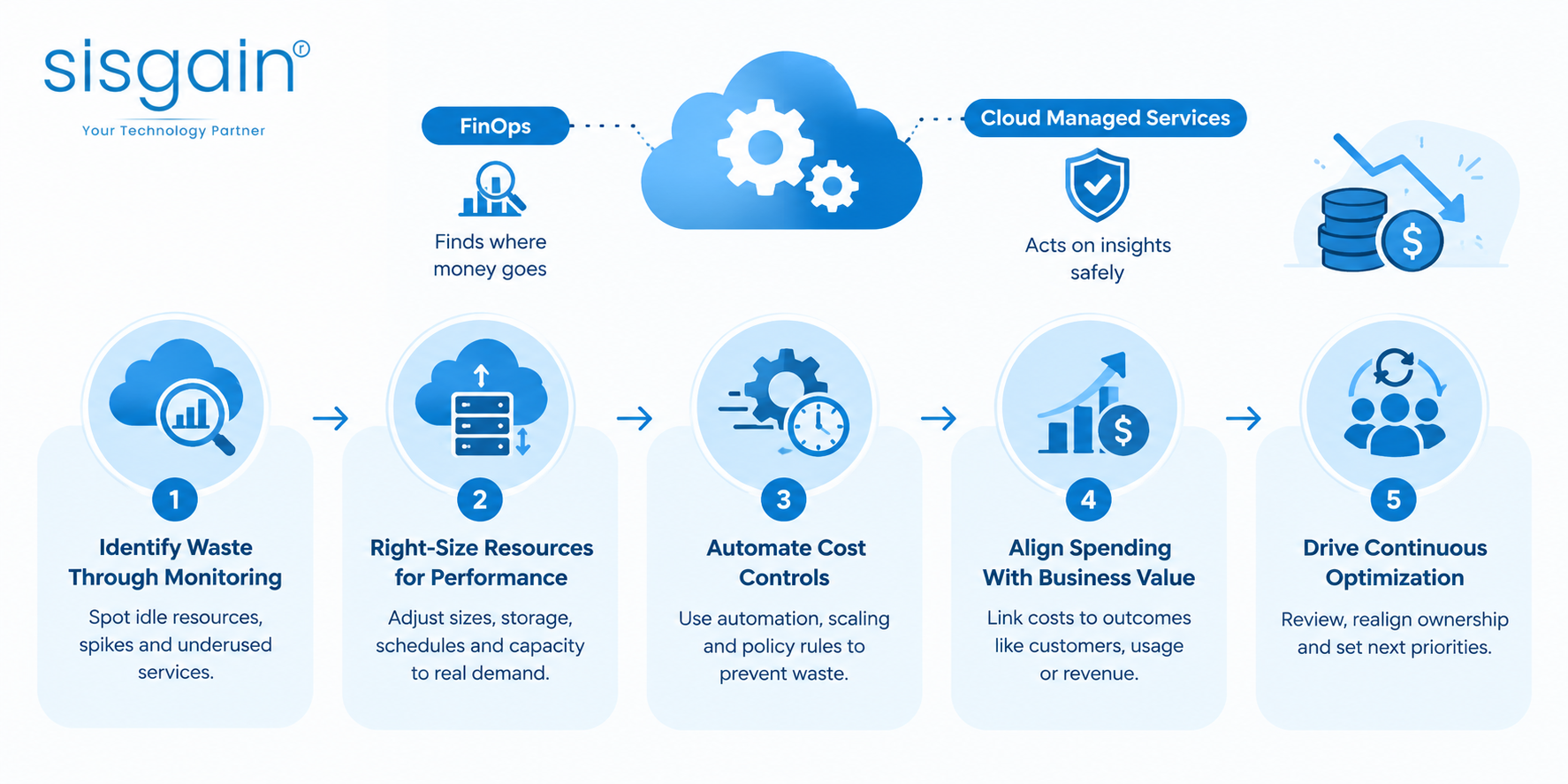
Operational execution and financial decision-making are complementary. FinOps tells you where money is being spent and why, while Cloud Managed Services act on that insight safely. This partnership is the clearest answer to How FinOps Reduces Cloud Costs in practice: it replaces guesswork with data and ownership. For organizations that want both under one roof, it infrastructure managed services can combine day-to-day operations with cost governance.
Note: The practices below reflect general industry best practice. They are not tied to the results of any single provider.
Identify Waste Through Continuous Cloud Monitoring
Usage monitoring, utilization reports, and cost anomaly alerts reveal idle resources, sudden spend spikes, and underused services. Continuous visibility means waste is caught in days rather than discovered months later on an invoice.
Right-Size Cloud Resources Without Sacrificing Performance
Using actual utilization data, teams adjust compute sizes, move data to suitable storage tiers, schedule workloads, and plan capacity around real demand. The goal is to match resources to need while keeping a safe performance margin.
Automate Cost Controls and Resource Management
Automation makes savings repeatable. Common controls include shutting down non-production environments after hours, scaling automatically with demand, enforcing policy-based limits, and requiring approval workflows for expensive resources.
Align Cloud Spending With Business Outcomes
Connect infrastructure costs to metrics such as transactions processed, active customers, or features used. This shows whether spend is growing in step with value, which is the foundation of Cloud Managed Services for Business Growth.
Establish Continuous Optimization and Accountability
Hold recurring reviews between finance, engineering, and cloud operations. Each review should confirm progress, reassign ownership where needed, and decide the next optimization priorities.
Cloud Cost Optimization Strategies for Modern Businesses
Effective Cloud Cost Optimization combines several techniques, each suited to different workloads. Evaluate them against your own environment, and test changes before applying them broadly. If your architecture itself drives cost, specialist cloud architecture services can review design choices that tuning alone cannot fix.
Right-Size Compute, Storage, and Database Resources
Review CPU, memory, and storage utilization over a meaningful period, then reduce or consolidate resources that are consistently underused. Apply storage lifecycle policies to move older data to cheaper tiers, and review database capacity regularly, since databases are often overprovisioned for safety.
Use Autoscaling and Workload Scheduling
Autoscaling lets capacity follow demand, so you pay for peak resources only during peak periods. Scheduling reduces non-production capacity outside working hours where appropriate. The trade-off is that scaling policies need careful tuning, because aggressive settings can cause latency during sudden traffic surges.
Optimize Cloud Pricing and Resource Commitments
On-demand pricing offers flexibility, while reserved capacity and savings plans offer lower rates in exchange for commitment. Commit only for stable, predictable baseline usage. Overcommitting is a real risk: if demand falls or architecture changes, you may pay for capacity you no longer need.
Improve Cloud Architecture for Cost Efficiency
Workload placement, architecture reviews, and resilient design all influence cost. Sometimes the cheapest option increases latency or reduces reliability, so decisions should balance cost, performance, and availability rather than optimizing for price alone.
Apply FinOps to Containers, Serverless, and AI Workloads
Modern workloads introduce new cost patterns:
- Containers: In Kubernetes, poorly set resource requests and limits waste capacity. Teams building containerized platforms often benefit from Kubernetes Application Development expertise that bakes efficiency into the design.
- Serverless: Costs depend on execution count, duration, and memory, so inefficient code becomes directly expensive. Well-planned serverless application development services help control these variables from the start.
- Automation: Pipelines that enforce tagging, scaling rules, and environment shutdowns are easier to maintain with DevOps Automation Services.
- AI workloads: Inference and GPU usage can become costly quickly. Monitoring utilization and right-sizing accelerators is essential, and custom ai solutions development should consider cost per prediction from the outset.
- Observability: Logging and monitoring data volumes can quietly become a major expense, so review retention and sampling settings.
How Cloud Managed Services Support Business Growth Without Overspending
The goal of cost control is not austerity. It is using infrastructure efficiently so you can grow without waste. Well-run Cloud Managed Services support this by keeping capacity matched to demand and reducing operational friction.
Scale Applications Based on Real-Time Demand
Elastic capacity, workload distribution, and proactive capacity planning allow applications to handle traffic spikes without permanent overprovisioning.
Accelerate Product Development and Deployment
Standardized infrastructure, automated deployment, and fewer operational bottlenecks help teams release features faster. Organizations extending their capacity often combine this with software engineering services or saas development outsourcing to move quickly without overloading internal teams.
Improve Reliability, Security, and Operational Efficiency
Resilience, monitoring, and disaster recovery must be preserved during optimization. Reliable service quality protects revenue, and secure operations protect trust.
Reinvest Cost Savings Into Innovation
Once savings are verified, they can fund product improvements, engineering hiring, and new digital capabilities. This is where cost efficiency becomes a growth strategy.
A Step-by-Step Framework for Implementing Cloud Managed Services and FinOps
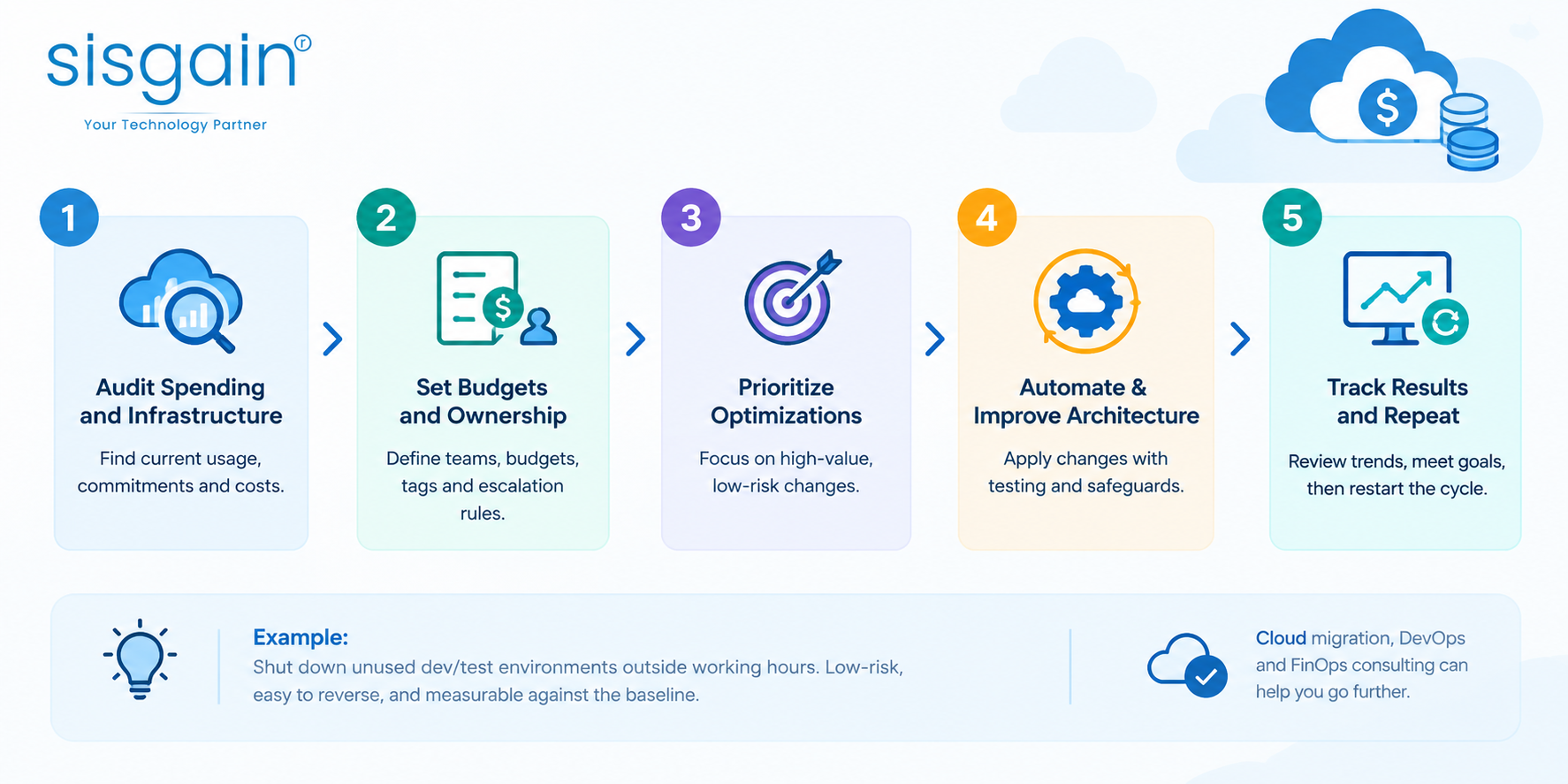
A structured roadmap prevents random, risky cost-cutting. Follow these five steps in order, and repeat the cycle regularly.
Step 1: Audit Existing Cloud Spending and Infrastructure
Establish a baseline covering services in use, resource utilization, current commitments, and operational costs. Without a baseline, savings cannot be proven.
Step 2: Set Budgets, Ownership, and Cost Allocation Rules
Define responsible teams, budgets, tagging standards, and escalation procedures. Consistent tags are what make accurate cost allocation possible.
Step 3: Prioritize High-Impact Optimization Opportunities
Rank opportunities by potential savings, implementation effort, business risk, and expected performance impact. Start with low-risk, high-value changes. If migration is part of your plan, a cloud migration service can help you design cost-aware environments from day one.
Step 4: Implement Automation and Architecture Improvements
Apply approved changes with testing, rollback plans, and suitable safeguards. Use DevOps Automation Services or in-house pipelines to make successful changes permanent.
Step 5: Track Results and Repeat the Optimization Cycle
Review spending trends, unit costs, service reliability, and progress against business goals. Then return to Step 1 with fresh data. For guided support, FinOps Consulting Services can help embed this loop into daily operations.
Practical example (illustrative): A team discovers its development and test environments run 24 hours a day but are used only during working hours. After agreeing on ownership, it schedules automatic shutdowns overnight and on weekends, then confirms that deployments and tests still work. The change is low-risk, easy to reverse, and directly measurable against the baseline. This is a hypothetical example, not a real client result.
How to Measure Cloud Cost Savings, Efficiency, and ROI
You can only call an optimization program successful if you measure it against a baseline and account for growth. Focus on both cost and service quality.
Essential Cloud Cost Optimization KPIs
- Total cloud spend and variance against budget.
- Cost per transaction, customer, deployment, or workload.
- Resource utilization and idle-resource spend.
- Unit-cost trends as usage and revenue change.
- Availability, latency, incident rates, and recovery performance.
- Verified savings compared with implementation and service costs.
How to Calculate Cloud Optimization ROI
Use a transparent formula:
ROI (%) = (Net Benefits ÷ Total Investment) × 100
Net benefits equal recurring verified savings, plus attributable incremental revenue where relevant, minus implementation and operating costs.
Hypothetical example for illustration only:
| Item | Amount (USD, per year) |
|---|---|
| Verified recurring savings | $150,000 |
| Total investment (tools, services, effort) | $60,000 |
| Net benefits ($150,000 − $60,000) | $90,000 |
| ROI ($90,000 ÷ $60,000 × 100) | 150% |
These figures are assumptions. Your results depend on your environment, baseline, and growth. Always compare against comparable usage levels so that growth is not mistaken for waste, or savings for luck.
Read More – Maximizing ROI with Managed Azure Services
Common Mistakes to Avoid When Reducing Cloud Costs
Cost-cutting can backfire when done carelessly. Avoid these mistakes in Cloud Infrastructure Optimization and Cloud Cost Management:
- Cutting resources without assessing workload requirements.
- Buying long-term commitments before understanding demand.
- Optimizing infrastructure without assigning cost ownership.
- Ignoring data transfer, observability, licensing, and support costs.
- Measuring savings without accounting for usage growth.
- Sacrificing security, resilience, or performance to lower the bill.
How to Choose the Right Cloud Managed Services and FinOps Partner
A good partner improves visibility and outcomes without creating dependency or hidden costs. Use the following checklist when comparing managed cloud services providers and consultants.
Evaluate Technical Expertise and Cloud Cost Visibility
Look for relevant platform experience, strong cost allocation, monitoring, and reporting capabilities.
Check Security, Governance, and Scalability Practices
Assess access controls, incident management, backup policies, compliance support, and change management processes.
Demand Transparent Reporting and Measurable Outcomes
Expect clear baselines, agreed KPIs, documented recommendations, and regular reviews.
Understand the Scope of Managed Services and FinOps Consulting
Clarify responsibilities, service levels, reporting frequency, pricing, and who owns optimization decisions. Compare scope across FinOps Consulting Services and it infrastructure managed services so there are no gaps or overlaps.

Final Thoughts: Scaling Business Growth With Smarter Cloud Spending
Sustainable growth does not come from spending less at any cost. It comes from spending wisely. Three ideas matter most:
- Cloud Cost Optimization requires continuous visibility, right-sizing, and operational discipline.
- Cloud Managed Services and FinOps Services work best when infrastructure decisions are aligned with financial accountability and business outcomes.
- Sustainable growth depends on balancing cost efficiency with performance, security, reliability, and innovation.
If your cloud bill is rising faster than your results, now is a good time to review your environment. A structured assessment can help you review your cloud infrastructure, identify optimization opportunities, and explore managed cloud and FinOps solutions that fit your goals. Get in touch to start your cloud cost review.
Frequently Asked Questions
How do cloud managed services reduce cloud costs?
They reduce costs through continuous monitoring, right-sizing, automation, proactive maintenance, and efficient capacity management. By catching idle resources and preventing outages early, they cut both direct waste and the hidden cost of downtime.
How does FinOps reduce cloud costs for growing businesses?
FinOps improves cost visibility, forecasting, and shared ownership. Teams see what they spend, understand why, and optimize usage continuously. Regular financial reviews keep growth and spending aligned.
What is the difference between FinOps services and cloud managed services?
FinOps focuses on financial accountability and technology value, while managed services focus on operational delivery and infrastructure management. Their scopes can overlap, and they deliver the best results when combined.
Which cloud cost optimization strategies deliver the most value?
The most valuable strategies are usually identifying waste, right-sizing, using appropriate pricing commitments, scheduling workloads, optimizing architecture, and monitoring workload-specific costs. The best mix depends on your environment.
How can businesses measure the ROI of cloud cost optimization?
Start with a baseline, track comparable unit costs, and count only verified savings. Subtract implementation and service costs, and set performance guardrails so savings do not reduce reliability.
When should a business hire a cloud managed services provider?
Consider one when in-house capacity is limited, operations are growing more complex, reliability needs are rising, governance gaps exist, or you need specialized expertise that is difficult to hire.