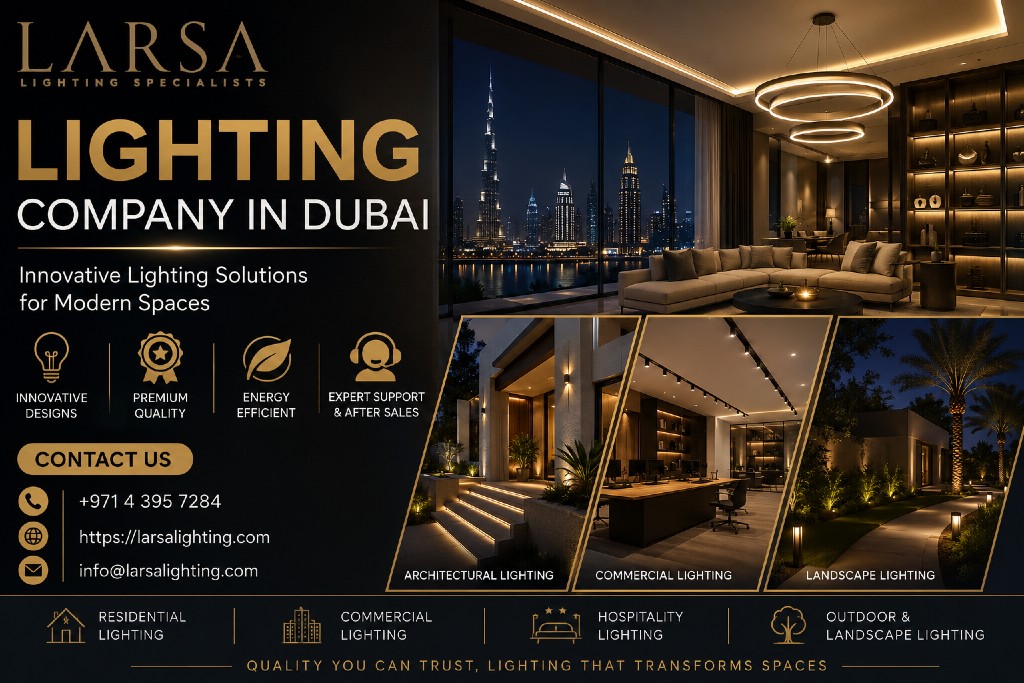
Lighting has a direct influence on how a space looks, feels, and functions. Whether you are planning a residential interior, office, retail store, hotel, restaurant, or outdoor area, the right lighting can improve visibility while supporting the overall design. With many options available, choosing the right Lighting Company in Dubai requires more than comparing products and prices. It involves understanding design requirements, technical specifications, energy efficiency, installation needs, and long-term performance.
Understand Your Lighting Requirements
Before selecting a lighting provider, define what your space needs. Every project has different requirements based on its size, purpose, architecture, and interior style.
For a home, you may need ambient lighting for general illumination, task lighting for kitchens and work areas, and accent lighting to highlight artwork or architectural details. Commercial spaces may require a combination of functional, decorative, and feature lighting to create a comfortable environment for employees and visitors.
A clear project brief helps you communicate your expectations and allows potential lighting companies to recommend suitable solutions rather than simply offering a catalogue of fixtures.
Look at Design and Technical Expertise
A reliable lighting company should understand both aesthetics and technical performance. Lighting is not only about selecting attractive fixtures; it also involves factors such as beam angles, colour temperature, lumen output, glare control, mounting height, and light distribution.
For example, a warm colour temperature can create a relaxed atmosphere in hospitality and residential spaces, while cooler or neutral lighting may be appropriate for offices and task-oriented environments. Similarly, narrow-beam spotlights can emphasize decorative elements, whereas wider beams may be better suited for general illumination.
When comparing a Lighting Company in Dubai, consider whether its team can translate your architectural and interior requirements into a practical lighting plan.
Check the Quality of Lighting Products
The quality of the fixture can significantly affect performance and maintenance requirements. Look beyond appearance and consider specifications such as LED efficiency, colour rendering, lifespan, driver quality, ingress protection ratings, and warranty coverage.
Colour Rendering Index (CRI), for instance, indicates how accurately a light source reveals colours compared with a reference source. High-CRI lighting can be particularly useful in retail, hospitality, galleries, residential interiors, and other spaces where accurate colour perception matters.
For outdoor applications, fixtures may also need suitable protection against dust, moisture, and changing environmental conditions. A good lighting provider should be able to explain these specifications in straightforward terms.
Consider Energy Efficiency
Energy consumption is an important consideration for both homes and commercial properties. LED technology has become a common choice because modern LED fixtures can provide substantial illumination with comparatively low energy consumption.
However, efficiency does not depend solely on choosing LED products. Lighting layouts, controls, fixture positioning, and operating schedules also influence energy use. Occupancy sensors, daylight controls, dimming systems, and automated lighting management can help reduce unnecessary consumption in suitable applications.
When evaluating a Lighting Company in Dubai, ask how its recommendations address both immediate lighting requirements and long-term operating efficiency.
Evaluate Customisation and Project Flexibility
Not every space can be effectively illuminated using standard solutions. Some projects require custom lengths, specialised mounting systems, decorative fixtures, recessed profiles, track lighting, or carefully controlled accent lighting.
This is particularly relevant for spaces with distinctive architectural features. A lighting provider should be able to assess the project and determine where standard products are suitable and where customised solutions may be necessary.
Flexibility is also important when project requirements change. Renovations, material changes, ceiling modifications, and evolving interior concepts can affect lighting specifications. Clear communication between the designer, contractor, electrical team, and lighting supplier can help minimise complications during implementation.
Review Installation and After-Sales Support
Choosing lighting products is only one part of a successful project. Installation, aiming, commissioning, and maintenance can also affect the final result.
Poor positioning can create unwanted shadows, glare, uneven illumination, or reduced visual impact. For this reason, it is useful to understand whether the lighting provider offers technical support during installation and commissioning.
After-sales support is another factor worth considering. Ask about warranty conditions, replacement procedures, spare components, driver availability, and maintenance assistance. These details can become important after a project has been completed.
Compare Experience Across Different Spaces
Experience can provide useful insight into how a company approaches different lighting challenges. Rather than focusing only on the number of completed projects, review the types of spaces involved.
Residential, hospitality, commercial, retail, landscape, and architectural projects each have distinct lighting considerations. A provider familiar with different applications may be better positioned to adapt its recommendations to the specific characteristics of your space.
For those researching a Lighting Company in Dubai, reviewing project portfolios can also help you understand the range of lighting styles, technologies, and applications the company has worked with.
Consider Compliance and Safety
Lighting installations must also meet relevant electrical, building, and safety requirements. Fixtures, drivers, wiring, emergency lighting, outdoor products, and control systems may have specific technical requirements depending on the application.
A professional lighting provider should be familiar with applicable standards and coordinate appropriately with consultants, contractors, and project teams. This is especially important for larger commercial and hospitality developments where several technical disciplines must work together.
Why Larsa Lighting Can Be Part of Your Research
When comparing lighting providers, Larsa Lighting can be included among the companies to research for lighting requirements in Dubai. Reviewing its product range, project experience, design approach, and technical capabilities can help you determine whether its services align with your particular space and project objectives.
The most suitable choice ultimately depends on the project’s requirements rather than a single factor such as price or product selection. A thoughtful evaluation of design expertise, product quality, efficiency, technical support, installation, and long-term service can lead to a more effective lighting outcome.
Conclusion
Finding the right Lighting Company in Dubai starts with understanding your space and establishing clear priorities. From fixture quality and lighting design to energy efficiency, customisation, installation, and after-sales support, each factor can influence the final result.
Taking time to compare providers and ask practical questions can make the selection process more straightforward. Whether you are developing a new property or upgrading an existing interior, a well-planned lighting strategy can provide better functionality, visual comfort, and lasting value.