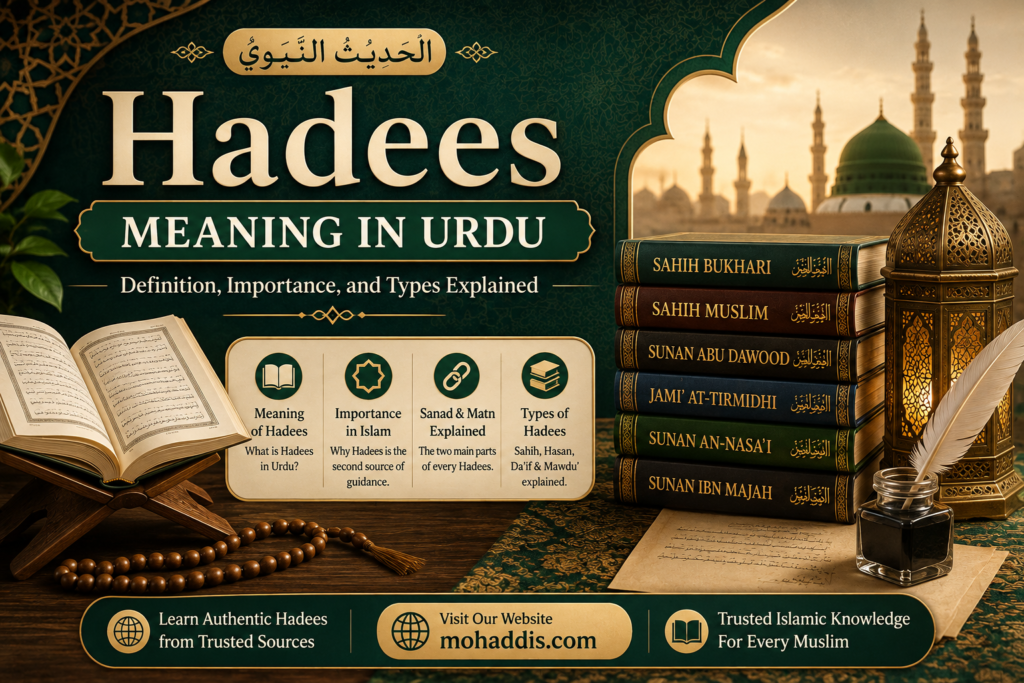
Many people search for the word “Hadees” but are not fully sure what it means or why it matters so much in Islam. This word appears almost every day in religious talks, Friday sermons, and Islamic books, yet its full meaning is often not clear.
In this article, you will learn the exact meaning of Hadees in Urdu, why it holds such a special place in Islam, and the different types of Hadees that scholars use to guide Muslims in their daily lives.
What Does Hadees Mean?
Hadees (حدیث) means a saying, action, or approval of Prophet Muhammad صلی اللہ علیہ وسلم. In Urdu, it is also written as “Hadith,” and both words refer to the same thing.
The word Hadees literally means “a new thing” or “a report” in Arabic. In Islamic terms, it refers to a report about what the Prophet صلی اللہ علیہ وسلم said, did, or silently approved of during his lifetime.
Every Hadees carries a message from the life of the Prophet صلی اللہ علیہ وسلم. It could be a piece of advice, a description of how he prayed, or a story that teaches a moral lesson.
Hadees Meaning in Urdu (Simple Explanation)
In Urdu, Hadees (حدیث) means “Nabi Kareem صلی اللہ علیہ وسلم کا قول، فعل یا تقریر,” which translates to “the saying, action, or silent approval of the Holy Prophet صلی اللہ علیہ وسلم.”
Urdu-speaking scholars use this word constantly in mosques, madrasas, and Islamic literature. It is one of the most commonly used religious terms across Pakistan, India, and other Urdu-speaking regions.
Some people confuse Hadees with Sunnah, but there is a small difference. Sunnah refers to the practical way of life and habits of the Prophet صلی اللہ علیہ وسلم, while Hadees is the recorded report that describes that way of life. In simple words, Sunnah is the practice, and Hadees is the written record of that practice.
Why Hadees Is Important in Islam
Hadees is the second most important source of guidance in Islam after the Holy Quran. Muslims rely on it to understand how to practice their faith correctly in daily life.
Here is why Hadees holds such high importance:
- It explains the Quran. Many Quranic verses give general instructions, and Hadees explains how to actually follow them. For example, the Quran commands Muslims to pray, but the details of how to pray came through the Hadees.
- It shows the practical example of the Prophet صلی اللہ علیہ وسلم. Hadees describes how he ate, spoke, treated others, and handled difficult situations, giving Muslims a real-life model to follow.
- It covers topics not directly mentioned in the Quran. Some daily matters, like specific manners or small acts of worship, are explained only through Hadees.
- It preserves Islamic law (Fiqh). Islamic scholars use Hadees along with the Quran to form religious rulings on modern and traditional issues.
Without Hadees, many parts of Islamic worship and daily conduct would remain unclear. This is why scholars have spent centuries collecting, checking, and preserving these narrations with great care.
The Two Main Parts of a Hadees
Every Hadees is made up of two important parts. Understanding these parts helps explain why some Hadees are considered stronger than others.
Sanad (Chain of Narrators)
The Sanad is the chain of people who passed the Hadees from one generation to the next, starting from the person who heard it directly from the Prophet صلی اللہ علیہ وسلم down to the scholar who recorded it.
Scholars examine each narrator in the Sanad carefully. They check the narrator’s honesty, memory, and reliability before accepting the Hadees as trustworthy.
Matn (The Actual Text)
The Matn is the actual wording or content of the Hadees, meaning the message itself. This is the part that contains the real teaching, instruction, or story.
Scholars also study the Matn to check that it does not contradict the Quran, other authentic Hadees, or established facts.
Types of Hadees
Not every Hadees carries the same level of authenticity. Scholars have divided Hadees into different categories based on how reliable their chain of narration is.
1. Sahih (Authentic)
A Sahih Hadees has a complete and trustworthy chain of narrators, with no weaknesses or breaks. This is the strongest and most reliable type of Hadees.
Collections like Sahih Bukhari and Sahih Muslim are especially known for containing Sahih narrations, which is why they are considered among the most trusted Hadees books in Islam.
2. Hasan (Good)
A Hasan Hadees is reliable, but its chain of narrators is slightly weaker compared to a Sahih Hadees. It is still accepted and used by scholars for guidance.
3. Da’if (Weak)
A Da’if Hadees has some weakness in its chain, such as a narrator with a poor memory or an unclear connection between narrators. Scholars are cautious about using weak Hadees for religious rulings.
4. Mawdu’ (Fabricated)
A Mawdu’ Hadees is a false statement wrongly attributed to the Prophet صلی اللہ علیہ وسلم. These are rejected by scholars and must never be used as a source of guidance.
Famous Books of Hadees
Over the centuries, many scholars devoted their lives to collecting and verifying Hadees. A few collections are especially well known and trusted worldwide:
- Sahih Bukhari – Compiled by Imam Bukhari رحمہ اللہ, widely regarded as one of the most authentic Hadees collections.
- Sahih Muslim – Compiled by Imam Muslim رحمہ اللہ, also known for its high level of authenticity.
- Sunan Abu Dawood – Focuses heavily on Hadees related to Islamic law and daily practices.
- Jami’ at-Tirmidhi – Known for including the scholarly opinions of early Islamic jurists alongside the narrations.
- Sunan an-Nasa’i and Sunan Ibn Majah – Together with the above, these form the well-known collection called the “Six Books” (Kutub al-Sittah).
These books took years of careful research, travel, and verification by their compilers, which is why they remain trusted references even today.
How Muslims Use Hadees in Daily Life
Muslims turn to Hadees for guidance on nearly every part of daily life, from worship to personal conduct.
- Prayer (Salah): The details of how to perform Salah correctly come mainly from Hadees.
- Manners and ethics: Hadees teaches honesty, kindness, patience, and respect for others.
- Family life: Many Hadees describe how to treat parents, spouses, and children with fairness and love.
- Business dealings: Several Hadees address honesty in trade and avoiding cheating in transactions.
- Personal hygiene and habits: Simple daily habits, such as cleanliness, also have guidance rooted in Hadees.
This wide coverage is what makes Hadees such a central part of everyday Muslim life, not just something limited to religious scholars.
Conclusion
Hadees means the sayings, actions, and approvals of Prophet Muhammad صلی اللہ علیہ وسلم, and it stands as the second most important source of guidance in Islam after the Holy Quran. It explains the Quran, shows the Prophet’s صلی اللہ علیہ وسلم practical example, and covers everyday matters of faith and conduct.
Understanding the different types of Hadees, from Sahih to Da’if, helps Muslims know which narrations to rely on for guidance. By learning about Hadees and its true meaning in Urdu, readers can better appreciate why this knowledge has been preserved so carefully across generations.