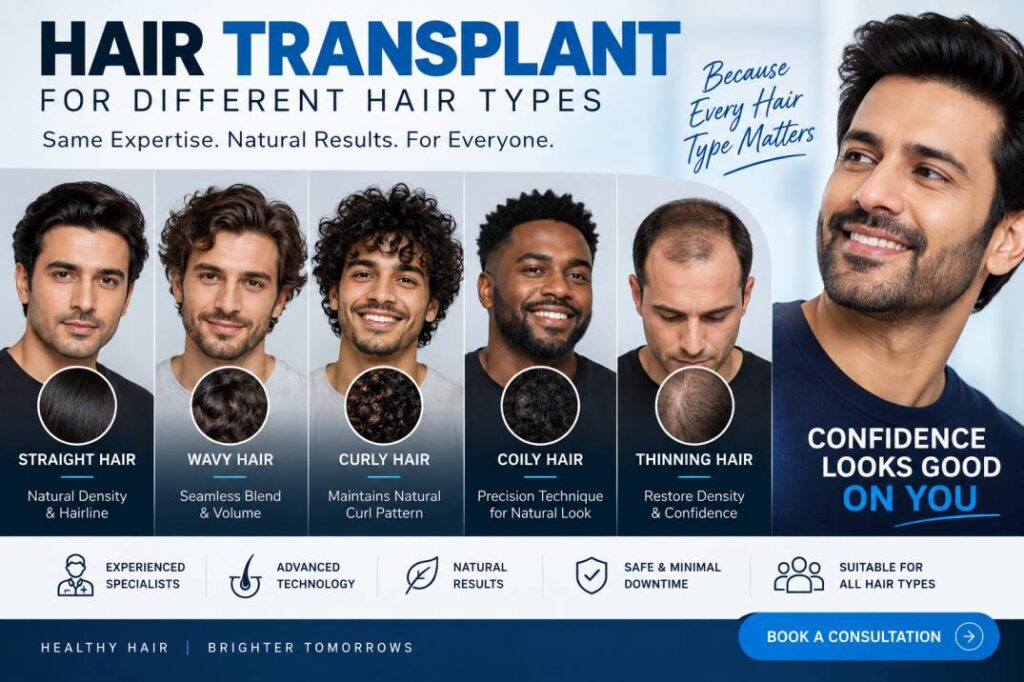
Hair loss can affect people with every hair texture, but straight, wavy, and curly hair can differ in appearance, density, and follicle characteristics. These differences may influence how a hair transplant is planned and how transplanted hair blends with existing hair.
Understanding Hair Transplant for Different Hair Types can help people explore their options and develop realistic expectations about hair restoration.
What Is a Hair Transplant?
A hair transplant is a surgical procedure that relocates healthy hair follicles from a donor area, commonly the back or sides of the scalp, to areas affected by hair loss. The transplanted follicles can then grow hair in their new location.
Common techniques include Follicular Unit Extraction (FUE) and Follicular Unit Transplantation (FUT). The appropriate method depends on factors such as hair loss pattern, donor supply, scalp characteristics, and individual treatment goals.
Why Hair Type Matters
Hair texture can affect the visual appearance of scalp coverage. Curly hair may create more volume because the strands naturally bend away from the scalp, while straight hair tends to lie closer to the scalp and can make thinning more noticeable.
The characteristics of the hair follicles may also influence extraction and placement. For this reason, treatment should be individually planned rather than based only on whether someone has straight, wavy, or curly hair.
Hair Transplant for Straight Hair
Straight hair typically lies close to the scalp. As a result, areas with reduced density may be more visible, particularly under strong lighting or when the hair is wet.
During transplantation, careful attention may be given to the direction, angle, and distribution of grafts. Natural-looking hairline design is especially important because transplanted hair should blend with the surrounding straight hair.
Hair Transplant for Wavy Hair
Wavy hair naturally creates movement and volume, which may help provide a fuller visual appearance. When planning a transplant, the existing wave pattern can be considered to help transplanted hair integrate naturally with the surrounding hair.
Graft placement, direction, and spacing can be customized according to the patient’s existing hair characteristics and the areas requiring coverage.
Hair Transplant for Curly Hair
Curly hair can provide substantial visual coverage because the strands naturally create volume and separation from the scalp. However, some curly hair follicles can have a curved structure beneath the skin.
This can make follicular extraction technically more demanding. Careful planning and appropriate surgical experience are therefore important when considering Hair Transplant for Different Hair Types, particularly for strongly curly hair.
Read also: Common Projects Sneakers: Fashionable Footwear for Daily Life
Comparing Hair Types for Hair Transplantation
Straight Hair
Straight hair can make scalp visibility more noticeable when density decreases. Natural graft direction and appropriate distribution are important for achieving a blended appearance.
Wavy Hair
Wavy hair provides natural texture and movement. Its structure may help create visual fullness, although individual results depend on donor density and other factors.
Curly Hair
Curly hair can create excellent visual coverage, but follicle curvature may require additional technical consideration during extraction.
FUE and FUT for Different Hair Types
FUE involves extracting individual follicular units from the donor area before placing them into recipient sites. FUT involves removing a strip of donor scalp and separating it into individual follicular units.
Both techniques can be used for different hair textures in appropriately selected patients. The choice should be based on the patient’s individual characteristics rather than hair texture alone.
Hairline Design and Graft Placement
A natural-looking hairline should reflect the person’s facial structure, age, existing hair pattern, and long-term hair loss considerations.
The angle and direction of transplanted follicles are also important. Proper placement can help transplanted hair follow the natural pattern of surrounding hair.
Factors That Affect Hair Transplant Results
Several factors can influence the outcome of a hair transplant, including:
- Hair texture and thickness
- Donor hair density
- Number of available grafts
- Hair loss pattern
- Scalp condition
- Follicle characteristics
- Hairline design
- Surgical technique
- Post-procedure care
- Future progression of hair loss
Therefore, hair texture is only one part of the overall treatment assessment.
Recovery After Hair Transplantation
Temporary redness, swelling, tenderness, and small crusts may occur following transplantation. Transplanted hair commonly sheds during an early stage before new growth develops.
Hair growth is gradual, and the final appearance takes time to develop. Following the post-procedure instructions provided by the treating medical team can support the recovery process.
Who May Be a Candidate?
Hair transplantation may be considered for people with certain types of permanent hair loss who have sufficient donor hair and realistic expectations.
A professional assessment is important before treatment. The specialist can evaluate the donor area, hair loss pattern, scalp condition, and overall suitability for transplantation.
How to Choose the Right Hair Transplant Option
There is no single transplant method that is best for everyone. The appropriate option depends on the individual’s hair characteristics, donor availability, degree of hair loss, treatment goals, and medical assessment.
People with straight, wavy, or curly hair should discuss their specific characteristics with a qualified hair restoration professional before choosing a technique.
Conclusion
Hair Transplant for Different Hair Types requires personalized planning. Straight, wavy, and curly hair can each present different considerations related to visual density, follicle characteristics, graft placement, and hairline design.
FUE and FUT may both be suitable for appropriately selected patients, but the best approach depends on individual circumstances. A qualified professional can assess the hair and scalp and recommend an appropriate treatment strategy based on the patient’s needs and goals.