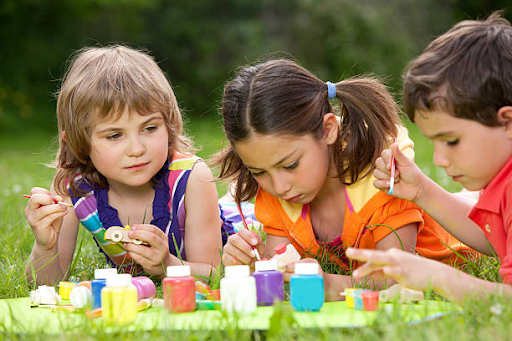
Spending time in a children’s art camp is not just about paint, glue, or making something “cute” for the fridge. It’s a bit messier than that, in a good way. Kids walk in thinking they’re just drawing or colouring, but what actually happens is deeper. They start figuring things out on their own, even when nobody is giving step-by-step instructions. And honestly, that’s where real problem-solving sneaks in. You’ll see a kid stare at a blank page, hesitate, then try something, mess it up, try again. That whole cycle, that’s the real lesson. Not perfection, not art trophies, just thinking through stuff when there’s no clear answer sitting in front of them.
How Art Becomes a Thinking Space, Not Just Craft Time
In a real children’s art camp, the environment is kinda loose on purpose. There’s structure, sure, but not the kind that tells kids exactly what to do every second. That gap matters. When a child is asked to “make a forest,” nobody gives them a manual for it. So they pause, look around, maybe copy something they saw yesterday, or just guess. That guessing is where thinking starts. They test ideas without even realizing it. Some work, some don’t. And nobody’s really stopping them from saying “wrong move.” That freedom builds a quiet kind of confidence, like they’re allowed to figure life out without being spoon-fed answers all the time.
When Things Don’t Work, Kids Start Adjusting Naturally
There’s always a moment where something goes off. Paint turns muddy, paper tears, glue doesn’t stick, whatever. In those moments, kids don’t usually freeze for long. They shift. They adapt. That’s the core of problem-solving right there. In a children’s art camp, failure isn’t treated like failure. It’s just… part of the process. A kid might redraw a shape three times without anyone telling them to. Not because they were instructed, but because they want it to look “right” in their head. And that internal correction system it’s powerful. You don’t get that from worksheets or rigid classroom drills.
Decision-Making Hidden Inside Creative Choices
People don’t always notice this, but every small art choice is a decision. Color here or there, big brush or small, sharp edges or soft lines. In a children’s art camp, kids are constantly choosing without realizing they’re building decision-making skills. And yeah, sometimes they freeze. Too many options can do that. But eventually they pick something. Even if it’s random at first. Over time, those random picks turn into intentional choices. It’s not sudden, it’s slow and a bit uneven. But that’s how real thinking develops, not in clean steps but in messy, repeated tries that slowly make sense.
Working With Others Creates Unexpected Solutions
Put a bunch of kids in a room with shared supplies, and things get interesting fast. Someone grabs the wrong brush, someone spills water, someone else wants the “good paper.” It’s chaos, a little. But inside that, they start negotiating, swapping, fixing each other’s problems. In a children’s art camp, group work isn’t just about teamwork, posters on the wall, it’s real interaction. One kid figures out how to stabilize a leaning sculpture, another shows a trick for mixing colours without turning everything brown. They learn from each other faster than from instructions. And yeah, sometimes they argue too, but even that becomes part of problem-solving, figuring out how to move forward without quitting.
Mistakes That Turn Into Unexpected Answers
Kids mess up a lot in art settings. That’s just reality. But here’s the thing, they also recover fast. A torn sheet becomes part of the design. A wrong line turns into something else entirely. That kind of flexible thinking doesn’t come from being perfect. It comes from being allowed to mess up without panic. In a children’s summer camp, especially one focused on creative work, mistakes don’t sit there like dead ends. They shift into new directions. A kid who planned one thing ends up with something completely different, and sometimes better, just because they didn’t quit halfway through. That ability to reroute thinking is real problem-solving, not the textbook kind.
Conclusion
At the end of the day, a children’s art camp is less about producing finished artwork and more about shaping how kids handle uncertainty. They learn to sit with confusion, make small decisions, adjust when things go off track, and keep going anyway. It’s not polished, it’s not always neat, but it sticks with them. Long after the paint dries or the paper gets thrown away, that habit of figuring things out remains. And honestly, that’s the part that matters more than anything hanging on a wall.