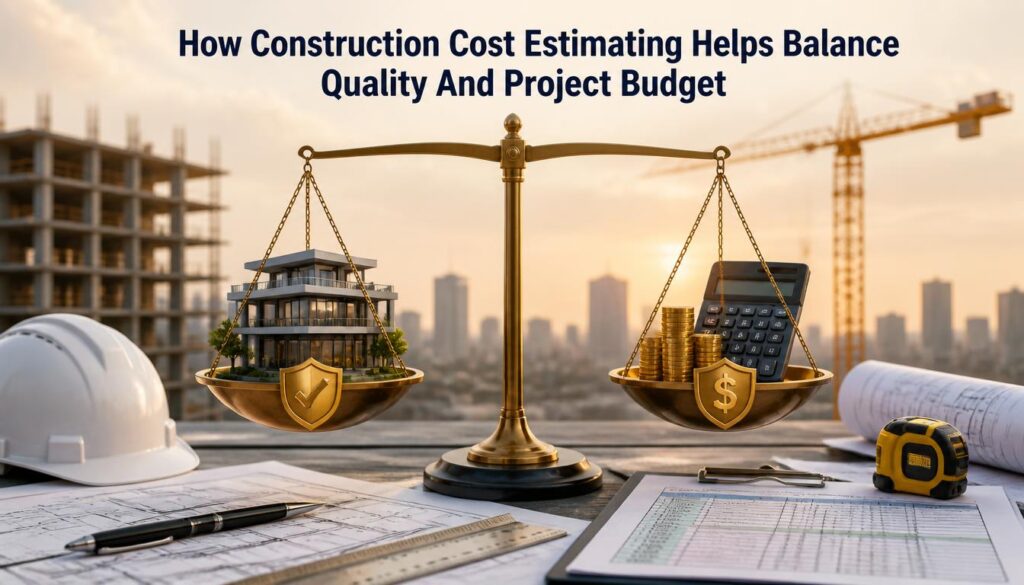
The main aim of every project owner is to ensure good quality while staying within budget. The role of construction cost estimating is to balance two aspects: the quality of the project and its overall cost. In other words, this process helps determine how much a project will cost before it is launched.
Construction cost estimating services are essential and enable project owners to remain on course by managing expenses for materials, labor, and other costs. This is critical for quality control of the process while maintaining the allocated budget.
What Does It Mean to Balance Quality and Budget in Construction Cost Estimating?
Balance does not mean forgoing the value of the quality items. It means knowing the cost impact of quality items before the start of work.
Early budgeting allows owners to understand the cost impact of a material change or design upgrade before the final decision is made. Otherwise, it could turn into a change order, which typically has a higher cost impact on the owner. This is why quality-versus-cost issues are of such concern during project financial planning.
Why Are Material Costs Outrunning Bid Prices Right Now?
Construction input costs are rising exponentially, cutting into the profits of contractors (Associated General Contractors of America).
The cost of construction inputs climbed 8.4 percent per year in May 2026, and the price of bids increased 3.5 percent per year. As a result, there is an even bigger need to ensure costs are estimated correctly.
| Measure | Year-over-Year Change (May 2026) |
| Construction input costs | +8.4% |
| Contractor bid prices | +3.5% |
Source: AGC of America
That difference needs to be taken into account during project budget planning. It is better to consider it earlier rather than have to pay for it during construction.
How Risk-Averse Is The Industry Getting About Budgets?
Construction leaders are optimistic but cautious. This is changing how project budgets are prepared.
The Global Construction Survey reports that 71 percent of construction executives are optimistic about the industry. Similarly, 3 out of 4 construction leaders are more cautious about risk than they were a year ago.
Meanwhile, 1/3 of respondents said that price increases in materials and equipment pose a significant risk to their business. Therefore, for construction companies, there is even less room for error when it comes to budgets and timelines for projects.
Why Is Skilled Estimating Talent Getting Harder To Find?
The number of cost estimators is shrinking, not rising. The Bureau of Labor Statistics predicts that these careers will experience only 4 percent job growth over 2024-2034. However, because of retirements and job switching, there are an estimated 16,900 annual job openings. Fewer estimators. There is a decrease in estimators with the same or higher workload, which induces owners to seek outside estimating resources to maintain accuracy and keep estimates up-to-date.
What Should Real Project Cost Control Actually Look Like?
- Estimates updated against current input pricing, not last quarter’s numbers.
- Quality and spec decisions priced before they’re approved, not after.
- A clear line item for the gap between material inflation and contract pricing.
- Ongoing tracking through construction, not a single number at bid stage.
Taken together, these four factors are what distinguish good project cost control from a snapshot figure presented at the time of bid. Universe Estimating constructs estimates by considering that material, labor, and project requirements will change during the course of the work. Estimates are constructed to provide accurate values throughout the project lifecycle.
Conclusion
Construction cost estimating keeps a project quality controlled and within budget. The cost of materials is rising at a time when bid prices are low, and qualified estimators are hard to find. A single estimate is no longer enough for a competitive advantage. This can cause serious problems for a project if not prepared correctly according to the required standards.