India Healthy Snacks Market: Industry Report 2026–2034
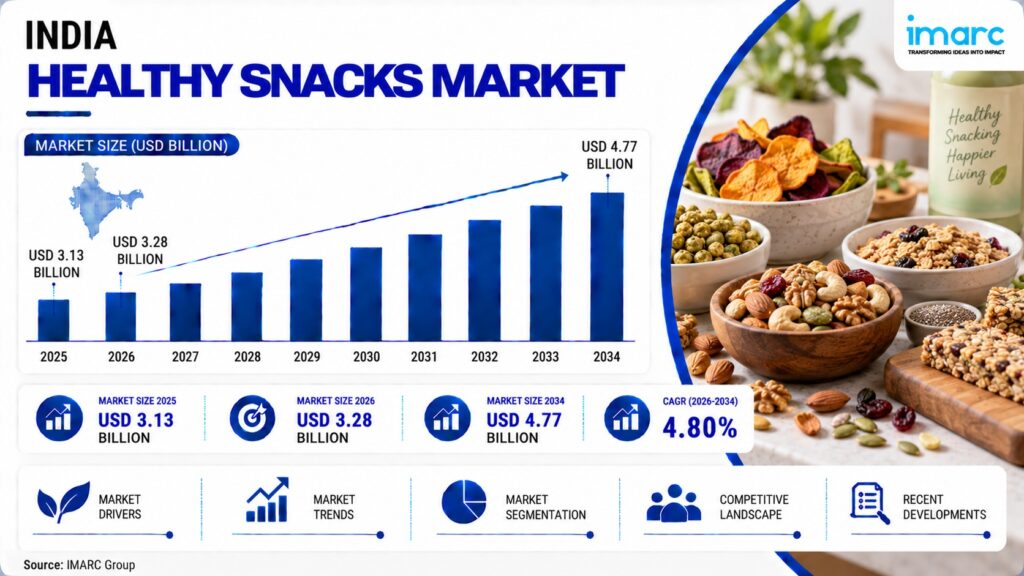
The India healthy snacks market size increased from USD 3.13 Billion in 2025 to USD 3.28 Billion in 2026 and is projected to reach USD 4.77 Billion by 2034, exhibiting a steady compound annual growth rate (CAGR) of 4.80% during the 2026–2034 forecast period. The market operates as one of the most commercially dynamic and heavily contested national food categories. Driven by rising health consciousness and a growing preference for high-protein, natural, and low-calorie options, consumers are rapidly shifting their wallet share away from traditional, deep-fried treats toward nutrient-dense snacking alternatives.
What Is the Size and Growth Forecast of the India Healthy Snacks Market?
The market is exhibiting consistent expansion, firmly anchored by the rapid premiumization of domestic consumer preferences and unprecedented health motivation across urban centers.
-
Market Size in 2025: USD 3.13 Billion.
-
Market Size in 2026: USD 3.28 Billion.
-
Market Forecast in 2034: USD 4.77 Billion.
-
Compound Annual Growth Rate (CAGR): 4.80% during the 2026–2034 forecast period.
-
Underpinning Momentum: The structural market foundation built around immunity awareness has sustained robust growth, creating highly lucrative opportunities for D2C startups and legacy FMCG giants alike.
What Are the Latest Emerging Trends in the India Healthy Snacks Market?
-
Mainstreaming of Clean-Label and Preservative-Free Products: Consumers are heavily scrutinizing ingredient lists. A recent 2025 Farmley consumer insights study revealed that 55% of consumers strictly prefer natural, preservative-free options. Parallel to the ongoing India Water Purifier Market trends, where consumers are increasingly prioritizing absolute health and purity at home, the healthy snacks sector is witnessing a massive transition toward transparent, clean-label consumption.
-
Quick-Commerce Impulse Buying: The explosive rise of 10-minute delivery platforms has fundamentally altered how healthy snacks are purchased. By stocking specialized premium health snacks in neighborhood dark stores, these platforms have successfully transitioned high-protein bars and trail mixes from planned grocery purchases into high-frequency, late-night impulse buys.
-
Rise of Millet-Based and Plant-Protein Snacks: Aligned with the global focus on sustainable superfoods, domestic brands are aggressively incorporating traditional Indian millets (like jowar, bajra, and ragi) into extruded snacks and baked chips. This perfectly addresses the rising demand for gluten-free and plant-based protein alternatives.
-
Online D2C Subscription Snack Boxes: Direct-to-Consumer (D2C) brands are capturing significant market share by bypassing traditional retail margins. By utilizing subscription models for curated wellness snack boxes, these digital-first platforms lock in recurring household revenue and foster intense brand loyalty.
-
Corporate Wellness Snack Procurement: The commercial B2B segment is evolving rapidly. To combat employee burnout and enhance workplace wellness, modern corporate enterprises and tech parks are aggressively replacing traditional junk food in office pantries with bulk procurements of roasted nuts, seeds, and energy bars.
Grab a sample copy of this report: https://www.imarcgroup.com/india-healthy-snacks-market/requestsample
What Growth Factors Are Driving the India Healthy Snacks Market?
-
High Lifestyle Disease Burden: India’s consumers face one of the highest lifestyle disease burdens globally, encompassing diabetes, obesity, and cardiovascular issues. This creates an unprecedented health motivation, directly driving consumers to substitute calorie-dense, traditional Indian snacks with healthier, functional alternatives.
-
Expanding Middle-Class Purchasing Power: By 2036, India’s middle-class and affluent consumers are expected to contribute a massive 93% of total spending. Much like the India Water Purifier Market trends that highlight an urgent shift toward preventive healthcare investments, growing disposable incomes allow consumers to confidently upgrade to premium, nutrient-dense snacking alternatives.
-
The “No Compromise on Taste” Mandate: While health is a priority, taste remains absolutely critical. Market studies indicate that a staggering 94% of consumers want healthy snacks without sacrificing flavor. Brands successfully bridging this gap—using natural spices, honey glazes, and innovative roasting techniques—are experiencing rapid volume growth.
-
Deep Cultural Familiarity with Nuts and Dry Fruits: The Indian market possesses a deeply rooted cultural affinity for dry fruits. This existing familiarity acts as a powerful catalyst, driving a ~5.1% CAGR in the nuts, seeds, and trail mixes category through premium branding and India-specific flavor innovations.
-
Surging Urbanization in North India: Rising disposable incomes and high urbanization across cities like Delhi-NCR, Chandigarh, Jaipur, and Lucknow act as major geographical volume drivers, strongly supported by modern retail penetration and growing fitness awareness.
What Are the Key Challenges Facing the India Healthy Snacks Market?
-
Extreme Price Sensitivity and Premiumization Gap: Healthy snacks, particularly those utilizing premium imported nuts, seeds, or organic certifications, carry a significantly higher price tag than mass-market traditional savory snacks. This price gap acts as a severe friction point, heavily restricting penetration in highly price-sensitive rural and Tier-3 markets.
-
Shelf-Life Constraints of Clean-Label Formulations: Removing synthetic preservatives and artificial additives directly compromises the product’s shelf life. Maintaining absolute freshness and crunch for roasted nuts or baked healthy chips across India’s harsh, humid climate requires expensive, high-barrier multi-layered packaging, which compresses manufacturer margins.
Explore the Full Report with Charts, Table of Contents, and List of Figures: https://www.imarcgroup.com/india-healthy-snacks-market
Who Are the Key Players Shaping the India Healthy Snacks Sector?
The competitive landscape is fiercely contested by traditional multinational FMCG giants, established Indian conglomerates, and a rapidly growing cohort of VC-funded D2C health food startups fighting for urban wallet share. Prominent entities actively shaping the industry include:
-
ITC Limited
-
PepsiCo
-
Wadia Group
-
Farmley
Deep-Dive Segment Insights
The market is meticulously segmented to address varying nutritional profiles, distinct distribution channels, and regional demographic trends.
By Product
-
Nuts, Seeds and Trail Mixes (34.8% in 2025): The absolute dominant segment. They dominate the market due to their inherently high protein, fiber, and nutrient content, making them immensely popular among health-conscious buyers. Their clean-label appeal and convenience as on-the-go snacks further solidify this demand.
-
Other Segments: The market also encompasses Dried Fruit Snacks, Cereals and Granola Bars, Meat Snacks, and extruded healthy alternatives.
By Distribution Channel
-
Supermarkets and Hypermarkets (31.6% in 2025): The leading distribution channel. They command this share due to their vast product variety, trusted shopping environment, and excellent visibility for branded products. In-store promotions, discounts, and easy product comparisons heavily drive sales volume in these modern trade outlets.
-
Online/Quick Commerce: A rapidly accelerating segment characterized by the explosive growth of D2C brands and 10-minute delivery integrations in metropolitan hubs.
By Region
-
North India (29.4% in 2025): Commands the highest regional market share. This dominance is heavily anchored by concentrated urbanization, elevated disposable incomes, and booming demand for packaged nutrition across the Delhi-NCR and Punjab corridors.
-
South, West, and East India: Represent extremely robust commercial regions, with South and West India particularly driven by high fitness awareness and deep modern retail penetration.
Recent Developments
-
2025 (Consumer Insights Validation): At the Indian Healthy Snacking Summit 2025, Farmley released a massive consumer insights study surveying approximately 6,000 individuals across various age groups. The data conclusively highlighted the mainstreaming of the clean-label trend, with 55% of respondents actively preferring natural, preservative-free options while demanding zero compromise on taste.
-
Mid-2026 (VC Funding and Scale-up): Driven by the projected expansion of the sector, major D2C healthy snack brands (such as Open Secret) attracted significant venture capital backing to expand their omnichannel push and heavily penetrate the corporate wellness and quick-commerce spaces.
Customization Note: If you require any specific information not covered within this report’s scope, we will provide it as part of the customization.
Request Report Customization: https://www.imarcgroup.com/request?type=report&id=30408&flag=E
FAQs
Q1. What is the current size of the India healthy snacks market?
The India healthy snacks market size increased from USD 3.13 Billion in 2025 to an estimated USD 3.28 Billion in 2026.
Q2. What is the projected growth rate for this sector?
The market is projected to reach USD 4.77 Billion by 2034, exhibiting a steady compound annual growth rate (CAGR of 4.80%) during the 2026–2034 forecast period.
Q3. Which product category dominates the market?
Nuts, Seeds and Trail Mixes strictly dominate the product mix, capturing a 34.8% market share in 2025. This is fundamentally driven by deep cultural familiarity and their high protein and fiber content.
Q4. Where do consumers primarily purchase healthy snacks?
Supermarkets and Hypermarkets lead the distribution channels with a 31.6% share (2025). Consumers heavily utilize these modern retail environments for their wide variety, trustworthy shopping experience, and attractive promotional discounts.
Q5. Which region accounts for the highest consumption in India?
North India commands the highest regional share at 29.4% (2025). The region’s dominance is heavily fueled by high urbanization rates, rising disposable incomes, and concentrated demand across major cities like Delhi-NCR and Chandigarh.