Market Overview & Summary
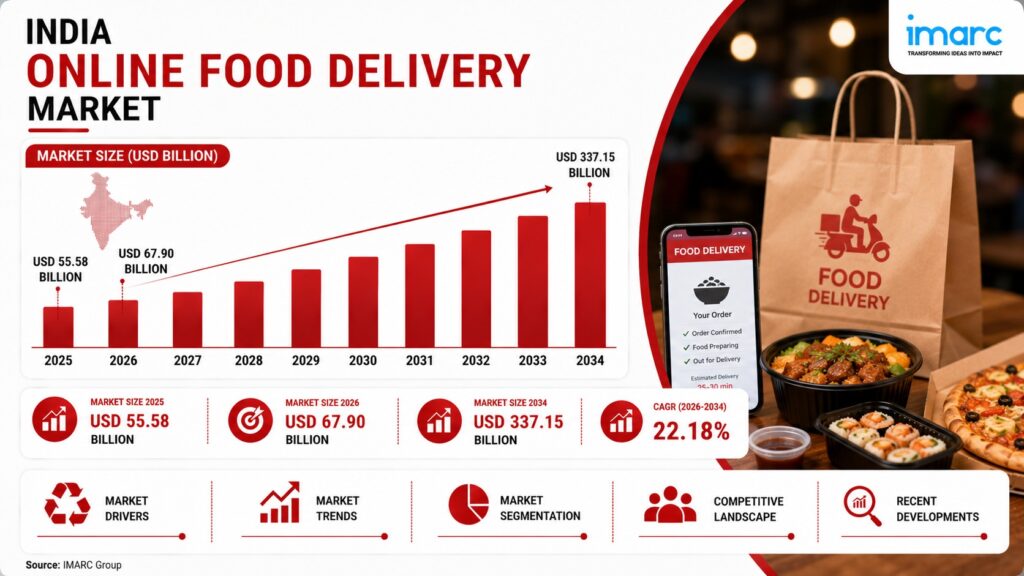
The India online food delivery market size reached USD 55.58 Billion in 2025 and expanded to USD 67.90 Billion in 2026. Looking forward, the market is projected to reach an impressive USD 337.15 Billion by 2034, exhibiting a massive compound annual growth rate (CAGR) of 22.18% during the 2026–2034 forecast period.
India’s online food delivery ecosystem is experiencing a remarkable, hyper-growth expansion. Driven by widespread smartphone adoption, evolving urban lifestyles, and a profound preference for convenience-oriented dining solutions, the market is structurally moving away from traditional dine-in models toward digital-first consumption. Furthermore, technological innovations such as AI-driven route optimization and unified digital payment infrastructure have allowed major aggregator platforms and cloud kitchen operators to seamlessly connect consumers with a diverse array of culinary choices, fueling unprecedented transaction volumes across both metropolitan hubs and emerging Tier-2 cities.
Market Size & Forecast
-
Market Size (2025): USD 55.58 Billion
-
Market Size (2026): USD 67.90 Billion
-
Projected Market Size (2034): USD 337.15 Billion
-
CAGR (2026 – 2034): 22.18%
-
Leading Regional Market: North India (30% Share in 2025)
Key Market Trends
-
AI-Driven Personalization and Route Optimization:
Modern food delivery platforms are heavily leveraging data analytics, machine learning, and AI to optimize every touchpoint. Features such as predictive order timing, dynamic dispatch algorithms, personalized menu recommendations, and hyper-local offers are driving higher conversion rates and optimizing last-mile delivery logistics.
-
Proliferation of the Cloud Kitchen Model:
To avoid the high real-estate overheads of traditional dine-in restaurants, operators are aggressively pivoting to internet-only “cloud kitchens” (dark kitchens). Pioneers operate multiple digital-first culinary brands from shared kitchens, enabling rapid scaling, menu adaptation, and significantly better unit economics.
-
Integration of Quick Commerce (Q-Commerce):
The boundary between restaurant food delivery and daily essentials is dissolving. Major aggregators have deeply integrated ultra-fast grocery delivery into their core apps, leveraging their existing logistics fleets to maximize driver utilization and increase order frequency.
-
Sustainable Operations and EV Fleet Adoption:
To mitigate volatile fuel costs and align with corporate ESG goals, leading delivery platforms are heavily investing in sustainable logistics. There is a massive operational shift toward deploying electric vehicle (EV) fleets for last-mile delivery and utilizing eco-friendly packaging materials.
-
Subscription Models and Loyalty Programs:
To ensure customer stickiness in a highly competitive market, platforms are refining subscription programs that offer waived delivery fees and exclusive discounts. This successfully guarantees recurring revenue and drives higher monthly order frequencies among urban millennials.
Grab a sample copy of this report: https://www.imarcgroup.com/india-online-food-delivery-market/requestsample
Strategic Market Dynamics
Growth Drivers
-
Widespread Smartphone and High-Speed Internet Penetration:
The absolute bedrock of the market is the deep penetration of affordable data plans and smartphones across semi-urban geographies, enabling millions of first-time digital users to access food delivery platforms effortlessly.
-
Evolving Urban Lifestyles and Time Poverty:
The concentration of young professionals, dual-income households, and students in massive urban agglomerations drives a high propensity for convenience-oriented food consumption. Consumers are increasingly ordering out for multiple “meal occasions” rather than treating delivery as a weekend luxury.
-
Ubiquity of UPI and Digital Payment Infrastructure:
The seamless integration of the Unified Payments Interface (UPI) provides instant settlement, high reliability, and minimal transaction costs. This cashless ecosystem minimizes checkout friction, builds consumer trust, and drastically reduces the logistical headaches associated with cash-on-delivery.
-
Aggressive Expansion into Tier-2 and Tier-3 Cities:
With top cities driving massive consumption, platforms are identifying immense headroom for growth in non-metro markets. Rising incomes and changing lifestyles in Tier-2 and Tier-3 cities are prompting aggregators to expand aggressively by offering localized menus and adjusted pricing strategies.
-
Lower Entry Barriers for Restaurant Partners:
The aggregator model severely lowers the barrier to entry for local food businesses. Small eateries and home-chefs can immediately tap into a vast digital customer base without investing in their own delivery fleets or sophisticated digital marketing infrastructure.
Market Restraints
-
High Operational Cash Burn and Delivery Fleet Attrition: The aggregator business model is notoriously capital-intensive. The constant need for aggressive discounting to retain price-sensitive customers, combined with high attrition rates among gig-economy delivery partners, heavily strains overall platform profitability.
-
Intense Restaurant Pushback on Commission Rates: Delivery platforms frequently face friction from restaurant associations protesting steep commission structures and deep discounting mandates, forcing aggregators to continuously renegotiate terms to maintain their supply base.
Explore the Full Report with Charts, Table of Contents, and List of Figures: https://www.imarcgroup.com/india-online-food-delivery-market
Competitive Landscape & Key Company Insights
The India online food delivery market essentially functions as a highly aggressive duopoly, flanked by specialized cloud-kitchen titans and international QSR chains maintaining their proprietary delivery networks. The competitive intensity forces continuous innovation in app interfaces, loyalty programs, and delivery speed.
Key players actively defining the domestic ecosystem include:
-
Domino’s (Jubilant FoodWorks Ltd.)
-
EatClub Brands Pvt. Ltd.
-
FreshMenu
-
Rebel Foods
-
Swiggy Limited
-
Zomato Ltd.
Deep-Dive Segment Insights
Platform Type Insights
-
Mobile Applications
-
Websites
Key Insight: Mobile applications strictly dominate the market, commanding a 79% share in 2025. This supremacy is a direct reflection of India’s mobile-first internet economy, where consumers strongly prefer seamless, on-the-go ordering experiences equipped with real-time GPS tracking and instant push notifications.
Business Model Insights
-
Order Focused Food Delivery System
-
Logistics Based Food Delivery System
-
Full-Service Food Delivery System
Key Insight: The Order Focused model leads the market with a 50% share in 2025. This segment capitalizes on aggregator platforms that act purely as a centralized digital marketplace, connecting consumers with immense restaurant variety without bearing the heavy capital investment of full-service operational logistics.
Payment Method Insights
-
Online
-
Cash on Delivery (COD)
Key Insight: The Online payment segment represents the largest market share at 69% in 2025. This dominance is heavily driven by the nationwide proliferation of digital wallets and UPI integration, reflecting high consumer trust in the security and speed of cashless transactions.
Region Insights
-
North India
-
West and Central India
-
South India
-
East India
Key Insight: North India dominates the regional landscape with a 30% market share in 2025. This leadership stems from the massive urban agglomeration of the Delhi National Capital Region (NCR), which concentrates millions of young professionals, students, and dual-income households with high disposable incomes and a strong propensity for digital convenience.
Recent News and Developments (2025–2026)
-
Aggressive Expansion into Non-Metros (2025-2026): Leveraging improved logistics infrastructure and rising disposable incomes, major platforms aggressively pushed into Tier-2 and Tier-3 cities. This strategy involved rolling out highly localized menus, onboarding regional culinary favorites, and offering introductory discounting structures to capture first-time digital users.
-
Technological Deployments in Logistics (2025): The major food delivery companies dramatically enhanced their AI-driven backend infrastructure. By deploying sophisticated machine learning algorithms for dynamic dispatch and predictive order timing, platforms effectively lowered delivery latency and reduced overhead costs during peak weekend demand spikes.
-
Scaling Up of Q-Commerce Capabilities (2025-2026): Aggregators continued to blur the lines between food and grocery. Leading delivery companies scaled up their respective quick-commerce arms, integrating warehouse dark-stores with their existing food delivery fleets to offer 10-to-15 minute delivery windows for daily essentials, thereby drastically increasing their order volume density.
Customization Note: If you require any specific information not covered within this report’s scope, we will provide it as part of the customization.
Request Report Customization: https://www.imarcgroup.com/request?type=report&id=1241&flag=E
Frequently Asked Questions (FAQs)
Q1. What is the India online food delivery market size in 2025 and 2026?
Ans. The India online food delivery market size reached USD 55.58 Billion in 2025 and expanded rapidly to USD 67.90 Billion in 2026.
Q2. What is the projected market size and growth rate by 2034?
Ans. The market is projected to reach an astounding USD 337.15 Billion by 2034, exhibiting a hyper-growth compound annual growth rate (CAGR) of 22.18% during the 2026–2034 forecast period.
Q3. Which platform type and payment method dominate the market?
Ans. Mobile Applications absolutely dominate platform access with a 79% share in 2025 due to India’s mobile-first consumer behavior. Concurrently, Online payment methods lead with a 69% share, heavily fueled by the nationwide success of digital wallets and UPI.
Q4. What are the key factors driving the market’s exponential growth?
Ans. Growth is fundamentally driven by deep smartphone penetration, evolving urban lifestyles experiencing time poverty, the convenience of cashless UPI payments, and the aggressive expansion of aggregator platforms into untapped Tier-2 and Tier-3 cities.
Q5. Which region leads the online food delivery market in India?
Ans. North India leads with a 30% market share in 2025. This is primarily supported by the dense population, high internet connectivity, and concentrated urban consumer base across the Delhi-NCR metropolitan hub.