Introduction
Energy costs affect every organization. Poor energy management can increase operating expenses and reduce efficiency. Many businesses still manage energy use only when problems raised
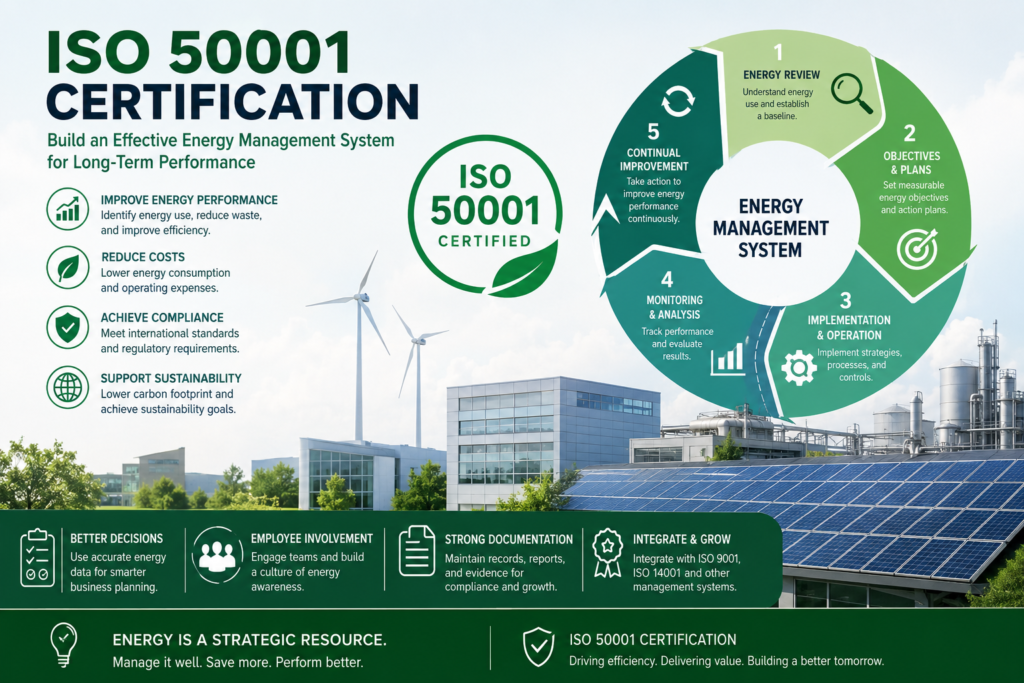
ISO 50001 certification provides a structured solution. It helps organizations build an Energy Management System (EnMS) that improves energy performance and supports continual improvement.
The standard applies to organizations of every size and industry. Manufacturing plants, commercial buildings, healthcare facilities, logistics companies, and service organizations all use ISO 50001 to manage energy more effectively.
What ISO 50001 Focuses On
ISO 50001 specifies the requirements for an Energy Management System. It helps organizations identify energy consumption patterns, establish performance objectives, and measure results.
The standard promotes continual improvement instead of one-time energy-saving projects.
Rather than recommending specific technologies, ISO 50001 provides a flexible framework. Organizations can choose solutions that match their operations and business goals.
Why Organizations Pursue ISO 50001 Certification
Understanding Energy Consumption
Many organizations lack clear information about how they use energy.
An Energy Management System collects accurate data and highlights areas where energy consumption is highest. This visibility helps organizations make informed decisions.
Supporting Long-Term Efficiency
Energy management should become part of everyday operations.
ISO 50001 encourages organizations to monitor performance continuously, improve processes, and achieve long-term energy savings.
Core Elements of an Energy Management System
Energy Review and Baseline
Organizations first evaluate current energy use.
They establish an energy baseline that serves as a reference for measuring future improvements.
Energy Objectives and Action Plans
The standard requires organizations to set measurable energy objectives.
Clear action plans help teams achieve these targets within defined timeframes.
Monitoring and Performance Analysis
Organizations should monitor energy performance regularly.
Performance data helps managers evaluate progress and identify opportunities for further improvement.
How the Certification Process Works
Most organizations begin with a gap analysis.
They compare existing energy management practices with ISO 50001 requirements. After identifying gaps, they improve their Energy Management System and implement new processes.
The organization operates the system for a period before the certification audit.
Many businesses pursue ISO 50001 certification because they want to standardize energy management across departments and facilities. This structured approach often improves consistency and performance.
Who Benefits from ISO 50001?
Manufacturing and industrial facilities often achieve significant benefits because they consume large amounts of energy.
However, ISO 50001 also supports commercial buildings, hospitals, educational institutions, logistics providers, warehouses, hotels, and service organizations.
Organizations facing rising energy costs or sustainability goals also benefit from implementing this international standard.
Common Implementation Challenges
Collecting reliable energy data can be difficult during the early stages.
Organizations with multiple facilities often struggle to gather consistent information. Coordinating improvement activities across departments may also require careful planning.
Clear responsibilities, employee involvement, and regular monitoring help overcome these challenges.
How ISO 50001 Supports Business Performance
Improving Operational Efficiency
Energy management often reveals hidden operational problems.
Organizations may discover equipment that runs longer than necessary or processes that waste valuable resources.
Correcting these issues improves productivity while reducing energy consumption.
Supporting Better Business Planning
Reliable energy data helps organizations make better long-term decisions.
Managers can evaluate equipment upgrades, budget accurately, and set realistic energy performance targets based on actual results.
Why Documentation Matters
Accurate documentation supports every successful Energy Management System.
Organizations should maintain energy records, monitoring reports, performance indicators, corrective actions, and improvement plans.
These records demonstrate compliance and help identify trends over time.
Well-organized documentation also simplifies internal audits and management reviews.
Integrating ISO 50001 with Other Management Systems
Many organizations already maintain quality, environmental, or occupational health and safety management systems.
ISO 50001 shares a common structure with standards such as ISO 9001 and ISO 14001.
Organizations can combine internal audits, document control, management reviews, and corrective action processes. Integration reduces duplicate work and improves overall business efficiency.
Preparing for ISO 50001 Certification
Begin by reviewing current energy consumption.
Identify where energy data already exists and where information is missing.
Involve facilities, maintenance, operations, procurement, and management teams early in the project.
Their knowledge helps create an accurate energy review and a practical Energy Management System.
Maintaining Energy Performance
Certification marks the beginning of continuous improvement.
Organizations should review energy data regularly, evaluate objectives, update action plans, and involve employees in improvement activities.
Regular internal audits also help maintain system effectiveness.
Businesses that make energy management part of daily operations usually achieve stronger and longer-lasting results.
Over time, continuous improvement lowers energy costs, strengthens operational efficiency, and supports sustainability goals.
Conclusion
ISO 50001 certification provides a practical framework for improving energy performance across an organization.
A well-implemented Energy Management System helps organizations understand energy use, reduce waste, improve efficiency, and support continual improvement.
Organizations that integrate energy management into everyday decision-making often reduce operating costs, improve sustainability, and strengthen long-term business performance. By treating energy as a strategic resource, businesses create lasting value for customers, employees, and stakeholders.