
Most articles about Oracle EPM describe features. Few describe what actually happens after a company in Bangrak signs the contract, migrates its data, and sits through its first quarter closing on the new system. That gap matters, because the real value of Oracle EPM shows up in the details nobody puts in a sales deck, like how long it takes a finance analyst to trust a forecast of the software produced on its own.
Triforce Global Solutions has implemented and supported Oracle EPM and Infor ERP Thailand projects for finance teams across Bangkok, including several companies based in Bangrak near Silom and Sathorn. This piece draws on that hands-on experience rather than a generic product overview, and it is meant for finance directors and controllers who want to know what to expect before they commit a budget to a new planning system.
What Oracle EPM Is Built to Do
Oracle EPM, short for Enterprise Performance Management, is a cloud platform for budgeting, forecasting, financial consolidation, and account reconciliation. It is not an accounting system in the traditional sense. It sits above the transactional data and turns it into forward looking plans, scenario models, and group level reports.
For a company in Bangrak managing entities across Thailand and the wider region, this distinction matters. Transactional accuracy comes from the ERP. Planning accuracy comes from Oracle EPM. Confusing the two, or trying to make one system do both jobs, is where a lot of finance teams run into trouble before they even bring in outside help.
The core modules most companies start with include:
- Planning and Budgeting Cloud for annual budgets and rolling forecasts
- Financial Consolidation and Close for multi entity group reporting
- Account Reconciliation for closing the books with fewer manual checks
- Profitability and Cost Management for tracing margin back to its actual source
A company rarely needs all four on day one. The teams that get the best results tend to start with one module, prove it out over a full quarter, then expand.
What Actually Changes in the First Year
Based on projects run for Bangrak and wider Bangkok clients, the shift is not immediate. The first close on Oracle EPM is often slower than the old spreadsheet process, simply because the team is learning a new system while also doing their regular job. That is normal and worth planning for rather than being surprised by.
By the second or third close, the pattern usually reverses. Reconciliation steps that used to take a full day get done in a few hours. Consolidated reports that once required someone manually rekeying numbers from five subsidiaries now pull automatically. The finance director stops fielding late night emails asking which version of the forecast is correct, because there is only one live version.
The part that surprises most clients is not the software itself but the process discipline it forces. Chart of accounts inconsistencies that had been ignored for years suddenly have to be resolved before the system will consolidate cleanly. That cleanup work is often harder than the software configuration, and any partner who skips over it is setting the project up to struggle later.
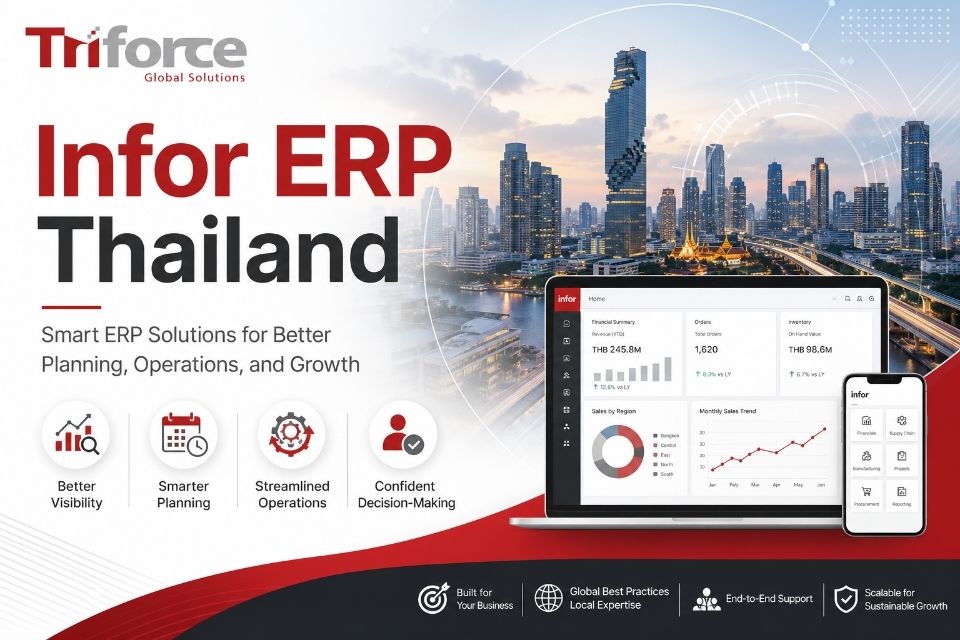
Oracle EPM and Infor ERP Thailand Working Together
A fair number of companies in Bangrak already run Infor ERP Thailand for procurement, inventory, and day to day transactions. The question that comes up constantly is whether Oracle EPM replaces that system or works alongside it.
It works alongside it. Infor ERP Thailand remains the system of record for operational transactions, purchase orders, supplier invoices, and stock movements. Oracle EPM pulls summarized financial data from that ERP and builds the planning layer on top, including budgets, forecasts, and consolidated statements across entities.
Companies that try to build heavy planning models directly inside their ERP usually hit a wall. ERPs are built for transaction volume and operational accuracy, not for running dozens of forecast scenarios or modeling what happens if raw material costs rise eight percent next quarter. Oracle EPM is built specifically for that kind of modeling, which is why the two systems complement each other rather than compete.
Where Projects Go Wrong
It is worth being honest about failure points, because most public content skips this. The most common reason an Oracle EPM implementation stalls in our experience comes down to two things.
- Data was not cleaned before migration, so the new system inherited old errors
- The finance team was not involved early enough in defining how the model should work, so the final build did not match how people actually plan
Neither of these is a software problem. Both are process and communication problems, which is why a partner who understands finance operations, not just Oracle configuration screens, tends to produce a smoother rollout.
What a Realistic Timeline Looks Like
For a mid-sized company in Bangrak implementing a single module such as Planning and Budgeting, a realistic timeline runs eight to sixteen weeks. That includes:
- Two to three weeks of discovery, mapping the current budgeting process end to end
- Three to five weeks of design and configuration, including chart of accounts and hierarchies
- Two to three weeks of data integration, usually the longest phase if multiple entities are involved
- Two to three weeks of user testing, ideally run against one full historical budget cycle
- A final week for training and go live, followed by hypercare support through the first real close
Companies that try to compress this timeline to save cost often end up paying for it later in rework and user frustration.
Choosing a Partner You Can Actually Trust
Anyone can install Oracle EPM. Fewer partners can tell you honestly where a project is likely to struggle before it happens. When evaluating a partner in Bangkok, ask for specifics rather than general claims.
- Ask which industries and company sizes they have actually implemented for in Thailand
- Ask how they handle a project when the ERP data turns out to be messier than expected
- Ask what support looks like three months after go live, not just during the project
- Ask for a reference client who will speak honestly, including about what was hard
Triforce Global Solutions has been through these conversations directly with finance teams in Bangrak, and the honest answer is that no implementation is completely smooth. What matters is whether the partner has the experience to handle the rough patches without the project losing momentum.
Final Thoughts
Oracle EPM is a strong platform for finance teams in Bangrak dealing with multi-entity reporting, tighter close timelines, and boards that want forward looking numbers rather than historical summaries. Paired with Infor ERP Thailand for operational data, it gives a company the same planning capability that larger regional headquarters in the district already rely on.
The companies that get the most out of it are the ones that go in with realistic expectations, clean their data before migration, and choose a partner who has actually lived through an implementation rather than one reciting a product brochure.
Frequently Asked Questions
1. How is Oracle EPM different from a regular accounting or ERP system?
An ERP records transactions as they happen. Oracle EPM sits above that data and focuses on planning, forecasting, and consolidated reporting, so the two serve different purposes rather than competing with each other.
2. Can a company already using Infor ERP Thailand still benefit from Oracle EPM?
Yes, and this is one of the more common setups seen in Bangkok. Infor ERP Thailand handles daily operations while Oracle EPM builds forecasts and consolidated reports from that operational data.
3. What usually takes the longest during implementation?
Data integration and cleanup, especially when a company has multiple entities or has been running spreadsheets with inconsistent formats for years. Clean data before migration shortens this significantly.
4. Is the first quarter close after going live usually faster or slower?
Slower, in most cases, because the team is learning the new system while still doing their regular work. Speed improvements typically show up by the second or third close cycle.
5. What is the single biggest factor in whether an Oracle EPM project succeeds?
Involving the finance team early in defining how the planning model should actually work, rather than letting the build proceed based only on technical configuration decisions.