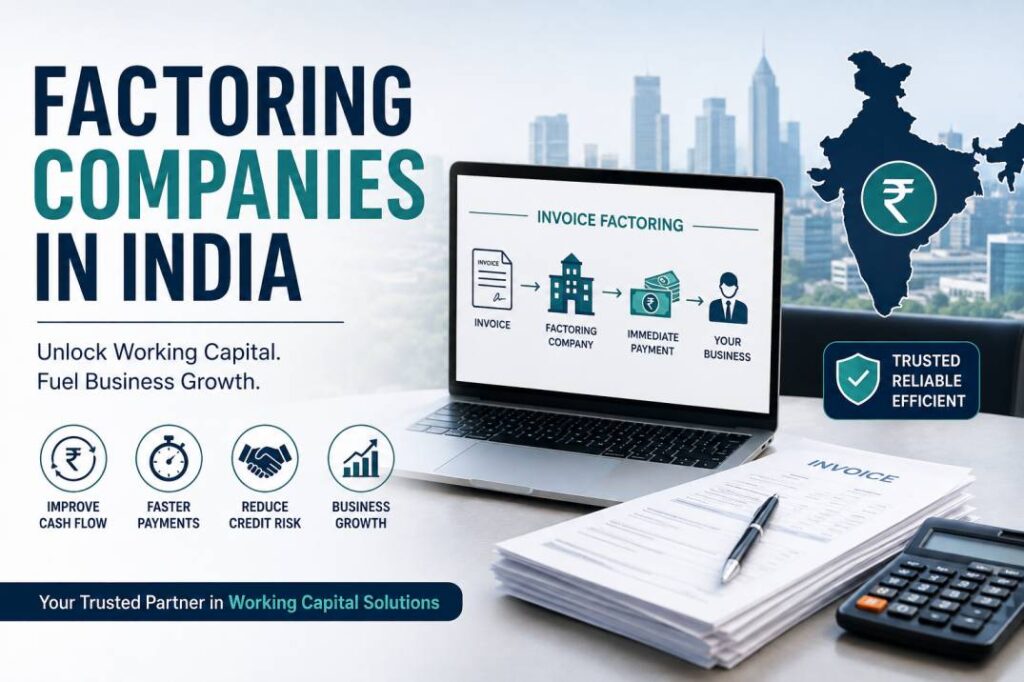
Managing cash flow is one of the biggest challenges for businesses that sell products or services on credit. A company may generate strong sales but still struggle to maintain liquidity because customers can take 30, 60, 90, or even 120 days to pay their invoices.
This is where factoring companies in India can play an important role.
Factoring allows businesses to convert eligible accounts receivable into working capital before customers make their payments. Instead of waiting for outstanding invoices to mature, a business can obtain financing against eligible receivables and use the funds for inventory, payroll, supplier payments, business expansion, and other operating requirements.
India’s factoring ecosystem includes dedicated factoring companies, NBFC-Factors, bank-backed subsidiaries, and RBI-authorised TReDS platforms that facilitate invoice discounting for eligible MSME receivables.
In 2026, the Indian receivables-finance market is particularly relevant for MSMEs. The Government of India announced in June 2026 that operating Central Public Sector Enterprises must route settlement of purchases from MSMEs through authorised TReDS platforms. The government stated that five TReDS platforms were operational and that invoice discounting on TReDS had reached ₹3.47 lakh crore in FY 2025–26.
This article explains the leading names businesses should research, how factoring works, what to compare, and how to select a suitable provider.
What Is Invoice Factoring?
Invoice factoring is a form of receivables financing in which a business assigns or sells eligible invoices to a factor in exchange for earlier access to cash.
The basic process is:
Business Sale → Invoice Generated → Invoice Assigned to Factor → Advance Received → Customer Pays → Transaction Settled
For example, suppose an MSME has issued a ₹10 lakh invoice to an established corporate customer with 60-day payment terms.
Instead of waiting 60 days, the business may be able to obtain an agreed percentage of the invoice value earlier.
The factor then manages the receivable according to the agreed arrangement.
The exact advance percentage, fees, recourse provisions, collection responsibility, and settlement mechanism depend on the provider and contract.
Why Are Factoring Companies in India Important for Businesses?
Traditional business financing can take time and may require extensive assessment of the company’s balance sheet, collateral, profitability, and repayment capacity.
Factoring focuses heavily on the quality of the underlying receivables and the creditworthiness of customers.
This can make it particularly useful for businesses that have:
- Strong B2B customers
- Regular invoices
- Extended payment terms
- Growing sales
- Temporary cash-flow gaps
- Large corporate buyers
- Government or PSU customers
- Export receivables
The key advantage is the ability to turn part of the value locked in receivables into working capital sooner.
Top Factoring Companies in India: Companies and Platforms to Research
There is no single official ranking that determines the “best” factoring company in India for every business. The appropriate provider depends on factors such as customer quality, invoice size, domestic or export transactions, cost, recourse structure, geography, and eligibility.
The following are important names and platforms businesses can consider when researching factoring companies in India.
1. SBI Factors Limited
SBI Factors Limited is a major bank-backed factoring provider in India.
The company is a subsidiary of State Bank of India and operates as an NBFC regulated by the Reserve Bank of India. It provides both domestic and export factoring and has a nationwide presence. The company was formerly known as SBI Global Factors Limited and changed its name to SBI Factors Limited in February 2025.
SBI Factors can be particularly relevant for businesses looking for:
- Domestic factoring
- Export factoring
- Receivables financing
- Working capital support
- Bank-backed financial services
In July 2026, CRISIL reaffirmed SBI Factors’ ratings at CRISIL AAA/Stable and CRISIL A1+, citing the company’s strategic importance to and strong support from State Bank of India.
Why Consider SBI Factors?
Its association with SBI, domestic and export factoring capabilities, and nationwide presence make it an important provider for businesses comparing factoring solutions.
Businesses should still compare pricing, advance rates, eligibility, recourse provisions, and service requirements against competing providers.
2. Canbank Factors Limited
Canbank Factors Limited is a subsidiary of Canara Bank and one of India’s established specialist factoring companies.
The company was incorporated in 1991 and offers products including:
- Sales bill factoring
- Purchase bill discounting
- Invoice discounting
- Vendor financing
- Other working capital products
Canbank Factors states that it provides financing against invoices and can advance up to 80%–90% of invoice value under its factoring arrangements, depending on the applicable terms.
The company also states that more than 50% of its funds are deployed in the MSME sector.
Why Consider Canbank Factors?
Canbank Factors may be relevant for:
- MSMEs
- Manufacturing companies
- Trading businesses
- Service businesses
- Suppliers to large corporations
- Businesses seeking domestic factoring
Its vendor-financing product is designed to provide working-capital finance to suppliers that have business relationships with large corporates.
3. India Factoring and Finance Solutions
India Factoring and Finance Solutions is another prominent name among factoring companies in India, particularly for businesses with international receivables.
The company states that it specialises in working-capital solutions through factoring and is registered with the RBI as an NBFC-Factor. It is also a subsidiary of FIMBank p.l.c., Malta.
India Factoring provides solutions covering:
- Domestic factoring
- Export factoring
- Import factoring
- Receivables financing
- Receivables management
- Credit protection
- Collections
The company’s website states that, according to FCI statistics, it has ranked Number 1 in India for eight consecutive years in export factoring.
Why Consider India Factoring?
It can be especially relevant for:
- Exporters
- Importers
- International businesses
- Companies with overseas customers
- Businesses seeking export receivables financing
Its international network can be an important consideration for companies with cross-border trade.
4. IFCI Factors Limited
IFCI Factors Limited is another established specialist factoring institution in India’s financial-services ecosystem.
The company has historically focused on both domestic and export factoring.
Its published materials describe factoring as an arrangement in which invoices generated from open-account sales are assigned to the factor for funding, collection, and sales-ledger administration.
Why Consider IFCI Factors?
It may be relevant for businesses looking for:
- Domestic factoring
- Export factoring
- Receivables financing
- Working-capital support
- Invoice-based funding
Businesses should verify current product availability, pricing, limits, and eligibility directly with the provider before applying.
5. PinCap
PinCap is another name appearing in current Indian factoring and invoice-financing listings.
GoodFirms’ August 2026 directory identifies PinCap as the trade name of Pinnacle Capital Solutions Private Limited and describes it as an RBI-registered NBFC.
PinCap is relevant to businesses researching technology-enabled and alternative working-capital financing.
Potential areas to evaluate include:
- Invoice financing
- Working-capital solutions
- Receivables financing
- SME funding
Businesses should verify the exact factoring product, regulatory status, pricing, and eligibility applicable to their transaction before proceeding.
6. TReDS Platforms: An Important Alternative to Traditional Factoring
When discussing factoring companies in India, it is important not to overlook TReDS.
TReDS stands for Trade Receivables Discounting System.
It is an electronic platform designed to facilitate financing and discounting of MSME trade receivables from eligible corporate buyers, government departments, and public-sector undertakings.
Rather than being a single factoring company, TReDS connects MSME sellers, buyers, and financiers through an electronic platform.
The Government of India stated in July 2026 that five TReDS platforms were operational:
- RXIL
- M1xchange
- Invoicemart
- C2treds
- DTX
The same government release reported TReDS invoice discounting of ₹3.47 lakh crore during FY 2025–26.
7. RXIL
RXIL is one of India’s established TReDS platforms.
Receivables Exchange of India Limited is a joint venture promoted by SIDBI and NSE, with financial-sector institutions among its shareholders.
Canara Bank currently identifies RXIL as one of the TReDS platforms on which it participates as a financier.
Who Can Benefit From RXIL?
RXIL may be particularly relevant to MSMEs supplying:
- Large corporations
- Government organisations
- Public-sector entities
- Established corporate buyers
The TReDS structure can allow eligible invoices to be presented to financiers through a competitive financing process.
8. M1xchange
M1xchange is another established TReDS platform in India.
The platform is operated by Mynd Solutions and facilitates invoice financing between MSME suppliers, corporate buyers, and financiers.
Canara Bank confirms its participation as a financier on M1xchange.
Why Consider M1xchange?
It can be relevant for MSMEs that:
- Sell to large corporate buyers
- Have eligible trade receivables
- Want digital invoice discounting
- Need faster access to working capital
9. Invoicemart
Invoicemart is operated by A.TReDS Limited and is another important TReDS platform.
The platform facilitates invoice financing through an electronic process connecting MSME suppliers and corporate buyers with multiple financiers. Canara Bank confirms that it participates as a financier on Invoicemart.
Invoicemart’s platform information also highlights participation by banks and financial institutions in financing eligible receivables.
Who Should Consider Invoicemart?
It may be worth researching for MSMEs supplying large corporate buyers and businesses that want a digital receivables-discounting process.
How TReDS Differs From Traditional Factoring
Traditional factoring generally involves a direct relationship between:
Business → Factor
TReDS creates a broader electronic ecosystem:
MSME Seller → TReDS Platform → Buyer + Multiple Financiers
This distinction can be important when comparing financing options.
| Feature | Traditional Factoring | TReDS |
| Main asset | Receivables | Eligible trade receivables |
| Structure | Direct factor relationship | Electronic platform |
| Financiers | Usually selected provider | Multiple participating financiers |
| Buyer involvement | Depends on arrangement | Buyer acceptance is central |
| Pricing | Negotiated with factor | Can involve competitive bidding |
| Best suited for | Various businesses | Eligible MSME invoices |
| Regulatory framework | Factoring regulations | RBI TReDS framework |
How Invoice Factoring Works in India
A typical transaction can be illustrated using a ₹20 lakh invoice.
Step 1: Sale
An MSME sells goods worth ₹20 lakh to a corporate customer.
Step 2: Invoice
The business issues an invoice with a 60-day payment term.
Step 3: Invoice Assignment
The invoice is submitted to a factoring provider or eligible TReDS platform.
Step 4: Buyer Confirmation
Depending on the structure, the buyer confirms or accepts the invoice.
Step 5: Financing
The financier provides funding based on the agreed advance or discounting structure.
Step 6: Customer Payment
The buyer pays the invoice according to the agreed process.
Step 7: Settlement
The financing transaction is settled after deducting applicable charges and adjusting any reserve.
Actual procedures differ between providers.
Example of Invoice Factoring
Suppose:
Invoice Value: ₹10,00,000
Customer Payment Term: 60 days
Illustrative Advance: 80%
Potential initial funding:
₹10,00,000 × 80% = ₹8,00,000
The remaining amount may be retained as a reserve and settled after customer payment, subject to fees and contractual terms.
This is only an example. Actual advance rates and costs vary by provider, customer, industry, invoice quality, and financing structure.
Benefits of Working With Factoring Companies in India
Faster Working Capital
Businesses can potentially access cash earlier instead of waiting for customers to pay.
Improved Cash Flow
Earlier access to receivables can make it easier to manage regular operating expenses.
Supports Business Growth
Working capital can be used to purchase inventory, accept larger orders, hire employees, and expand operations.
Reduces Cash-Flow Gaps
Factoring can bridge the difference between supplier payment dates and customer collection dates.
Potentially Scalable Financing
As eligible sales and receivables increase, financing capacity may also increase, depending on the facility.
Collection Support
Some factoring arrangements include receivables management and collection services.
Can Support Exporters
International factoring can provide financing and credit-management support for businesses selling to overseas customers.
What Are the Costs of Invoice Factoring?
The cost of factoring can include several components.
Discount or Financing Charge
This is the cost of receiving funds before the invoice’s maturity date.
Service Fee
Some factors charge a separate fee for receivables management, collection, or administration.
Processing Fee
Certain providers may charge fees when establishing or renewing a factoring facility.
Other Charges
Depending on the agreement, there may be additional charges related to:
- Documentation
- Legal review
- Credit assessment
- Collection
- Delayed payments
- Facility renewal
- Other services
Businesses should compare the total effective cost rather than focusing only on the advertised financing rate.
Recourse vs. Non-Recourse Factoring
This is one of the most important issues to understand.
Recourse Factoring
Under recourse factoring, the business may remain responsible if the customer does not pay under specified circumstances.
Non-Recourse Factoring
Under non-recourse factoring, the factor may assume specified customer credit risk.
However, non-recourse does not necessarily cover every reason an invoice may remain unpaid.
Contractual exclusions can include:
- Commercial disputes
- Product returns
- Fraud
- Documentation problems
- Contractual offsets
- Quality disputes
Always read the agreement carefully.
Domestic vs. Export Factoring
Domestic Factoring
Domestic factoring applies when the seller and customer are generally operating within the same country.
It can be useful for businesses selling to Indian corporate customers.
Export Factoring
Export factoring supports businesses selling goods or services to international customers.
It can potentially provide:
- Export receivables financing
- Customer credit assessment
- Collection support
- Credit protection
- International receivables management
India Factoring, for example, specifically states that it provides domestic and international receivables-finance solutions and has particular strength in export factoring.
Who Can Benefit From Factoring?
Factoring can be useful for businesses that regularly sell on credit.
Potential users include:
Manufacturing Companies
Manufacturers frequently provide credit to distributors and corporate customers.
Wholesale Businesses
Wholesalers may have significant receivables from retailers and distributors.
Exporters
Export businesses may face extended international payment cycles.
Staffing Companies
Staffing firms often pay employees before corporate customers settle invoices.
IT and Technology Companies
Technology service providers may have monthly or milestone-based invoices.
Logistics Companies
Transport businesses can incur fuel, payroll, and maintenance costs before customer payments arrive.
Construction Companies
Construction businesses can face long billing cycles and project-related expenses.
How to Choose Among Factoring Companies in India
Choosing a factoring provider should be based on your business requirements rather than brand name alone.
1. Check Regulatory Status
Verify whether the provider is appropriately regulated or authorised for the service it offers.
For NBFC-Factors, RBI registration and applicable regulatory requirements are important considerations.
2. Compare Financing Costs
Ask for a complete fee schedule.
Compare:
- Financing rate
- Service fees
- Processing charges
- Renewal fees
- Other costs
3. Compare Advance Rates
Find out how much of each eligible invoice can be accessed.
4. Understand Recourse Terms
Ask exactly who carries the risk if your customer does not pay.
5. Check Customer Eligibility
A factor may have specific requirements regarding:
- Customer creditworthiness
- Invoice age
- Customer concentration
- Invoice size
- Industry
- Payment history
6. Understand Collection Procedures
Find out whether:
- You retain collection responsibility
- The factor contacts customers
- Customers pay the factor directly
7. Check Contract Terms
Review:
- Minimum commitment
- Facility duration
- Termination provisions
- Renewal conditions
- Security requirements
8. Compare Funding Speed
If cash flow is urgent, determine how quickly approved invoices can be funded.
9. Evaluate Digital Capabilities
For businesses processing large numbers of invoices, digital onboarding, invoice submission, reporting, and tracking can save time.
Factoring Companies in India vs. Banks
Businesses sometimes compare factoring providers with conventional bank finance.
| Factor | Factoring Company | Bank Working Capital |
| Primary focus | Receivables | Overall business credit |
| Main asset | Invoices/receivables | Various collateral/financial strength |
| Funding basis | Eligible invoices | Borrowing limits and assessment |
| Collections | May be managed by factor | Usually business-managed |
| Flexibility | Depends on provider | Depends on facility |
| Customer credit | Often important | Also considered |
| Funding model | Receivables-based | Loan/CC/OD/bill finance |
Neither option is automatically better.
The right choice depends on the company’s financial position, operating cycle, customer base, and funding requirement.
Factoring Companies in India vs. TReDS
TReDS can be particularly attractive for eligible MSMEs selling to large corporate buyers.
On TReDS, multiple financiers can participate in the financing process.
The Government of India describes TReDS as an RBI-regulated electronic platform for financing and discounting MSME trade receivables through competitive bidding by multiple financiers.
Traditional factoring can provide a more customised relationship with a specific factor.
Therefore:
TReDS may be attractive for eligible invoices and competitive bidding.
Traditional factoring may be attractive when a business needs a broader receivables-management relationship.
What Documents Are Usually Required?
Requirements vary, but a factoring provider may request:
- PAN
- GST registration
- Udyam registration
- Business registration documents
- Bank statements
- Financial statements
- GST returns
- Income tax returns
- Customer list
- Accounts receivable aging
- Outstanding invoice details
- Customer contracts
- Purchase orders
- Existing borrowing details
- KYC documents
Export factoring may require additional documentation related to international trade.
How to Improve Factoring Eligibility
Businesses can improve their receivables profile by:
Maintain Strong Customer Relationships
Reliable customers can make invoices more attractive to financiers.
Invoice Correctly
Incorrect invoices can result in disputes and delays.
Reduce Overdue Receivables
A strong collection process can improve the quality of the receivables book.
Maintain Accurate Accounts
Up-to-date accounting information makes credit evaluation easier.
Diversify Customers
Excessive dependence on one buyer can create concentration risk.
Keep Tax and Regulatory Records Updated
Good compliance can strengthen the overall credit profile.
Common Mistakes When Choosing Factoring Companies in India
Mistake 1: Choosing Only on Advance Rate
A higher advance does not necessarily mean a cheaper financing facility.
Mistake 2: Ignoring Total Fees
Always calculate the complete cost.
Mistake 3: Not Reading Recourse Provisions
Businesses should understand who bears the loss if a customer does not pay.
Mistake 4: Ignoring Customer Notification
Some businesses prefer confidentiality while others are comfortable with disclosed factoring.
Mistake 5: Financing Poor-Quality Invoices
Disputed or overdue invoices may be difficult or expensive to finance.
Mistake 6: Ignoring Contract Duration
A low initial rate may not compensate for an expensive long-term commitment.
How Government and RBI Frameworks Are Supporting Receivables Financing
India’s receivables-financing ecosystem has developed significantly through regulatory and policy initiatives.
The RBI’s TReDS framework provides an electronic mechanism for financing eligible MSME trade receivables.
In June 2026, RBI issued comprehensive TReDS Directions aimed, among other things, at simplifying MSME seller onboarding and allowing financiers to avail credit guarantee cover for exposures undertaken on TReDS.
The government’s July 2026 announcement requiring operating CPSEs to route MSME procurement invoices through TReDS is another major development for the sector.
These developments are important because delayed customer payments have historically tied up significant amounts of MSME working capital.
What Should MSMEs Check Before Factoring an Invoice?
Before submitting an invoice to a factoring company, verify:
- Is the invoice genuine?
- Has the customer accepted the invoice?
- Is the customer creditworthy?
- Is the invoice disputed?
- What is the payment due date?
- What advance rate is available?
- What is the financing cost?
- Are there service fees?
- Is the transaction recourse or non-recourse?
- Who collects the invoice?
- Will the customer be notified?
- What happens if the customer pays late?
These questions can help prevent unexpected costs.
Frequently Asked Questions About Factoring Companies in India
What are factoring companies in India?
Factoring companies in India are financial institutions or specialised providers that offer financing against eligible trade receivables. They may provide invoice factoring, receivables financing, collections, credit protection, or related working-capital services.
Which are the best factoring companies in India?
There is no single provider that is best for every business. SBI Factors, Canbank Factors, India Factoring, IFCI Factors, and eligible TReDS platforms such as RXIL, M1xchange, and Invoicemart are among the names businesses can research. The right provider depends on financing requirements, customer profile, domestic or export receivables, cost, and contract terms.
Is invoice factoring available for MSMEs?
Yes. Factoring and TReDS-based receivables financing can be particularly relevant to MSMEs that sell to eligible corporate, government, or PSU buyers.
Is factoring the same as a business loan?
Not necessarily. A business loan is generally structured as debt, while factoring involves financing or transferring eligible receivables depending on the arrangement.
How much funding can I receive against an invoice?
The amount depends on the provider, customer credit quality, invoice terms, transaction structure, and applicable advance rate.
Is factoring collateral-free?
Some factoring structures are based primarily on receivables rather than traditional fixed-asset collateral. However, security, guarantees, reserves, or other conditions can still apply depending on the provider and transaction.
TReDS financing for eligible MSME invoices has specific regulatory characteristics, and the Government of India states that such financing is collateral-free and without recourse to the seller under the applicable framework.
Does the customer need to know about factoring?
It depends on the financing structure. Some factoring arrangements involve disclosed assignment and direct customer payment to the factor, while other structures can operate differently.
Can exporters use factoring in India?
Yes. Export factoring is an important part of India’s receivables-financing ecosystem. SBI Factors and India Factoring both offer international/export factoring capabilities.
What is TReDS?
TReDS stands for Trade Receivables Discounting System. It is an electronic system for financing and discounting eligible MSME trade receivables from qualifying buyers.
Which TReDS platforms operate in India?
The Government of India’s July 2026 release identifies RXIL, M1xchange, Invoicemart, C2treds, and DTX as operational TReDS platforms.
Final Thoughts
The Indian factoring industry provides businesses with an important alternative to conventional working-capital financing.
For companies with strong receivables, factoring companies in India can help convert unpaid invoices into usable working capital, reduce cash-flow pressure, support inventory purchases, manage supplier payments, and fund business growth.
Businesses should not choose a provider simply because it advertises a high advance rate or fast funding.
A proper comparison should consider:
Regulatory status + Total Cost + Advance Rate + Customer Eligibility + Recourse + Collection Process + Contract Terms + Funding Speed
For MSMEs supplying large corporates, government departments, or PSUs, TReDS can also be an important alternative to conventional factoring. India’s TReDS ecosystem has expanded significantly, and the 2026 policy changes have further increased its relevance for MSME receivables financing.
Ultimately, the right factoring solution is the one that matches the company’s receivables quality, customer profile, cash-flow cycle, financing requirement, and risk tolerance.
Businesses should verify current regulatory status, pricing, eligibility, product availability, and contractual terms directly with the relevant provider before entering into a financing arrangement.

