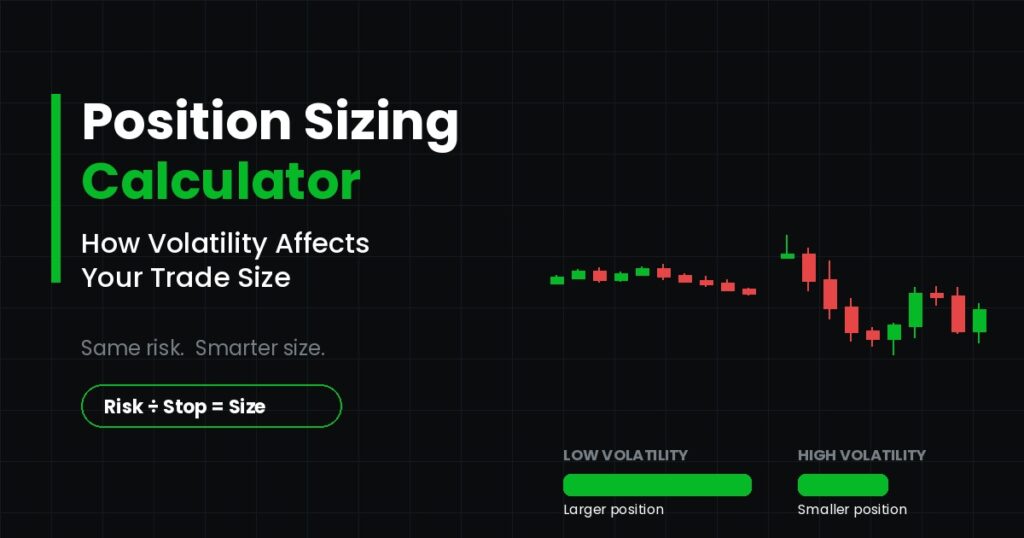
Most traders spend hours hunting for the perfect entry. However, the size of a trade often decides whether an account survives a losing streak. Two traders can take the same setup and still get very different results. The difference usually comes down to how much they risk.
A position sizing calculator turns that decision into a simple, repeatable process. Instead of guessing, you enter your account size, risk limit and stop distance. The result tells you exactly how many shares, lots or contracts to trade.
Yet one factor quietly changes every calculation: volatility. When a market swings wildly, a fixed trade size can expose you to far more risk than you planned. In this guide, you will see how volatility affects your trade size. You will also learn how to calculate position size step by step, so your risk stays steady in calm and wild markets alike.
What Is a Position Sizing Calculator?
A position sizing calculator works out how large a trade should be based on your risk rules. In other words, it answers one question: how much can I buy without losing more than I can accept?
Every calculation relies on four inputs:
- Account balance: the total capital in your trading account.
- Risk percentage: the share of that balance you are willing to lose on one trade.
- Entry price: where you plan to open the position.
- Stop-loss price: where you will exit if the trade moves against you.
The gap between entry and stop is the key variable. A wide stop means each unit carries more risk, so you buy fewer units. Conversely, a tight stop lets you buy more units for the same dollar risk.
This is why sizing has nothing to do with how confident you feel. Rather, it matches your exposure to the distance price might travel before the trade idea is proven wrong. Professional trading desks have relied on this logic for decades, and it remains the foundation of sound risk management.
How Volatility Changes the Right Trade Size
Volatility measures how far and how fast price tends to move. A stock that moves 1% a day behaves very differently from one that moves 6% a day. Consequently, the same stop distance cannot work for both.
Consider what happens in a volatile market. Normal price noise becomes larger, so a tight stop gets hit by random swings. To avoid that, you must place your stop further away. A wider stop, however, raises the risk on every unit. Therefore, a position sizing calculator reduces the number of units to keep your total risk unchanged.
The reverse applies in quiet markets. Price moves less, so a closer stop can survive normal noise. As a result, the calculator allows a larger position while the dollar risk stays the same.
This creates an important principle: position size and volatility move in opposite directions. When volatility rises, size falls. When volatility drops, size grows. Your risk per trade, on the other hand, stays fixed.
Many traders ignore this and trade the same size every time. That habit feels simple, but it hides a serious flaw. During volatile periods, their real risk can double or triple without them noticing. After years of reviewing trading journals, I have seen this single mistake behind many sudden drawdowns. Volatility-adjusted sizing keeps each trade’s impact on the account consistent, whatever the market mood.
Using ATR to Set Volatility-Based Stops
So how do you decide how wide a stop should be? One widely used answer is the Average True Range, or ATR. J. Welles Wilder introduced ATR in 1978. It measures the average price range over a set number of periods, usually 14.
ATR gives you an objective reading of current volatility. Instead of guessing a stop distance, you place it at a multiple of ATR. Many traders use 1.5 to 3 times ATR, depending on their timeframe and style.
Here is how it works in practice:
- A stock has a 14-day ATR of $1.50.
- You choose a 2× ATR stop, so the stop sits $3 below your entry.
- With $200 at risk, the position size becomes about 66 shares.
If ATR later climbs to $3, the same 2× rule pushes your stop $6 away. Your position then shrinks to about 33 shares. Meanwhile, the risk remains $200.
This approach links your stop, your size and market conditions in one consistent method. It also takes emotion out of stop placement, which is where many traders struggle. Feeding an ATR-based stop into a position sizing calculator is one of the simplest ways to build volatility awareness into every trade.
Risk Per Trade Calculator: Choosing Your Risk Percentage
A risk per trade calculator focuses on the first input: how much of your account you put on the line. This number matters more than most people realise, because it controls how quickly losses compound.
Most experienced traders risk between 0.5% and 2% per trade. Here is why that range is so common. At 1% risk, ten losing trades in a row cost roughly 10% of the account. At 5% risk, the same streak wipes out about 40%. Recovering from a 40% loss then requires a 67% gain, which is a steep climb.
Furthermore, volatility should shape this choice too. When markets turn unusually turbulent, many professionals cut their risk percentage for a while. For instance, a trader who normally risks 1% might drop to 0.5% around major news events. A risk per trade calculator makes these adjustments quick and precise.
Keep these guidelines in mind:
- Choose a fixed percentage and write it into your trading plan.
- Lower your risk after a run of losses rather than raising it to “win it back.”
- Watch correlated trades, since three positions in the same sector act like one larger bet.
Ultimately, the risk percentage sets your ceiling. The position sizing calculator then fits each trade neatly beneath that ceiling.
Common Position Sizing Mistakes to Avoid
Even disciplined traders slip into habits that undermine their sizing. The most frequent errors include:
- Using a fixed share count. Trading 100 shares every time ignores volatility completely. As a result, risk swings wildly from one trade to the next.
- Moving the stop to fit the size. Some traders pick a size first, then squeeze the stop to make the math work. This puts stops inside normal noise, so they get hit far too often.
- Ignoring gaps and slippage. Overnight gaps can jump straight past a stop. Therefore, volatile assets deserve extra caution and a slightly smaller size.
- Forgetting leverage. Margin magnifies both gains and losses. A leveraged position should still be sized by risk, not by available buying power.
- Recalculating rarely. Your balance changes after every trade. For that reason, update your position sizing calculator inputs before each new entry.
All of these mistakes share a common root. In each case, something other than risk decides the trade size.
Practical Habits for Consistent Position Sizing
Good sizing gets easier once it becomes part of your routine. Start by checking ATR or recent price ranges before every trade. Next, set your stop based on market structure and volatility, not on the size you want. Then run the numbers through a position sizing calculator before you place the order.
It also helps to keep a simple journal. Record your planned risk, the actual result and the volatility reading at entry. Over time, clear patterns will appear. You may notice, for example, that your biggest losses came on days when you skipped the calculation.
Finally, review your risk percentage every few months. As your skills and account grow, your comfort with risk may change. Adjust it deliberately, though, and never in the middle of a losing streak.
Final Thoughts
Volatility is not something to fear; it is something to measure. A position sizing calculator lets you respect that measurement on every single trade. When markets get wild, your size shrinks. When they calm down, your size grows. Through it all, your risk stays exactly where you planned it. Once you know how to calculate position size and pair it with a sensible risk per trade calculator, consistency follows naturally.
At GainzAlgo, we believe sound risk management matters just as much as any trading signal. Traders who ask “is GainzAlgo legit” usually want to know whether a tool fits a responsible approach to the markets. The honest answer is that no indicator can replace disciplined sizing. Pair any signal with careful, volatility-based position sizing, and you give your strategy a fair chance to work over time.