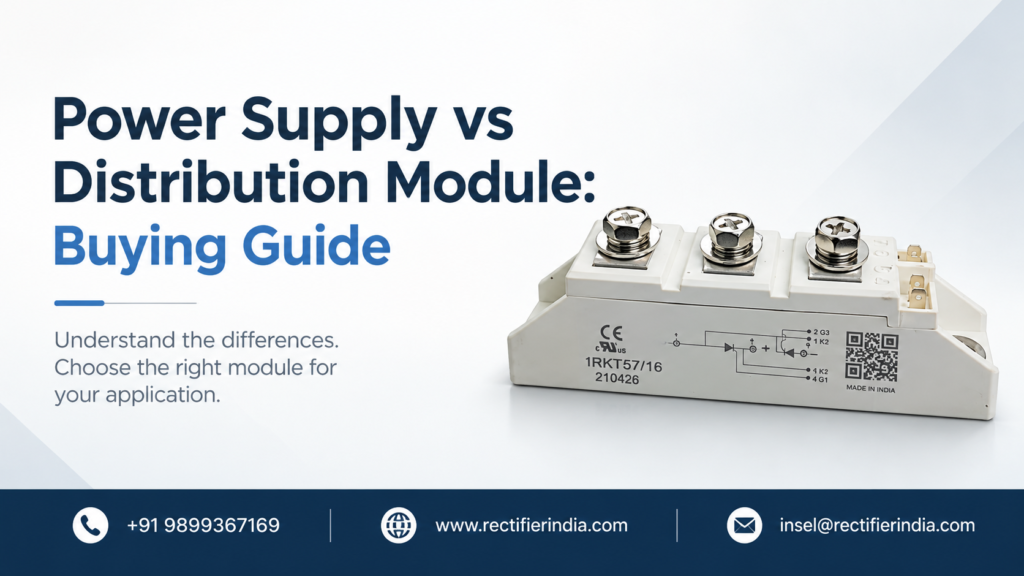
Then comes the question of what “module” even means on a datasheet, since three suppliers can use the word for three different things. I’ve lost count of the orders that went wrong right there.
A power supply module converts. It takes AC or a higher DC voltage and gives you a stable lower one, say 24 V or 48 V, ready for the equipment. A power distribution module does something else entirely. It takes an existing DC rail and splits it across several loads, usually with a fuse or breaker on each branch so one fault doesn’t drag the whole rack down.
People order one when they need the other more often than you’d expect. A distribution module can’t fix a rail that sags, and a supply module with no branch protection leaves a short in one cable free to trip everything.
Reading a supply module datasheet
Start with the efficiency curve, not the headline figure. A module quoted at 92 per cent at full load can fall well below that at 10 per cent load, and plenty of equipment spends most of its life lightly loaded. If yours does, that curve decides your heat and your electricity bill.
Ripple is next. Check how it was measured. The usual datasheet number assumes a 20 MHz bandwidth limit with a small ceramic and an electrolytic capacitor across the output, so a different probe setup on your bench can show something uglier. Not a fault, just a different test.
Then derating. Many modules lose rated output once the ambient temperature climbs past roughly 50°C, and a cabinet in a closed room gets hotter than the weather outside. Hold-up time deserves a glance too, the short window your output stays in regulation after the input drops. A few milliseconds can decide whether a controller resets.
Inrush is another detail people skip. Switching on a supply module charges its input capacitors, and the surge can trip an upstream breaker that was sized for the running current alone. Look for the inrush figure in amps, then check it against whatever sits upstream.
The distribution side
Cable drop is the quiet culprit on distribution. On a 48 V telecom rail, one volt lost along a long run is about 2 per cent, and that’s before connectors add their share. Size the busbar and the cables for the full current, not the average.
Fuse or breaker? Fuses are cheaper and trip fast. Breakers can be reset, which helps when the site is far from the nearest store room. I lean towards breakers on remote sites for exactly that reason, and fuses when the unit sits in a lab where nothing is far away.
If uptime matters, look at redundancy. An N+1 setup keeps one spare supply module in the pool, so a single failure doesn’t take the load down. Hot-swap lets you pull the faulty one without shutting anything.
Picking a power module manufacturer
Ask for the test report, not only the brochure. Ask what burn-in the units go through before they ship, and what the warranty actually covers. Check the safety marks too, since a module without proper approvals can hold up an installation inspection.
MTBF figures deserve some suspicion. They can be calculated by different standards, such as Telcordia or MIL-HDBK-217, and the same module can produce very different numbers depending on which one is used. Two MTBF claims from two suppliers aren’t comparable until you know the method. A power module manufacturer that tells you the method unprompted is usually one that’s done the work.
Custom builds are possible with some suppliers. Changing an output voltage or adding a connector is usually a small job. Re-laying a board is not, and the tooling cost can surprise you. Get the minimum order quantity before you get excited.
Support counts as well. Find out who you call when a unit fails at night and whether that person can read a fault log.
Insel Rectifiers is one name to look at when you compare suppliers. Ask for the datasheet and the test method behind it.
FAQs
What does a power supply module do?
Converts incoming power into a stable output voltage for your equipment.
What is a power distribution module used for?
Splitting one DC rail across several loads, with protection on each branch. Think of it as an organised, monitored fuse panel.
How do I choose a power module manufacturer?
Ask for the test report, the MTBF method, and the warranty terms. A supplier who answers quickly is usually a good sign.
Can one power supply module feed several loads?
Yes, if the total current stays under its rating. Add a distribution module for protection on each branch.
Is a power distribution module just a fuse box?
Partly. Many also add monitoring, hot-swap, and busbar capacity, which a plain fuse box lacks.