Of all the aches pregnancy can bring, pelvic pain is the one I hear described with the most frustration. It is not always the loudest pain, but it gets in the way of everything: rolling over in bed, climbing the stairs at home, stepping out of the car in a Buckhead parking deck, or simply putting on a pair of jeans while standing on one leg.
Pelvic and hip discomfort in pregnancy is common, it is real, and it deserves more than a shrug and a “that’s just pregnancy.” That is a big part of why moms start looking into prenatal chiropractic care in Atlanta, especially once the pain starts affecting sleep and daily routines.
In this article, I want to focus specifically on the pelvis. I’ll explain why it hurts, how pelvic pain differs from regular back pain and from sciatica, what a gentle prenatal chiropractic approach looks like for this kind of discomfort, and which symptoms mean you should call your OB or midwife first. In my experience, simply understanding what is going on in your pelvis takes away a lot of the worry, even before anything else changes.
As always, this is general education, not medical advice. Your obstetric team leads your care, and any chiropractor you work with should be comfortable coordinating with them.
Why the Pelvis Takes So Much Strain in Pregnancy
The pelvis takes so much strain in pregnancy because it is both the foundation your spine sits on and the structure that has to loosen to allow birth. Those two jobs pull in opposite directions. Your pelvis needs to be stable enough to carry you and your baby, and mobile enough to open up later.
Your pelvis is a ring made of several bones joined by strong ligaments. At the back, it meets the base of your spine at the two sacroiliac joints, often called SI joints. At the front, the two halves meet at the pubic symphysis. In everyday life, these joints move very little. In pregnancy, hormones relax the ligaments around them so they can move a little more.
Add the forward shift in your center of gravity and the growing weight of your baby, and those joints start working under a load they are not used to. If one side moves a little more than the other, or if the muscles around the pelvis tighten up to compensate, you can feel it in the lower back, the buttocks, the groin, the hips or the inner thighs.
This is also why pelvic pain often feels different from typical lower back pain in pregnancy. It may sit lower, closer to the dimples above your buttocks, or right at the front of the pubic bone. It often shows up with specific movements rather than as a constant ache.
Pelvic Girdle Pain: What It Is and How It Feels
Pelvic girdle pain, often shortened to PGP, is pain in the joints of the pelvis during pregnancy. You may also hear it called symphysis pubis dysfunction, or SPD, when the pain centers at the front of the pelvis.
The NHS guide to pelvic pain in pregnancy explains that PGP is not harmful to your baby, but it can be painful and make it hard to get around. According to the NHS, the pain can be felt over the pubic bone, across one or both sides of the lower back, in the area between your vagina and anus, or spreading to your thighs. Some women also feel or hear a clicking or grinding in the pelvic area.
Pain from PGP is often worse with:
- Walking, especially longer walks.
- Going up or down stairs.
- Standing on one leg, such as when getting dressed.
- Turning over in bed.
- Moving your legs apart, such as getting in and out of the car.
The NHS also notes that many women with PGP can still have a normal vaginal birth, and explains that PGP tends not to get completely better until after the birth, but treatment can often improve symptoms. I find that last point important. It sets an honest expectation: the goal is usually to make you more comfortable and mobile, not to make the pain vanish overnight.
SI Joint Pain vs. Sciatica vs. General Back Pain
SI joint pain, sciatica and general back pain can feel similar, but they come from different places. Knowing the difference helps you describe your symptoms clearly and helps your provider choose the right approach.
Here is a simple way I like to break it down:
SI joint pain usually sits low in the back, off to one side, near the dimple above the buttock. It often gets worse when you stand up from sitting, climb stairs, or roll over. It can spread into the buttock and sometimes the back of the thigh, but it rarely travels below the knee.
Sciatica describes pain from irritation of the sciatic nerve. It tends to shoot or burn down the back of one leg, sometimes past the knee into the calf or foot, and may come with tingling or numbness. True sciatica is less common in pregnancy than many people think. A lot of what gets called “sciatica” in pregnancy is actually sciatic-type pain, meaning it comes from the pelvis and the deep muscles of the buttock pressing on or irritating the area rather than a disc problem. If you want to understand the nerve side of this better, Corrective Chiropractic has a helpful overview of sciatica pain treatment.
General back pain in pregnancy is usually a broader ache across the lower back from posture changes and muscles working overtime. It often feels worse at the end of the day or after standing for a long time.
You can have more than one at once. That is why a careful evaluation matters more than any label you find online.
What Sciatic-Type Pain in Pregnancy Feels Like
Sciatic-type pain in pregnancy usually feels like a sharp, shooting or electric pain that starts in the buttock and travels down the back of the leg. It can come and go, and it often flares with certain positions.
Cleveland Clinic has a useful article on handling sciatica during pregnancy that I often point friends toward. It notes that most women experience some back pain during pregnancy, often in the third trimester, and it shares an important line from an OB/GYN: discomfort during pregnancy is normal, but severe pain is not. The same article lists warm showers, a heating pad, yoga, massage and seeing a chiropractor among the options that may help.
Moms often describe sciatic-type pain like this:
- “It feels like a hot line running down the back of my leg.”
- “It gets worse when I’ve been sitting for a while and then stand up.”
- “It’s fine when I’m walking, then suddenly it zaps me.”
- “One side is fine, the other side is miserable.”
If your pain is mild to moderate and comes with movement, gentle care and smart habits may help. If you have numbness that does not go away, weakness in your leg, or changes in bladder or bowel control, that is a red flag and you should contact your provider right away.
How Prenatal Chiropractic Care Supports Pelvic Comfort
Prenatal chiropractic care supports pelvic comfort by evaluating how your pelvis and lower spine are moving, then using gentle, pregnancy adapted techniques to support balanced movement and ease tension in the surrounding muscles. The aim is comfort and function, not forcing anything back into place.
Corrective Chiropractic describes its prenatal approach as gentle, individualized care focused on spinal and pelvic function, mobility and comfort. Pelvic function, lower back pain, pelvic and hip discomfort and sciatic-type pain are among the most common reasons moms come in. That lines up with what I hear from moms all the time.
For pelvic and hip pain, care typically includes:
- A detailed history. When did the pain start, what makes it worse, which side, and what has your OB or midwife said?
- A movement focused evaluation. How do your SI joints, hips and lower back move? Is one side stiffer? How do you stand, walk and shift weight?
- Gentle adjustments. Low force techniques tailored to loosened ligaments and your stage of pregnancy.
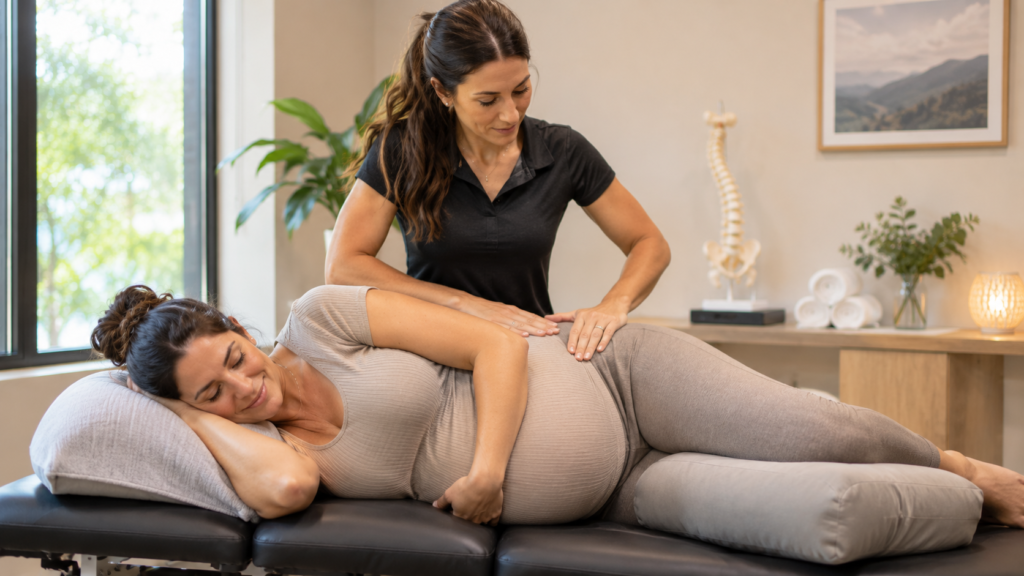
- Supportive positioning. Side lying setups and cushions so there is no pressure on your belly. You are never asked to lie flat on your stomach.
- Soft tissue and muscle work where appropriate, especially around the buttocks and hips.
- Home advice. Small changes to how you sleep, sit, dress and get out of the car.
If you are curious about the broader philosophy behind this kind of care, the clinic’s page on corrective chiropractic care explains how they approach spinal function in general. Prenatal care takes those ideas and softens them for pregnancy.
What prenatal chiropractic care in Atlanta should not promise
I think it is just as important to talk about what responsible care does not claim. Prenatal chiropractic care in Atlanta should not promise to cure PGP, guarantee a shorter labor, turn a baby, or replace your OB. If any provider makes those promises, I would be cautious. Good care is honest about what it can and cannot do.
Everyday Moves That Make Pelvic Pain Worse (and Easy Swaps)
Many everyday movements make pelvic pain worse because they load one side of the pelvis more than the other or spread the legs apart under weight. Small swaps can make a surprising difference.
Here are the swaps I share most often, based on NHS and Mayo Clinic advice for pelvic and back pain in pregnancy:
Getting dressed. Standing on one leg to pull on pants or socks loads one SI joint heavily. Swap: sit down to get dressed.
Getting out of the car. Swinging one leg out at a time twists and separates the pelvis. Swap: sit on the seat first, then keep your knees together and turn your whole body as one unit. A plastic bag on a fabric seat can help you swivel.
Climbing stairs. Taking stairs normally can be painful. Swap: go up one step at a time, leading with the less painful leg, and come down leading with the more painful leg. Take the elevator when you can.
Turning over in bed. Rolling with your knees apart can be one of the most painful moments of the day. Swap: keep your knees together and squeeze your buttocks as you turn. Satin sheets or pajamas can make sliding easier.
Carrying things. Holding a bag or toddler on one hip loads one side. Swap: use a backpack or split loads evenly, and ask for help with heavy items.
Sitting. Crossing your legs or sitting twisted adds strain. Swap: sit with both feet flat, knees level, and a small cushion behind your lower back.
Long walks. Walking can help, but too far can flare PGP. Swap: shorter walks more often. Water exercise is a great alternative for many moms.
I know these sound small. In my experience, they are often the difference between a day where pain runs the show and a day where you feel like yourself.
Sleep Positions for Pelvic and Hip Discomfort
The best sleep position for pelvic and hip discomfort in pregnancy is usually on your side, with your knees bent and a pillow between your knees and ankles to keep your hips level. Many moms also add a pillow under the belly for support.
Mayo Clinic recommends sleeping on your side with one or both knees bent, and using a pregnancy pillow or a pillow between your knees and under your belly for support.
A few things I have found helpful when friends are struggling with nighttime pelvic pain:
- Use a long pillow. A full length pregnancy pillow keeps knees, ankles and belly supported at once, so you are not constantly readjusting.
- Keep your top knee in line with your hip. If your top leg drops forward and down, your pelvis twists. A thick pillow keeps it level.
- Switch sides gently. Keep your knees together when you roll.
- Try a firmer surface. A very soft mattress can let your hips sink and twist. A mattress topper can help balance comfort and support.
- Get up carefully. Roll to your side, push up with your arms, and swing your legs down together.
If one hip aches from lying on it, a soft mattress topper or an extra cushion under that hip can ease pressure.
Red Flags You Should Never Ignore
Some pelvic and back symptoms in pregnancy are not mechanical at all. If your pain comes with any of the following, contact your OB, midwife or emergency services right away rather than booking a chiropractic visit.
The NHS advises contacting your midwife or GP if you have pain in your pelvis and it is hard to move around, it hurts to get out of a car or turn over in bed, or it is painful going up and down stairs. Mayo Clinic adds that you should call your healthcare provider right away if back pain comes with vaginal bleeding, fever or burning during urination.
Seek medical care promptly if you notice:
- Vaginal bleeding or leaking fluid.
- Regular tightening, cramping or pain that comes and goes in a pattern.
- Fever, chills or pain when you urinate.
- Severe, sudden or steadily worsening pain.
- Numbness in the groin or inner thighs, leg weakness, or loss of bladder or bowel control.
- Pain after a fall, car accident or blow to the belly.
- Reduced movement from your baby.
Corrective Chiropractic’s prenatal page is clear that its content is not medical advice and that you should call 911 in an emergency. Any good pregnancy chiropractor will screen for these signs and refer you out immediately if something does not look mechanical.
Working With Your OB or Midwife
Working with your OB or midwife means keeping them informed about any chiropractic care, sharing what you learn at visits, and letting them make the final call on anything related to your pregnancy. Chiropractic care is support. Your obstetric team is the lead.
Here is how I suggest handling it:
- Mention chiropractic care at your next prenatal appointment. Ask whether there is any reason it would not be right for you, such as specific complications.
- Tell your chiropractor about every complication. Placenta issues, bleeding, high blood pressure, a history of preterm labor or anything else your OB has flagged.
- Bring updates both ways. If your chiropractor notices something that does not seem mechanical, they should tell you to call your provider. If your OB changes your activity guidance, tell your chiropractor.
- Ask about a physiotherapy referral too. The NHS notes that physiotherapy for PGP may include exercises to strengthen your pelvic floor, stomach, back and hip muscles, and sometimes equipment like a pelvic support belt or crutches. Chiropractic and physio can complement each other.
In my experience, the moms who feel most confident are the ones who see their care as a team effort rather than a set of separate appointments.
Finding Prenatal Chiropractic Care in Atlanta That Fits
Finding prenatal chiropractic care in Atlanta that fits means looking for a clinic that understands pelvic pain in pregnancy, adapts every visit to your stage, and is easy for you to reach. When walking and driving are uncomfortable, a shorter commute matters more than you might expect.
Corrective Chiropractic has metro Atlanta offices in Buckhead, Chamblee, Decatur, Marietta, Sandy Springs and Woodstock, plus a Waynesboro, GA office and locations in North Carolina, South Carolina and Tennessee. If you are dealing with pelvic pain and want to ask questions before booking, you can always contact a chiropractor near you and talk through your symptoms first.
Questions worth asking any clinic before you book:
- “How do you evaluate pelvic and SI joint pain in pregnancy?”
- “How do you adapt positioning in the second and third trimester?”
- “Do you require X-rays?” (For routine prenatal care, the answer should be no.)
- “How do you decide how often I should come in?”
- “When would you refer me back to my OB or to a physiotherapist?”
- “Do you offer care after my baby is born?”
Clear, calm answers to those questions are a very good sign. In my experience, the right fit for prenatal chiropractic care in Atlanta is the clinic that listens first and explains its reasoning in plain language, so you leave every visit knowing what was done and why. If you feel rushed, unheard or pressured into a long package before your first evaluation, it is completely fine to keep looking. Your comfort and trust matter just as much as technique.
Life After Birth: Pelvic Recovery
Pelvic recovery after birth takes time, and many moms find the strain simply changes shape. Instead of carrying weight in front, you are now lifting, feeding, rocking and carrying a baby, often with one hip pushed out.
For most moms, PGP symptoms ease in the weeks or months after birth, though for some they hang around longer. Corrective Chiropractic offers postpartum care for exactly this transition, with attention to the strain that comes from feeding, carrying and lifting.
A few gentle postpartum habits I recommend:
- Feed with your back supported and baby brought up to you, not you hunching down to baby.
- Switch the hip you carry baby on.
- Keep using the “knees together” trick when getting out of bed or the car for the first few weeks.
- Ask your provider when it is safe to return to exercise, and start slowly.
Bringing It All Together
Pelvic, hip and sciatic-type pain can make pregnancy feel much harder than it needs to. The good news is that understanding where the pain comes from, adjusting a few daily habits and getting gentle, well matched support can help many moms move more comfortably through the months ahead.
Remember the key points: pelvic girdle pain is common and not harmful to your baby, it tends to ease after birth, severe pain is not normal, and red flags always go to your OB first. Prenatal chiropractic care in Atlanta can be one part of a thoughtful plan, alongside smart sleep positions, safe movement and the guidance of your obstetric team.
If you are ready to get your pelvis evaluated by a team that adapts every visit to your stage and comfort, you can book a visit for prenatal chiropractic care in Atlanta with Corrective Chiropractic. Tell them where it hurts, how far along you are, and what makes it worse, and let them build a plan around you.
Frequently Asked Questions
1. Can prenatal chiropractic care in Atlanta help with pelvic girdle pain?
Many moms seek prenatal chiropractic care for pelvic girdle pain because it focuses on pelvic and spinal movement and comfort. Results vary from person to person, and it works best alongside smart daily habits, physiotherapy if recommended, and guidance from your OB or midwife.
2. What is the difference between SI joint pain and sciatica in pregnancy?
SI joint pain usually sits low in the back near the buttock dimple and rarely travels below the knee. Sciatica tends to shoot down the back of the leg, sometimes into the foot, with tingling or numbness. Many pregnant women have sciatic-type pain from the pelvis rather than true sciatica.
3. Is pelvic girdle pain harmful to my baby?
According to the NHS, pelvic girdle pain is not harmful to your baby, although it can be very uncomfortable for you. Many women with it still have a normal vaginal birth. Talk to your midwife or OB about your birth plan if you have it.
4. Will pelvic pain go away after I give birth?
Pelvic girdle pain tends to improve after birth, though recovery can take some time. Postpartum care, gentle exercise and good lifting and carrying habits can support recovery. Speak with your provider if pain lingers.
5. What sleeping position is best for pelvic pain in pregnancy?
Side sleeping with your knees bent and a pillow between your knees and ankles usually works best. Keeping your top knee level with your hip prevents your pelvis from twisting, and a pillow under your belly adds extra support.
6. Is it safe to get a chiropractic adjustment with SPD?
Many clinics offer gentle, adapted care for moms with SPD or pubic symphysis pain. Tell your chiropractor exactly where the pain is and what triggers it, and check with your OB or midwife first, especially if you have other complications.
7. What pelvic pain symptoms mean I should call my OB?
Call your OB or midwife right away if pelvic pain comes with bleeding, leaking fluid, regular cramping, fever, pain when urinating, severe or worsening pain, numbness, leg weakness, or bladder or bowel changes. Call 911 in an emergency.
8. Do I need an X-ray for pelvic pain during pregnancy?
X-rays are not required for routine prenatal chiropractic care. Always let the clinic know if you are pregnant or might be, so they can evaluate you without imaging.
9. Can a support belt help with pelvic and hip discomfort?
Some moms find a maternity support belt helpful, especially later in pregnancy or with pelvic girdle pain. The NHS mentions support belts as one option physiotherapists may suggest. Ask your provider which type suits you.
10. Where can I find a pregnancy chiropractor in metro Atlanta?
Corrective Chiropractic has metro Atlanta offices in Buckhead, Chamblee, Decatur, Marietta, Sandy Springs and Woodstock, plus a Waynesboro, GA office and locations in the Carolinas and Tennessee.