Industrial heat has a funny habit: once a process gets hot, it rarely stays useful in just one place.
An industrial oven needs heat to cure, dry, bake, or process materials. A thermal oxidizer needs high temperatures to treat pollutants. Thermal cleaning equipment relies on controlled heat to remove coatings, oils, adhesives, and other residues. Even a paint booth can become part of a larger conversation about airflow, energy use, and emissions.
The interesting part is what happens after that heat has done its original job.
Instead of allowing valuable thermal energy to disappear through exhaust systems, modern manufacturers are looking more closely at heat recovery systems. The goal is straightforward: use energy more intelligently, reduce unnecessary fuel consumption, and make industrial processes work harder without simply turning up the heat.
First Question: Where Did All That Heat Go?
Here is the slightly awkward part of industrial heating: producing heat is only half the job.
Factories generate substantial amounts of thermal energy during production. Some of it is transferred directly into products or materials, while some leaves the process through exhaust air, combustion gases, ventilation systems, or other streams.
That outgoing heat is not automatically useless.
Waste heat recovery systems are designed to capture usable thermal energy from these sources and redirect it toward another process. Depending on the application, recovered heat may be used to preheat incoming air, warm process fluids, support another production stage, or reduce the energy required by heating equipment.
It is less about creating new energy and more about being smarter with energy that already exists.
The Industrial Oven: Still Hot, Just More Strategic

An industrial oven does not get many breaks.
It may operate for long production cycles, maintaining carefully controlled temperatures to cure coatings, dry components, bake materials, or complete other manufacturing processes. Keeping those temperatures stable can require significant energy.
This is where heat recovery systems can become particularly useful.
Exhaust air leaving an oven can contain considerable thermal energy. Rather than immediately sending all of that heat outside, a properly designed recovery system can transfer part of its energy to incoming air.
The result can be lower heating demand for the oven.
The oven still gets hot. It just does not have to work quite as hard to stay there.
Paint Booths Have an Energy Story Too
Paint booths are primarily associated with coating quality, ventilation, worker safety, and contamination control. Energy efficiency may not be the first thing that comes to mind.
But airflow requires energy, and conditioned air does not come free.
A paint booth may exhaust large volumes of air while simultaneously requiring replacement air to be heated or cooled. In facilities operating throughout the year, that exchange can become a meaningful energy consideration.
Depending on the process and system design, heat recovery can help transfer energy between outgoing and incoming air streams while maintaining the required ventilation conditions.
The important word is “properly.”
Recovery equipment should never compromise required airflow, contamination control, safety requirements, or process conditions simply to chase an energy-saving number.
Efficiency matters, but production requirements still get the final vote.
Thermal Oxidizers: The Hot Part That Can Keep Helping

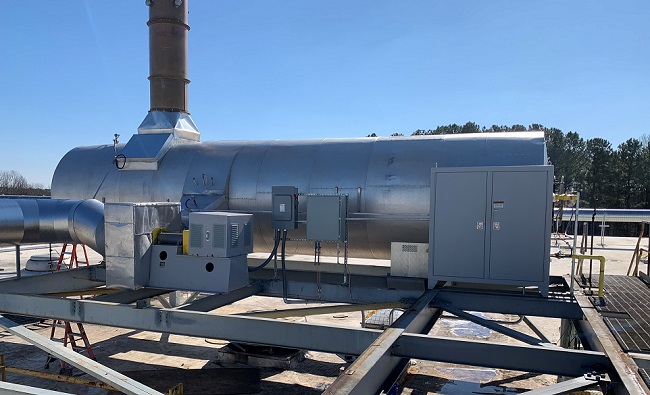
A thermal oxidizer is designed to treat volatile organic compounds and other combustible pollutants by using controlled thermal oxidation.
In simple terms, contaminated process air enters the system, reaches the required treatment conditions, and leaves after the pollutants have been converted into less harmful compounds.
That process requires heat.
It also creates an opportunity.
Because thermal oxidizers operate at elevated temperatures, their exhaust can contain significant recoverable energy. Modern heat recovery approaches can capture some of that thermal energy and redirect it to other parts of the facility.
Depending on the system, recovered heat may support combustion-air preheating, process-air heating, or another compatible thermal demand.
This is one reason thermal oxidizer design increasingly involves more than simply asking, “Does it destroy the pollutants?”
A better question is also:
“How efficiently can the system manage the energy required to do that job?”
Thermal Cleaning Equipment: Cleaning Without Pretending Heat Is Free
Thermal cleaning equipment is commonly used to remove unwanted organic materials from parts, components, tools, and manufacturing equipment.
The principle is effective: controlled temperatures break down or remove residues that would otherwise require extensive manual or chemical cleaning.
But thermal cleaning still consumes energy.
That makes system design important.
Thermal cleaning solutions can be developed around factors such as operating temperature, batch size, cycle duration, insulation, airflow, combustion efficiency, and heat recovery opportunities.
For facilities running frequent cleaning cycles, even modest improvements in thermal efficiency can become meaningful over time.
The trick is not necessarily to make the cleaning process hotter.
Sometimes the smarter move is to make the existing heat do more work.
Heat Recovery Systems Are Not a Magic Wand
It would be convenient if every factory could install a recovery unit, watch the energy bill fall, and call it a day.
Industrial equipment rarely behaves that politely.
Heat recovery depends on the temperature, volume, cleanliness, consistency, and timing of the available heat source. The location of the heat source also matters. So does the location of the process that needs the recovered energy.
If waste heat is available at one end of a facility while the thermal demand is far away, transferring that energy may become more complicated.
There can also be issues involving condensation, corrosion, fouling, pressure drop, process compatibility, and maintenance.
In other words, “free heat” is not actually free if recovering it creates a new maintenance problem.
Good engineering looks at the entire system.
The Temperature Gap Matters More Than People Think

Not all waste heat has the same value.
Imagine two exhaust streams. One leaves a process at a very high temperature. Another is only slightly warmer than the surrounding environment.
Both technically contain heat.
But they do not necessarily have the same recovery potential.
The useful question is not simply how much heat exists. It is whether that heat exists at a temperature and flow rate that make recovery practical.
This is why an energy assessment should consider:
- Heat-source temperature
- Exhaust volume
- Operating schedule
- Thermal demand elsewhere
- Distance between source and user
- Required process temperatures
- Equipment compatibility
- Maintenance requirements
A heat recovery project should begin with measurements, not assumptions.
The New Factory Mindset: Stop Treating Exhaust as the Finish Line
Modern industrial efficiency is increasingly about connecting processes rather than evaluating equipment in isolation.
An industrial oven may produce hot exhaust.
A thermal oxidizer may produce another high-temperature exhaust stream.
Thermal cleaning equipment may operate in repeated cycles.
A paint booth may exhaust conditioned air.
Individually, these systems have different purposes. Together, they may reveal opportunities for smarter energy management.
This is where waste heat recovery systems become part of a broader plant strategy.
Instead of asking, “How efficient is this machine?”
Engineers can ask:
“How does this machine interact with everything around it?”
That shift can uncover opportunities that are invisible when each piece of equipment is considered separately.
What Does This Look Like in Real Operations?
Suppose a facility operates an industrial oven continuously and uses a thermal oxidizer to treat process emissions.
The oven produces heated exhaust. The oxidizer also operates at elevated temperatures.
Rather than automatically releasing all available thermal energy, engineers can evaluate whether some of that energy can be recovered and reused.
Perhaps recovered heat can preheat combustion air.
Perhaps it can assist with incoming process air.
Perhaps it can support another heating demand.
The exact solution depends on the facility.
There is no universal “install this one thing” answer because industrial processes have different operating conditions.
And that is actually good news.
It means energy efficiency can be engineered around the process rather than forced into it.
A Quick Reality Check: Is Heat Recovery Worth Investigating?

If your facility answers “yes” to several of these questions, it may be worth taking a closer look:
- Do you operate high-temperature equipment for long periods?
- Does hot exhaust leave the facility continuously or frequently?
- Do you have another process that requires heating?
- Are fuel costs becoming a larger operational concern?
- Do your thermal processes run on predictable schedules?
- Is your facility considering equipment upgrades?
- Are you already evaluating energy-efficiency improvements?
The strongest opportunities often appear when a consistent heat source exists alongside a consistent thermal demand.
That combination is where the numbers can become interesting.
Reader Check-In: The Questions Engineers Usually Ask
Can waste heat really be reused?
Yes, when the heat source has suitable temperature, flow, and operating characteristics. Recovery systems can transfer thermal energy from one process stream to another instead of allowing it to leave unused.
Can heat recovery work with a thermal oxidizer?
It can. Thermal oxidizers are often evaluated for heat recovery because they operate at high temperatures. The appropriate recovery approach depends on the oxidizer design, exhaust characteristics, process requirements, and applicable safety considerations.
Is heat recovery useful for an industrial oven?
Potentially. Oven exhaust can contain recoverable thermal energy, which may be used to preheat incoming air or support another compatible process.
Does thermal cleaning equipment benefit from energy recovery?
It can, particularly in facilities with frequent or continuous thermal cleaning cycles. Reviewing cycle temperatures, exhaust conditions, and operating schedules can help identify practical recovery opportunities.
Can a paint booth use heat recovery?
In some applications, yes. Airflow and ventilation requirements must be carefully considered, but energy recovery may help reduce the energy needed to condition replacement air.
Are waste heat recovery systems expensive?
Costs vary significantly based on the heat source, recovery technology, installation complexity, and intended application. The better question is whether the expected energy savings and operational benefits justify the investment over the equipment’s useful life.
What is the first step?
Measure the process.
Before selecting equipment, understand where heat is being generated, how much is available, when it is available, and where thermal energy is needed.
That information turns a vague efficiency idea into an engineering problem that can actually be evaluated.
The Practical Takeaway

Industrial energy efficiency does not always require completely new production technology.
Sometimes it starts with looking differently at existing equipment.
A thermal oxidizer may have recoverable energy. An industrial oven may have useful exhaust heat. Thermal cleaning equipment may offer opportunities to improve cycle efficiency. A paint booth may present air-conditioning or heating recovery considerations.
And thermal cleaning solutions can be designed with energy use in mind from the beginning.
The broader role of heat recovery systems is simple: capture useful thermal energy before it disappears, then find a practical place for it to work again.
That does not mean every exhaust stream deserves a recovery system.
It means every significant heat source deserves a closer look.
Because in a modern industrial facility, efficiency is not always about producing less.
Sometimes it is about getting a second shift out of the energy you already paid for.