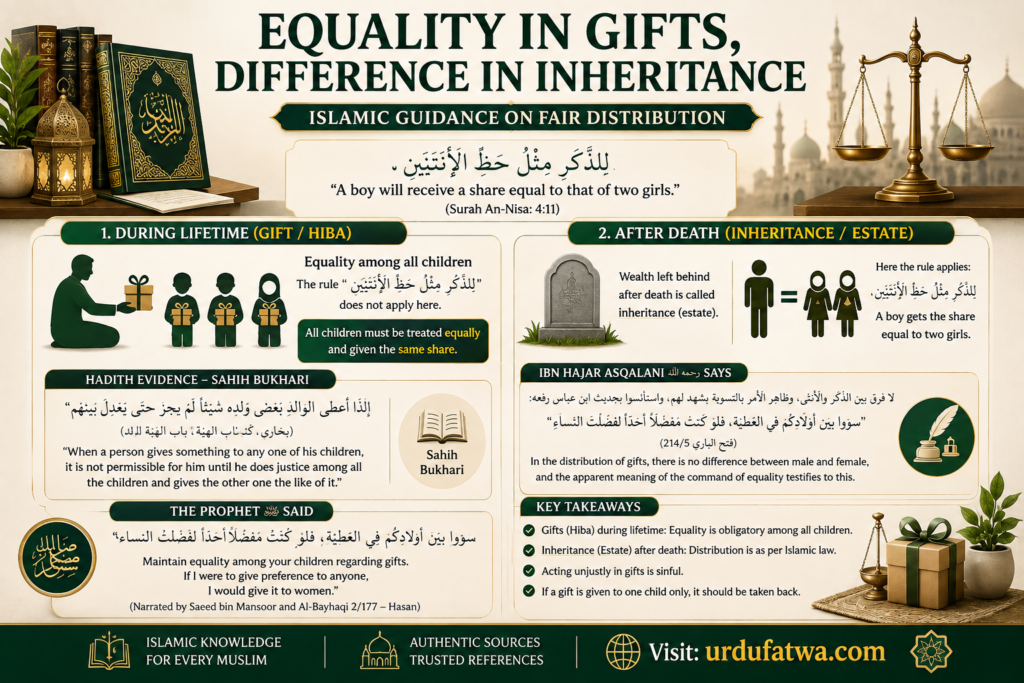
The distribution of a person’s property is of two types. (1) During his lifetime (2) After his death. In the first case, when a person distributes property among his children, it is not called inheritance but is called giving Hiba or a gift. And in the second case, the wealth that is left behind is called inheritance or estate. In this case, Allah تعالیٰ has mentioned the principle and rule for the distribution of property that لِلذَّكَرِ مِثْلُ حَظِّ الْأُنثَيَيْنِ that a boy will receive a share equal to that of two girls.
Whereas in the first case, there will be equality and equal treatment among the children; the rule of لِلذَّكَرِ مِثْلُ حَظِّ الْأُنثَيَيْنِ will not apply.
Imam Bukhari رحمۃ اللہ علیہ says:
” إذا أعطى الوالد بعض ولده شيئاً لم يجز حتى يعدل بينهم ويعطي الآخر مثله ” (بخاری، کتاب الهبة، باب الهبة للولد)
When a person gives something to any one of his children, it is not permissible for him until he does justice among all the children and gives the other one the like of it. Imam Bukhari رحمۃ اللہ علیہ has presented this Hadith as evidence.
“عن عامر قال سمعت النعمان ابن بشير رضى الله عنهما وهو على المنبر يقول اعطانى أبى عطية فقالت عمرة بنت رواحة لا أرضى حتى تشهد رسول الله صلى الله عليه وسلم فأتى رسول الله صلى الله عليه وسلم فقال انى اعطيت ابنى من عمرة بنت رواحة عطية فأمرتنى أن اشهدك يا رسول الله قال أعطيت سائر ولدك مثل هذا قال لا قال فاتقوا الله واعدلوا بين اولادكم قال فرجع فرد عطيته” (بخاری، کتاب الھبة، باب الاشهاد فی الهبة 2587)
“Amir Shabi said: I heard Numan bin Bashir رضی اللہ عنہ saying on the pulpit. My father gave me a gift, so Amrah bint Rawahah said: I will not be pleased until you make the Messenger of Allah صلی اللہ علیہ وسلم a witness to it. So he came to the Messenger of Allah صلی اللہ علیہ وسلم and said: I have given a gift to one of my sons from Amrah bint Rawahah. O Messenger of Allah, she has instructed me to make you a witness to it. He said: Have you given all your children a gift in the same way? He said: No. He said: Fear Allah and be just among your children. So he returned and took back his gift.”
Hafiz Ibn Hajar Asqalani رحمۃ اللہ علیہ says:
” وقد تمسك به من أوجب التسوية في عطية الأولاد وبه صرح البخاري وهو قول طاوس والثوري وأحمد وإسحاق وقال به بعض المالكية ” (فتح الباری 5/214)
“Those who have declared equality in gifts among children to be obligatory have relied upon this Hadith, and Imam Bukhari has also explicitly stated this, and this is also the view of Tawus, Sufyan al-Thawri, Ahmad, Ishaq bin Rahwayh, and some of the Malikis.”
Regarding the distribution of gifts, Ibn Hajar, while explaining the position of these Hadith scholars, says:
“لا فرق بين الذكر والأنثى، وظاهر الأمر بالتسوية يشهد لهم، واستأنسوا بحديث ابن عباس رفعه: “سووا بين أولادكم في العطية، فلو كنت مفضلاً أحداً لفضلت النساء”، اخرجه سعيد بن منصور والبيهقي من طريقه، وإسناده حسن” (فتح الباری 5/214)
“In the distribution of gifts, there is no difference between male and female, and the apparent meaning of the command of equality mentioned in the Hadith also testifies to this, and they have also taken evidence from the Marfu Hadith of Abdullah bin Abbas رضی اللہ عنہ.”
The Messenger of Allah صلی اللہ علیہ وسلم said: “Maintain equality among your children regarding gifts. If I were to give preference to anyone, I would give it to women.” It has been narrated by Saeed bin Mansoor, and Imam Bayhaqi (2/177) has narrated it through the same chain, and its chain of narration is Hasan.
The above explanation makes it clear that if a person wants to distribute his property among his children during his lifetime, either due to the fear of any dispute or conflict among the children or otherwise, then it is obligatory upon him to maintain justice and fairness among the children. Whatever share he gives to the boy, he should give the same to the girl. In the terminology of Shariah, this is called Hiba or a gift.
If he does not act with justice among his children, he will be sinful. And if he has given something to one of his children and has not given it to the others, then the father should take back such Hiba or gift, and if he has departed from this world and left behind some wealth, then it is called estate and inheritance, and its distribution will be according to the law of inheritance.
والله اعلم بالصواب

