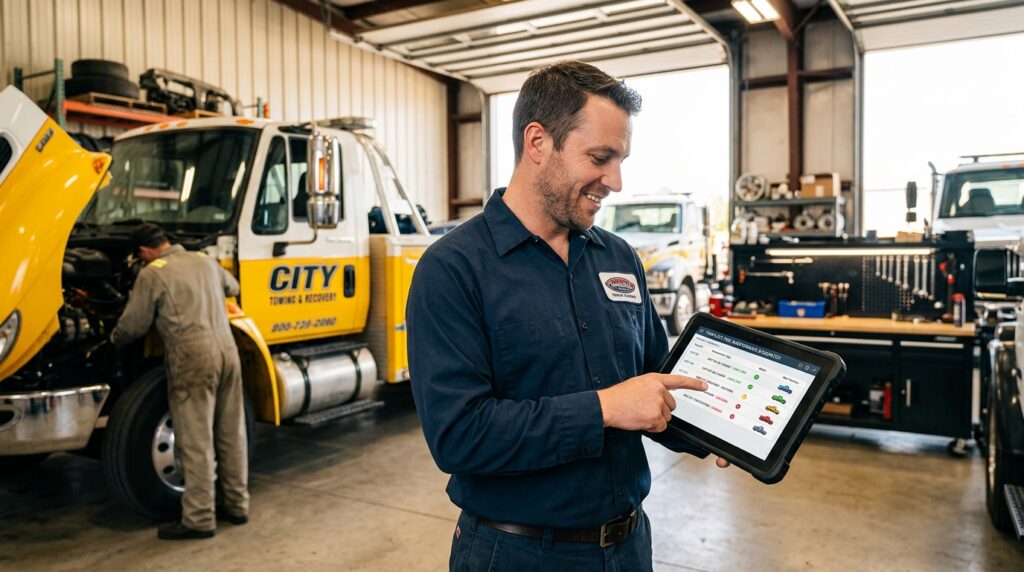
Tow truck repair software helps towing companies manage vehicle repairs, organize work orders, track repair histories, manage spare parts, and improve fleet maintenance operations. For businesses that depend on reliable trucks to respond to roadside emergencies, transport disabled vehicles, and provide vehicle recovery services, an efficient repair management system is essential.
Managing repairs manually through spreadsheets, paper records, and phone calls can become increasingly difficult as a towing fleet grows. Repair requests may be overlooked, parts availability can become uncertain, and communication between drivers, technicians, and fleet managers may become complicated. These issues can lead to longer repair times and unnecessary vehicle downtime.
Tow truck repair software provides a centralized platform for managing repair activities, monitoring vehicle conditions, and maintaining accurate service records. By streamlining repair workflows, towing businesses can improve operational visibility, coordinate maintenance tasks, and keep more vehicles ready for daily operations.
What Is Tow Truck Repair Software?
Tow truck repair software is a digital solution designed to help towing companies manage vehicle repairs, create work orders, track technician activities, maintain service histories, and monitor repair-related expenses. It enables fleet managers and maintenance teams to organize repair tasks from the initial problem report through diagnosis, parts allocation, repair completion, and vehicle release.
Depending on the platform, the software may include preventive maintenance scheduling, digital vehicle inspections, technician assignments, parts inventory, labor tracking, repair estimates, and maintenance reporting.
For example, a towing company operating several light-duty flatbeds and heavy-duty recovery trucks can use repair software to manage brake repairs, engine issues, hydraulic lift problems, winch repairs, tire replacements, and electrical faults. Instead of maintaining separate records for each truck, managers can access repair information through a centralized system.
The primary goal of tow truck repair software is to simplify repair management, reduce avoidable delays, improve maintenance visibility, and help towing businesses maintain reliable vehicles.
Why Do Towing Businesses Need Tow Truck Repair Software?
Tow trucks often operate under demanding conditions. They may travel long distances, handle heavy loads, perform frequent stops, and work in challenging weather. These operating conditions can increase wear on engines, transmissions, tires, braking systems, hydraulic equipment, winches, and recovery mechanisms.
Without a structured repair management process, small mechanical issues can develop into larger problems. Repair delays can also leave valuable vehicles unavailable when customers need roadside assistance or recovery services.
Reduce Vehicle Downtime
When a tow truck breaks down, the company may need to reschedule jobs, redirect another vehicle, or delay roadside assistance. Tow truck repair software helps managers identify reported problems, prioritize repairs, assign technicians, and monitor repair progress.
By maintaining clear records of unresolved issues and repair status, businesses can respond more efficiently to mechanical problems. Although software cannot prevent every breakdown, it can help reduce avoidable downtime through better coordination and timely repairs.
Streamline Repair Work Orders
Repair work orders provide a structured way to document vehicle problems and organize the work required to resolve them. A digital work order can include the truck identification, reported fault, diagnosis, assigned technician, required parts, labor hours, and repair status.
For instance, if a driver reports that a hydraulic lift is operating slowly, the maintenance manager can create a repair order, assign an inspection, document the diagnosis, and track the work until the vehicle is ready for dispatch.
This process reduces confusion and creates accountability throughout the repair workflow.
Improve Repair History Management
Each tow truck has its own repair history. One vehicle may experience recurring brake issues, while another may require repeated hydraulic system repairs.
A centralized repair history allows managers to review previous faults, replaced components, completed repairs, labor costs, and inspection findings. This information helps technicians investigate recurring problems and supports more informed decisions about repair priorities and vehicle replacement.
Control Repair and Maintenance Costs
Repair expenses can include parts, labor, outsourced services, towing equipment repairs, and vehicle downtime. Without accurate records, it can be difficult to understand where maintenance budgets are being spent.
Tow truck repair software can help businesses track repair expenses and identify vehicles that require frequent or costly work. Reporting capabilities vary by provider, but organized repair data can support better budgeting and cost-control decisions.
Essential Features of Tow Truck Repair Software
The right software should support the specific repair requirements of a towing fleet. The following features can help businesses organize repair operations more effectively.
1. Repair Order and Work Order Management
Work order management is one of the most important features of tow truck repair software. It helps businesses document reported issues, assign repair tasks, monitor progress, and maintain a record of completed work.
Useful capabilities may include:
- Creating repair orders for individual trucks.
- Recording reported faults and technician diagnoses.
- Assigning work to technicians or repair teams.
- Tracking repair status and job priorities.
- Recording labor hours and parts used.
- Documenting completed repairs and follow-up work.
A structured work order process helps ensure that reported problems are not forgotten and that managers can see which vehicles are waiting for inspection, parts, or repair completion.
2. Preventive Maintenance and Repair Scheduling
Although repair software focuses on resolving vehicle problems, preventive maintenance is equally important for reducing avoidable repairs.
Many platforms allow businesses to schedule oil changes, brake inspections, tire replacements, hydraulic system servicing, and other recurring maintenance tasks. Scheduling may be based on mileage, engine hours, time intervals, or manufacturer recommendations, depending on the software.
For towing companies with different vehicle types, customizable schedules can help ensure that light-duty flatbeds, wheel-lift trucks, integrated wreckers, and heavy-duty recovery vehicles receive appropriate attention.
3. Digital Vehicle Inspections
Digital inspections allow drivers and technicians to record vehicle conditions through standardized checklists. Instead of relying on paper forms, employees can submit inspection results electronically and document problems for further investigation.
Inspection checklists may cover:
- Tires, wheels, and braking systems.
- Engine fluids and cooling systems.
- Lights, mirrors, and safety equipment.
- Hydraulic hoses, cylinders, and pumps.
- Winches, cables, wheel lifts, and flatbed mechanisms.
- Warning lights and visible mechanical damage.
Some systems support photo attachments, defect reporting, and the conversion of inspection findings into repair orders. These features help maintenance teams track identified problems through to resolution.
4. Parts and Inventory Management
Tow truck repairs often require replacement parts such as filters, belts, brake components, tires, hydraulic hoses, fluids, electrical components, and recovery equipment accessories.
Inventory management features help companies track stock levels, record parts used during repairs, and identify items that need replenishment. Depending on the platform, businesses may also manage supplier information, purchase orders, and parts costs.
Better inventory visibility can reduce delays caused by unavailable components and help repair teams complete jobs more efficiently.
5. Technician and Labor Tracking
Repair operations become more complicated when several technicians work on multiple trucks at the same time. Technician management features help assign jobs, monitor repair progress, and record labor hours.
Managers can use this information to understand workloads, prioritize urgent repairs, and identify bottlenecks. For companies with in-house repair facilities, labor tracking can also help evaluate repair costs and technician productivity.
6. Vehicle Repair History
A detailed repair history provides a record of each truck’s maintenance and repair activities throughout its operating life.
Useful information includes repair dates, mileage, reported problems, diagnostic findings, parts replaced, labor hours, costs, and unresolved issues. When this information is easy to access, technicians can investigate recurring faults without repeating unnecessary diagnostic work.
Repair histories can also help businesses evaluate the long-term operating costs of individual vehicles.
7. Repair Cost Reporting and Analytics
Reporting tools help managers review maintenance expenses, repair frequency, labor utilization, parts consumption, and vehicle downtime.
For example, a towing company may discover that one heavy-duty truck consistently requires expensive hydraulic repairs. By reviewing the repair history and associated costs, management can decide whether further repairs, additional inspections, or vehicle replacement would be more practical.
The available reports depend on the software provider, so businesses should evaluate reporting capabilities before choosing a platform.
How Tow Truck Repair Software Improves Fleet Efficiency
Repair management involves more than fixing mechanical problems. It also requires coordinating vehicle availability, technician workloads, parts procurement, and daily towing assignments.
Tow truck repair software helps connect these activities by making repair information and outstanding work easier to monitor.
Better Vehicle Availability
When managers know which trucks are undergoing repairs and which are ready for dispatch, they can make more informed scheduling decisions. Repair progress visibility also helps dispatch teams plan around unavailable vehicles.
Improved Technician Productivity
Digital work orders provide technicians with clear information about reported faults, assigned jobs, required parts, and repair priorities. This reduces unnecessary communication and helps maintenance teams organize their workload.
Faster Repair Coordination
Shared repair records help drivers, technicians, managers, and external repair providers communicate more effectively. Everyone involved can work from a consistent record of the problem and the actions required to resolve it.
More Informed Business Decisions
Repair reports help managers identify vehicles with frequent breakdowns, high repair expenses, or repeated component failures. These insights can support decisions about maintenance budgets, replacement parts, repair procedures, and fleet expansion.
Popular Tow Truck Repair and Fleet Maintenance Software Companies
Different software providers serve different parts of the fleet maintenance and commercial repair market. Some focus on repair shop operations, while others concentrate on fleet maintenance, inspections, and vehicle management.
The following companies are worth evaluating when selecting a solution for a towing business.
Fullbay
Fullbay is a heavy-duty repair shop management platform designed for commercial vehicle repair businesses. Its capabilities focus on workflows such as repair orders, estimates, technician labor, parts management, and invoicing.
For towing companies that operate an in-house repair facility or maintain heavy-duty recovery vehicles, Fullbay may be worth considering when the business needs more comprehensive repair shop management rather than simple maintenance reminders.
Its suitability depends on whether the company needs to manage a repair shop, maintain its own fleet, or support both activities.
Fleetio
Fleetio is a fleet management platform that includes vehicle maintenance management, service history tracking, and maintenance-related workflows.
Towing businesses can evaluate Fleetio if they need to organize maintenance activities across multiple vehicles, track service requirements, and improve visibility into fleet operating costs.
It may be particularly relevant for companies that prioritize centralized fleet maintenance records and vehicle management rather than repair shop invoicing alone.
Whip Around
Whip Around focuses on fleet inspections, defect reporting, compliance-related workflows, and maintenance management capabilities.
For towing businesses that want to improve driver inspections and ensure that reported vehicle defects receive attention, Whip Around is another option to investigate.
Its relevance will depend on the company’s inspection procedures, fleet requirements, and the specific maintenance and repair features included in the selected plan.
Before choosing any provider, compare its current features, pricing, integrations, mobile capabilities, and support for your particular vehicle types. Product capabilities and plan availability can change, so confirm details directly with each vendor.
Tow Truck Repair Software vs. Fleet Maintenance Software
Tow truck repair software and fleet maintenance software have overlapping capabilities, but their primary purposes can differ.
Tow truck repair software generally emphasizes repair orders, technician workflows, parts usage, labor tracking, repair estimates, and repair completion. Fleet maintenance software typically focuses on vehicle maintenance schedules, inspections, service histories, and fleet-wide maintenance planning.
| Capability | Tow Truck Repair Software | Fleet Maintenance Software |
|---|---|---|
| Repair work orders | Core capability in many platforms | Available in many platforms |
| Technician assignments | Often supported | Depends on the platform |
| Labor and repair cost tracking | Common in repair-focused systems | May be available |
| Preventive maintenance | Available in many systems | Core capability |
| Digital inspections | Available in many systems | Common capability |
| Parts inventory | Depends on the platform | Depends on the platform |
| Repair estimates and invoicing | Often available in shop-focused systems | May require additional software |
| Fleet-wide service reporting | Available in many systems | Common capability |
The best choice depends on the company’s workflow. A towing operator that primarily needs to monitor vehicle condition may prefer fleet maintenance software. A business with an in-house repair department may benefit more from repair shop management features.
Some platforms combine both categories, allowing companies to manage their fleet and repair operations within a more unified system.
Choosing the Right Tow Truck Repair Software
Not every towing company has the same repair requirements. A small operator with three trucks may need straightforward work orders and service histories, while a regional towing business with multiple locations may require technician management, parts inventory, detailed reporting, and integrations.
Before selecting a platform, consider these factors.
- Fleet size and vehicle types: Ensure the software can accommodate your light-duty trucks, flatbeds, wheel-lift vehicles, integrated wreckers, and heavy-duty recovery trucks.
- Repair management: Look for repair orders, fault reporting, technician assignments, labor tracking, and repair status updates.
- Preventive maintenance: Check whether the system supports mileage-based, time-based, or engine-hour-based service schedules where required.
- Ease of use: Drivers and technicians should be able to submit defects and update repair records without unnecessary complexity.
- Parts management: Evaluate inventory tracking, supplier records, purchasing workflows, and parts usage documentation.
- Reporting capabilities: Look for useful information about repair costs, overdue work, vehicle downtime, and recurring mechanical problems.
- Integration options: Investigate connections with dispatch, GPS tracking, accounting, fuel management, and other business systems.
- Mobile access: Mobile inspection and repair updates can be particularly useful for towing teams working across different locations.
- Scalability: Select a system that can support additional trucks, employees, and repair facilities as your company grows.
- Pricing and support: Review subscription costs, implementation requirements, customer support, training, and data security.
A practical evaluation should include a demonstration using real repair scenarios from your business. This makes it easier to determine whether the platform fits your daily workflow.
Common Tow Truck Repair Challenges and How Software Helps
Towing companies often face recurring repair management challenges that affect vehicle availability and operating costs.
- Untracked repair requests: Digital work orders create a centralized record of reported problems and help managers monitor their status.
- Recurring mechanical faults: Repair histories help technicians identify repeated failures and investigate their underlying causes.
- Delayed repairs: Job assignments, repair priorities, and status updates help teams coordinate work more effectively.
- Missing spare parts: Inventory tracking helps managers identify shortages and plan replenishment before repairs are delayed.
- Poor communication: Shared work orders make it easier for drivers, technicians, and managers to coordinate repair activities.
- Unclear repair expenses: Cost records and reports help businesses understand spending on parts, labor, and external repair services.
- Incomplete documentation: Digital records provide a more consistent history of inspections, diagnoses, repairs, and replaced components.
Although software cannot eliminate all mechanical failures, it can help businesses establish a more organized and accountable repair process.
The Role of Heavy-Duty Repair Shop Software
Towing companies that operate heavy-duty recovery vehicles may face repair requirements that go beyond basic fleet maintenance. Specialized trucks can include complex hydraulic systems, heavy-duty transmissions, winches, lifting mechanisms, and other equipment that requires skilled technicians and detailed repair documentation.
Heavy-duty repair shop software helps businesses manage repair orders, estimates, labor, parts, invoices, and service histories. These capabilities can be especially valuable for towing companies that maintain their own vehicles and operate an internal workshop.
For example, Fullbay provides heavy-duty repair shop management tools that businesses can evaluate for commercial vehicle repair workflows. Companies looking for broader fleet maintenance capabilities may also compare solutions such as Fleetio, while businesses prioritizing inspections and defect reporting can investigate Whip Around.
The right option depends on whether the main requirement is managing an internal fleet, operating a repair facility, or combining both functions. Companies should compare the available workflows carefully rather than assuming every platform provides the same features.
Best Practices for Managing Tow Truck Repairs
Software delivers the greatest value when it supports a consistent repair management process. Towing companies can improve their results by following these practices.
- Create a clear repair reporting process: Require drivers to report mechanical problems promptly and provide sufficient details for diagnosis.
- Prioritize safety-related defects: Establish procedures for reviewing critical issues before a truck returns to service.
- Document every repair: Record the reported fault, diagnosis, parts replaced, labor performed, and follow-up requirements.
- Schedule preventive maintenance: Follow manufacturer recommendations and account for actual operating conditions.
- Monitor recurring problems: Review repair histories to identify repeated failures and investigate their causes.
- Maintain essential parts: Track inventory and keep commonly needed components available where practical.
- Review repair performance: Monitor repair costs, outstanding work orders, and vehicle downtime to identify improvement opportunities.
- Train employees: Ensure that drivers, technicians, and managers understand their responsibilities within the repair process.
- Keep records consistent: Use standardized repair categories and documentation procedures across the fleet.
These practices help create a more reliable repair management process and support better coordination between maintenance and towing operations.
Frequently Asked Questions
What is tow truck repair software used for?
Tow truck repair software helps towing businesses manage repair orders, track vehicle problems, assign technicians, document repairs, manage parts, and review service histories. Depending on the platform, it may also support preventive maintenance scheduling, estimates, invoices, and repair cost reporting.
Can tow truck repair software reduce vehicle downtime?
Yes. It can help reduce avoidable downtime by improving repair coordination, organizing work orders, tracking required parts, and identifying maintenance needs. However, it cannot eliminate all breakdowns or guarantee that every repair will be completed within a particular timeframe.
What features should towing companies look for in repair software?
Important features include digital work orders, repair history tracking, technician assignments, parts inventory, labor tracking, maintenance scheduling, digital inspections, and reporting. Businesses with in-house workshops may also need estimates, invoicing, and more advanced repair shop management.
Is tow truck repair software suitable for small towing companies?
Yes. Small towing companies can benefit from organized repair records, simple work order tracking, and maintenance reminders. The key is selecting a platform that matches the company’s fleet size, budget, and operational complexity.
What is the difference between Fullbay and Fleetio?
Fullbay focuses on heavy-duty repair shop management, while Fleetio provides broader fleet management and vehicle maintenance capabilities. Their feature sets may overlap in some areas, so businesses should compare their current offerings against their actual repair and fleet management requirements.
Is Whip Around suitable for tow truck repair management?
Whip Around is worth evaluating for towing companies that prioritize digital inspections, defect reporting, and related fleet maintenance workflows. Businesses that need advanced repair shop functions should verify whether the platform supports their required work order, technician, parts, and invoicing processes.
Can repair software manage heavy-duty tow trucks?
Some platforms are designed for heavy-duty commercial vehicle repair workflows, while others are more general fleet maintenance solutions. Before purchasing, verify support for your vehicles, repair processes, hydraulic equipment documentation, parts requirements, and reporting needs.
Conclusion
Tow truck repair software gives towing businesses a practical way to organize repair orders, manage technician workloads, track spare parts, document service histories, and monitor vehicle availability. By replacing scattered paperwork and disconnected records with structured digital workflows, companies can improve repair coordination and make more informed operational decisions.
Solutions such as Fullbay, Fleetio, and Whip Around provide different capabilities worth comparing, depending on whether your business prioritizes heavy-duty repair shop management, fleet maintenance, or digital inspections.
When choosing a platform, focus on the repair challenges your company faces most frequently. The right software, combined with accurate documentation, regular inspections, and consistent maintenance practices, can help your towing business manage repairs more effectively and keep its fleet ready for daily operations.