Technology plays an essential role in modern business operations. From desktop computers and servers to networking equipment and data storage devices, organizations depend on IT infrastructure to manage information, communicate with customers, and maintain productivity. However, as technology advances, equipment eventually becomes outdated, inefficient, or unsuitable for business requirements. Managing these retired assets requires more than simply removing them from an office or storage facility.
A reliable ITAD service provider helps businesses manage the entire retirement process, from equipment collection and data security to responsible recycling and asset recovery. Choosing the right partner is particularly important for organizations handling sensitive information, operating multiple locations, or managing complex technology infrastructure. Understanding the services, security practices, and environmental responsibilities involved can help businesses make informed decisions and avoid unnecessary risks.
1. Understanding the Importance of Professional IT Asset Disposition
IT asset disposition involves the responsible management of electronic equipment that businesses no longer need. The process can include collection, inventory management, data destruction, refurbishment, resale, and recycling.
For organizations with large technology inventories, handling these responsibilities internally can become complicated. Different equipment types may require different processing methods, while sensitive information must remain protected throughout the process.
Managing Retired Technology Efficiently
Businesses regularly replace computers, laptops, servers, storage devices, printers, and networking hardware. Without a structured retirement process, outdated equipment can accumulate in offices, warehouses, and data centers.
Professional disposition services help organizations establish an organized approach to retiring these assets. Equipment can be identified, documented, collected, and processed according to its condition and intended destination.
This approach also helps businesses maintain better visibility into their technology inventory. Accurate records can support internal audits, asset management procedures, and future purchasing decisions.
Reducing Operational and Financial Risks
Improperly managed equipment can create several challenges. Devices containing confidential information may expose businesses to data security risks, while unnecessary storage of outdated hardware can consume valuable space.
A structured disposition program helps address these concerns by establishing clear procedures for equipment handling, information security, and final processing.
2. Data Security Should Be a Top Priority
One of the most important considerations when retiring IT equipment is protecting the information stored on it. Computers, servers, hard drives, and other storage devices may contain customer records, financial information, employee details, business documents, and confidential company data.
Deleting files or performing a standard factory reset does not necessarily guarantee that information has been permanently removed.
Understanding Secure Data Destruction
Secure data destruction involves using appropriate methods to make stored information inaccessible and unrecoverable. Depending on the device, its condition, and the organization’s security requirements, this may involve software-based data sanitization or physical destruction.
Businesses should ask potential service partners about their data handling procedures, accepted sanitization standards, documentation practices, and employee access controls.
A reliable provider should also explain how data-bearing equipment is tracked from collection through final processing.
Why Documentation Matters
Documentation provides evidence that equipment has been processed according to agreed procedures. Depending on the services performed, businesses may receive inventory records, data destruction certificates, processing reports, and other relevant documentation.
Organizations should understand exactly what each document confirms. For example, a certificate of destruction should identify the relevant devices or equipment records and describe the destruction process performed.
Working with a secure data destruction company can help businesses establish documented procedures for handling sensitive storage devices. This is particularly important for organizations operating in industries with strict privacy, contractual, or regulatory obligations.
3. Nationwide Equipment Collection Simplifies Logistics
Businesses with offices, warehouses, retail locations, and data centers in different regions often face logistical challenges when retiring IT equipment.
Coordinating separate collection arrangements across multiple locations can require significant administrative effort. A centralized approach can make the process easier to manage.
Coordinating Equipment Pickup Across Multiple Locations
Nationwide IT equipment pickup allows organizations to coordinate equipment collection across different facilities through an organized service arrangement.
Instead of managing multiple unrelated collection providers, businesses can work with a single partner to establish consistent scheduling, inventory documentation, and transportation procedures.
Before arranging collection, organizations should consider:
- Equipment inventory: Prepare an accurate list of devices, quantities, and locations.
- Collection scheduling: Coordinate pickup dates with facility managers and IT departments.
- Access requirements: Identify loading areas, building restrictions, and security procedures.
- Packaging arrangements: Determine whether equipment needs special preparation or protective materials.
- Chain of custody: Establish how collected assets will be documented and tracked.
Maintaining Visibility During Transportation
Transportation is an important part of the disposition process. Equipment should be handled carefully, particularly when it contains sensitive information or valuable components.
Businesses should ask how devices are secured during transportation, who is responsible for collection, and how equipment quantities are verified upon arrival.
Clear communication between the business and service partner helps reduce confusion and supports accountability throughout the collection process.
4. Data Center Decommissioning Requires Detailed Planning
Retiring a data center is considerably more complicated than removing a few office computers. These facilities may contain server racks, storage systems, networking equipment, power infrastructure, cooling components, and interconnected hardware.
The process requires careful coordination because removing equipment incorrectly can affect active systems, business operations, and information security.
Planning Before Equipment Removal
A successful decommissioning project begins with a detailed assessment. Businesses should identify which systems are being retired, which services depend on them, and whether information needs to be transferred or preserved.
A typical planning process includes:
- Reviewing the existing infrastructure and equipment inventory.
- Identifying dependencies between systems and applications.
- Establishing data backup, migration, and retention requirements.
- Scheduling shutdowns and coordinating with internal IT teams.
- Identifying equipment for reuse, resale, destruction, or recycling.
- Documenting removal activities and final equipment destinations.
These steps help organizations avoid unexpected interruptions and ensure that equipment is handled according to its intended purpose.
Choosing the Right Decommissioning Partner
Experienced data center decommissioning services should account for equipment identification, technical coordination, physical removal, transportation, and downstream processing.
Businesses should also clarify whether the service provider handles rack removal, cable management, equipment testing, asset reporting, and other project-specific requirements.
Not every project requires the same scope of work. A small server room retirement may involve relatively straightforward removal, while a large enterprise facility may require phased scheduling and coordination among multiple technical teams.
5. Responsible Electronics Recycling Protects Resources
Electronic equipment contains materials that can be recovered and reused, but it may also contain substances that require careful handling. Discarding outdated devices with ordinary waste can create unnecessary environmental concerns.
Responsible recycling helps recover useful materials and reduces the amount of electronic waste sent to disposal facilities.
Understanding Certified Recycling Practices
Businesses should evaluate recycling partners based on their processing standards, environmental procedures, and documentation.
Certified e-waste recycling centers can provide structured processes for handling electronic equipment, recovering reusable materials, and managing components that require specialized treatment.
However, organizations should verify the specific certifications, facility practices, and services offered rather than assuming every recycling operation follows the same standards.
Questions worth asking include:
- What types of electronic equipment does the facility accept?
- How are hazardous or restricted components handled?
- Are reusable components separated from materials intended for recycling?
- Can the provider supply recycling and processing documentation?
- Which downstream facilities receive the recovered materials?
These questions help businesses understand what happens to their equipment after collection.
Supporting a Circular Technology Economy
Responsible recycling is only one part of extending the useful life of technology. Equipment that remains functional may be suitable for refurbishment, redeployment, or resale.
Recovering value from usable assets can reduce unnecessary replacement costs and make better use of existing resources.
A structured evaluation process helps determine whether equipment should be reused, refurbished, resold, or recycled based on its condition, security requirements, and remaining useful life.
6. Sustainability Should Be Part of IT Asset Management
Environmental responsibility is becoming an important consideration in corporate technology planning. Businesses increasingly recognize that their approach to purchasing, using, and retiring electronic equipment affects resource consumption and waste generation.
Sustainable e-waste management focuses on handling retired electronics responsibly while prioritizing opportunities for reuse and material recovery.
Prioritizing Reuse Before Recycling
Not every retired device needs to be immediately dismantled or recycled. Some computers, servers, and networking components may still have useful operational life.
Businesses can consider redeployment within other departments, refurbishment, donation where appropriate, or resale through approved channels.
Before transferring equipment, however, organizations must address data security requirements and confirm that devices are suitable for their intended next use.
Building an Environmental Responsibility Strategy
Businesses can improve their approach by establishing consistent equipment retirement policies.
These policies may include maintaining accurate asset inventories, extending equipment lifecycles when practical, evaluating refurbishment opportunities, and working with responsible downstream processors.
An effective strategy also includes documentation. Processing reports and recycling records can help organizations demonstrate how retired equipment was managed and identify opportunities to improve future disposal practices.
7. How to Evaluate and Select the Right Service Partner
Choosing a provider requires more than comparing collection prices. Businesses should evaluate the full range of services, security practices, operational capabilities, and reporting procedures.
A partner that offers convenient pickup but lacks appropriate data security controls may not meet the organization’s requirements.
Review the Provider’s Service Capabilities
Start by identifying the services your organization actually needs. Some businesses may only require equipment collection and recycling, while others need complete data center retirement, asset recovery, and documented data destruction.
An experienced ITAD service provider should be able to explain its capabilities clearly and identify which activities are performed internally versus outsourced to other facilities.
This distinction matters because businesses need visibility into every stage of the process.
Evaluate Security and Compliance Procedures
Ask potential partners how they manage sensitive equipment, maintain chain-of-custody records, and verify completed data destruction.
Organizations should also review relevant certifications, insurance coverage, facility security measures, and documented operating procedures.
Industry-specific requirements may influence the selection process. Healthcare organizations, financial institutions, government contractors, and businesses handling personal information may have different contractual and regulatory responsibilities.
Compare Reporting and Communication
Reliable communication is essential throughout an asset disposition project. Businesses should understand who their main contact will be, how collection schedules are confirmed, and how project updates are provided.
Useful reporting may include equipment inventories, serial number records, processing summaries, data destruction documentation, and recycling information.
Clear reporting makes it easier for internal teams to verify that agreed services were completed.
Conclusion
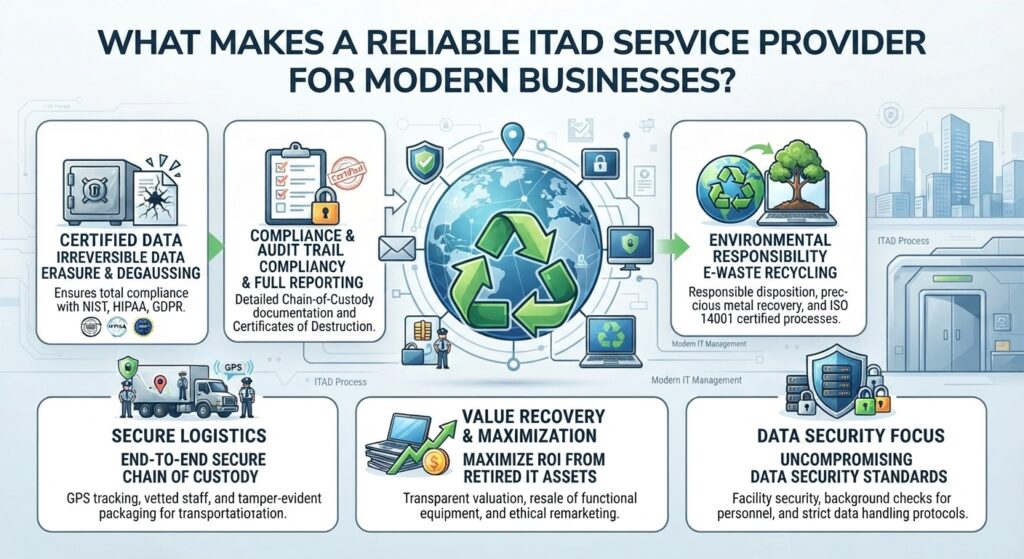
Retiring business technology involves several interconnected responsibilities, including logistics, information security, infrastructure planning, asset recovery, and environmental management. Organizations that approach these activities strategically can reduce operational risks, improve equipment visibility, and make more responsible use of electronic resources.
Selecting the right partner requires evaluating service capabilities, security procedures, collection arrangements, documentation, and recycling practices. A dependable ITAD service provider should understand these priorities and offer a structured process that fits the organization’s operational requirements. Businesses researching professional solutions can explore ITAD service provider information as part of their evaluation and compare the services needed to manage retired technology responsibly.
Frequently Asked Questions (FAQs)
1. What does IT asset disposition mean?
IT asset disposition refers to the process of managing electronic equipment that an organization no longer needs. It may include collection, inventory management, data destruction, refurbishment, resale, and responsible recycling.
2. Why should businesses use professional IT asset disposition services?
Professional services help businesses manage retired equipment through organized collection, documented processing, secure data handling, and appropriate recycling. They can also simplify projects involving multiple facilities or large technology inventories.
3. How can businesses ensure sensitive data is securely destroyed?
Businesses should select a provider that uses appropriate data sanitization or physical destruction methods, maintains documented handling procedures, and supplies relevant verification records. The method should match the device type and security requirements.
4. What is included in a data center decommissioning project?
A project may include infrastructure assessment, equipment inventory, shutdown coordination, data migration planning, physical equipment removal, transportation, and final asset processing. The exact scope depends on the facility and project requirements.
5. What happens to equipment after it is collected?
Collected equipment is generally evaluated to determine whether it can be reused, refurbished, resold, or recycled. Storage devices may undergo approved data sanitization or physical destruction before further processing.
6. How do certified e-waste recycling facilities help businesses?
These facilities provide structured processes for handling electronic waste, recovering reusable materials, and managing components that require specialized treatment. Businesses should verify the facility’s certifications and processing practices.
7. What should businesses consider when choosing an IT asset disposition partner?
Important considerations include service coverage, data security procedures, collection capabilities, relevant certifications, insurance, downstream processing practices, reporting, and experience with similar projects.
8. Is IT asset disposition important for environmental sustainability?
Yes. Responsible disposition encourages equipment reuse, refurbishment, and material recovery while helping reduce unnecessary electronic waste. It also supports better resource management throughout the technology lifecycle.