For agencies and service providers, this demand presents a significant opportunity. Building custom apps for each client takes a lot of time and resources. It’s also hard to scale. Hiring and maintaining in-house development teams complicates matters. It has high costs. There are also recruitment challenges. Plus, there’s added operational overhead.
Many agencies are moving to scalable development models. This change helps them deliver branded applications more efficiently. One effective way is to white-label app development. This lets businesses build customizable apps under their brand. It also cuts down on time and costs.
This guide shows how to build scalable branded apps for clients. It covers strategies to use and how to create a system focused on sustainable growth.
What Are Scalable Branded Apps?
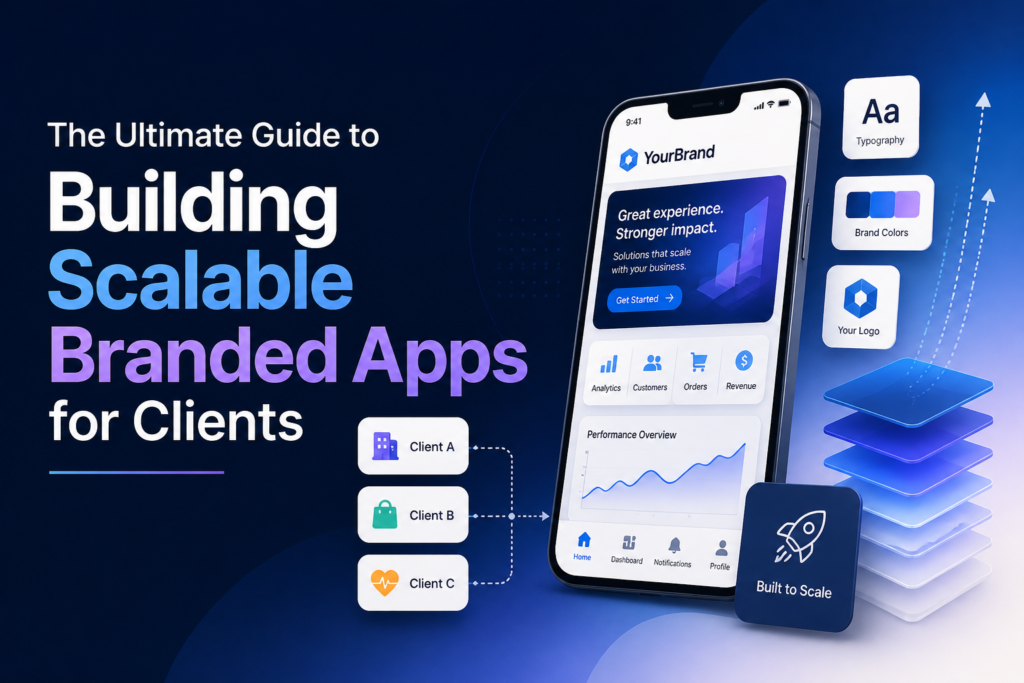
Designers build scalable branded apps. These apps can be reused, customized, and deployed for different clients. Each app keeps its unique branding for every business.
Instead of building each app from the ground up, agencies use:
- Pre-built frameworks
- Modular components
- Configurable features
This approach allows for faster deployment and consistent performance across many projects.
Why Scalability Matters in App Development
1. Faster Time-to-Market
Clients expect quick delivery. Scalable systems save development time. They do this by reusing existing components rather than starting from scratch.
2. Cost Efficiency
Agencies can cut costs by avoiding repetitive work. This way, they still deliver high-quality results.
3. Consistent Quality
Standardized frameworks help ensure every app works well. They keep apps secure and easy to use.
4. Easier Maintenance
Applying updates across many apps at the same time reduces long-term maintenance efforts.
Core Components of Scalable App Development
1. Modular Architecture
Modular architecture divides an app into independent components, such as:
- User authentication
- Payment systems
- Notification services
- Admin dashboards
You can reuse these modules across many projects.
2. Multi-Tenant Systems
A multi-tenant system allows a single application to serve many clients, each with:
- Separate data
- Custom branding
- Configurable features
This approach is common in SaaS platforms.
3. Customizable UI/UX
Each client requires a unique look and feel. To achieve this, scalable apps use flexible design systems that allow:
- Branding changes
- Layout customization
- Theme variations
These options allow for deep customization without altering core functionality.
4. API-Driven Development
APIs enable seamless integration with:
- Payment gateways
- Third-party tools
- CRM systems
This ensures flexibility and scalability.
Strategies to Build Branded Apps for Clients
1. Use White Label Development Models
With leading white-label application development, agencies can:
- Rebrand applications for different clients
- Customize features based on business needs
- Deliver apps faster without full redevelopment
This approach is one of the most efficient ways to scale app services.
2. Standardize Development Processes
Creating repeatable workflows ensures efficiency:
- Predefined feature sets
- Development templates
- Deployment pipelines
This reduces errors and improves delivery speed.
3. Focus on Industry-Specific Solutions
Instead of building generic apps, agencies can specialize in industries such as:
- Healthcare
- Ecommerce
- Real estate
- On-demand services
This specialization allows for deeper expertise and faster development.
4. Leverage No-Code and Low-Code Tools
These platforms help:
- Build MVPs quickly
- Reduce dependency on developers
- Enable rapid iteration
These tools are ideal for smaller projects and early-stage clients.
5. Automate Deployment and Scaling
These tools streamline:
- App deployment
- Performance monitoring
- Updates and maintenance
Automating these tasks reduces manual effort and improves efficiency.
Benefits of Building Scalable Branded Apps
1. Increased Profit Margins
Reusing components reduces development costs, increasing profitability.
2. Faster Client Onboarding
Pre-built systems help agencies onboard clients quickly. They also deliver solutions faster.
3. Competitive Advantage
Agencies that deliver faster and more efficiently gain a strong edge in the market.
4. Long-Term Growth
Scalable systems enable agencies to handle more clients without proportional increases in resources.
Challenges and How to Overcome Them
1. Customization Limitations
Standardized systems may restrict flexibility.
Solution:
- Use modular architecture
- Offer customization layers
2. Quality Control
Maintaining consistency across many apps can be challenging.
Solution:
- Implement strict testing processes
- Use standardized frameworks
3. Client Expectations
Clients may expect fully custom solutions.
Solution:
- Articulate capabilities with clarity.
- Offer tiered service packages.
4. Technical Complexity
Building scalable systems requires planning and expertise.
Solution:
- Invest in proper architecture
- Work with experienced development partners
Step-by-Step Framework to Get Started
Step 1: Define Your Target Market
Identify industries and client types you want to serve.
Step 2: Build a Core App Framework
Develop a base application with essential features that can be reused.
Step 3: Create Customization Options
Allow clients to personalize:
- Branding
- Features
- User experience
Step 4: Establish Development Workflows
Standardize processes for:
- Design
- Development
- Testing
- Deployment
Step 5: Focus on Marketing and Sales
Promote your services through:
- SEO
- Content marketing
- Case studies
Step 6: Check and Optimize
Track performance and make ongoing improvements to your systems.
Future Trends in Scalable App Development
1. AI Integration
AI tools are being used for:
- Personalization
- Automation
- Predictive analytics
2. Growth of SaaS Models
More businesses are adopting subscription-based app solutions.
3. Increased Demand for Customization
Clients expect more flexibility without sacrificing speed.
4. Expansion of White Label Ecosystems
More platforms will offer customizable solutions for agencies.
Conclusion
Building scalable branded apps for clients is essential. Agencies must do this to grow in today’s competitive digital landscape.
By leveraging modular architecture, automation, and best white-label application development, businesses can:
- Reduce costs
- Improve efficiency
- Scale operations
- Deliver high-quality apps
The future of app development focuses on scalability, flexibility, and smart tech use. Agencies using these strategies will meet client needs better. They’ll also set themselves up for long-term success.