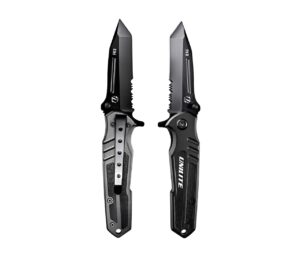
Small cutting jobs deserve the same attention as larger workshop tasks. The Unilite Retractable Knife, manufacturer part number FK3, combines a folding steel blade with an aluminium handle and a locking mechanism. Its appeal lies in bringing a substantial cutting tool into a format that closes for storage.
Although sold under this product name, Unilite identifies the FK3 as a heavy-duty folding utility knife. Understanding that construction helps buyers choose the right tool and use it correctly.
What Makes the FK3 Worth a Closer Look?
The manufacturer’s published features include:
- A 3Cr13 stainless steel blade
- A clip-point profile with a serrated section
- Blade hardness of 52–54 HRC
- Assisted opening using thumb studs
- A liner-lock mechanism
- An ergonomic aluminium handle with a front finger guard
- A pocket clip and lanyard attachment hole
- An extended length of 198 mm and weight of 119.5 g.
When comparing Pocket Knives & Multi-tools, consider how these details match your work. A folding knife’s opening method, handle shape and blade profile affect the experience just as much as its overall size.
For procurement, record FK3 alongside the product name so that future orders refer to the same model.
How Does the Folding Mechanism Work?
The blade pivots out of the handle and locks in its open position. To close it, the liner lock must be released according to the manufacturer’s instructions before the blade folds back into the handle.
This is a manually closed folding arrangement. It does not provide automatic blade retraction after a cut.
That distinction matters when a workplace specifies a particular cutting-tool mechanism. Buyers should compare the FK3’s operation with the task requirements before adding it to a shared toolkit.
If your procedure requires a concealed blade or automatic retraction, explore suitable Safety Knives and check the individual model’s mechanism.
Why Should Blade Shape Match the Material?
The FK3 combines a pointed profile with a serrated cutting section. Those features deserve attention when assessing the intended material and the finish required.
For example, opening a package involves more than separating its outer layer. The operator also needs to consider what sits underneath, how the package is supported and where the cut will finish.
For repeat work, evaluate the proposed method on a representative sample where appropriate. Check the finished edge and any marks on adjacent material.
A successful trial should establish whether the knife suits the task without requiring excessive force or awkward positioning.
What Difference Does the Handle Make?
Unilite equips the FK3 with a shaped aluminium handle, a front finger guard and a raised thumb area on the blade spine. These features are intended to support grip and control.
Comfort remains personal. Hand size, the working angle and any required gloves influence how a tool feels during use.
During selection, consider whether the operator can hold the handle securely while maintaining a clear view of the cutting area. Check accessibility for both opening and closing, especially if different people will use the tool.
A practical assessment should reflect the actual job, including the space available around the material.
How Can the Work Surface Improve the Result?
Prepare the cutting area before opening the knife. A well-supported item is easier to assess, and an uncluttered surface leaves room to position the work.
Suitable Cutting Mats can provide a sacrificial surface for compatible cutting tasks. Choose one that accommodates the workpiece and the intended cutting method; a mat alone does not secure the material.
Good lighting, stable support and sufficient working space are also priorities in HSE guidance on hand-knife use.
Keep offcuts separate from material awaiting work. A defined place for finished pieces can make repeated preparation easier to organise and inspect.
When Is Another Cutting Tool More Suitable?
A useful toolkit gives the operator a choice matched to the material. Some flexible sheets or thin packaging may be better handled with suitable Scissors, depending on their construction and the required finish.
Compare the completed result, access and effort involved before establishing a method. A knife that performs well on one material may be unsuitable for another.
For a recurring task, record the selected tool alongside the material specification. This helps maintain a consistent approach when supplies change or another person takes over.
What Checks Help Keep the Knife Ready?
Before use, inspect the blade, handle and mechanism for visible damage. Unilite advises against using the product when any of these parts are damaged.
Keep fingers clear of the blade’s path, avoid excessive force and fold the blade when the task is finished. Follow the manufacturer’s instructions for operation and care; do not dismantle or modify the knife.
If cutting becomes unexpectedly difficult, pause and review the material and tool condition before continuing.
How Should It Fit Into Your Tool Storage?
Give the closed knife a defined storage position. Compatible Tool Belts & Tool Pouches can help organise tools, but the chosen compartment should suit the knife’s dimensions and retain it securely.
Keep the model reference and instructions with the equipment record. For shared tools, make it clear where serviceable equipment belongs and how damaged items are taken out of use.
Before choosing the Unilite Retractable Knife, confirm the folding mechanism, assess the cutting task and plan its storage. These practical decisions help turn the FK3 into a considered addition to a professional toolkit.