Money is one of those things that almost everyone learns about the hard way. There’s no actual class where it’s taught, no distinct beginning. You’re simply earning, spending, and then somewhere along the way, you are trying to figure it out.
The issue with this process is that financial mistakes don’t actually appear as mistakes as you’re making them; everything feels in control. You’re earning money, your expenses are covered, and maybe you’re saving just a little. Nothing seems wrong to the naked eye.
However, time goes by, and little habits start accumulating and turning into things that are no longer manageable without you realising it.
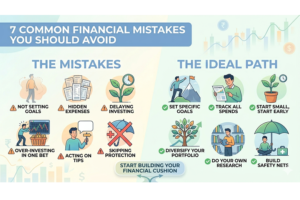
Here are some of the silent mistakes that people make without really realising how much they are holding them back.
1. Living Without a Budget
Here is something most people will admit if you ask them honestly: they have no real idea where their money goes each month. A rough idea, maybe. But not the actual numbers.
This is how people earning good salaries still feel broke by the 20th of the month. Without a budget, spending expands naturally to fill whatever is available. The subscriptions you forgot about, the daily coffees, the “small” purchases that add up faster than expected.
A budget does not need to be a strict, joyless spreadsheet. It just needs to show you the truth about your money. Once you have that clarity, the decisions become much easier to make.
2. Having No Emergency Fund
Think about the last time something went wrong financially: a car breakdown, a hospital bill, a gap between jobs. If you had savings set aside, it was probably a stress you could manage. If you did not, it likely caused a chain reaction that took months to recover from.
An emergency fund is not exciting. It sits in an account doing very little. But it is the single thing that separates a tough situation from a financial crisis.
Three to six months of essential expenses is the goal most financial advisors point to. Getting there takes time, but even a small starting amount, one month of expenses, changes how you handle unexpected costs. Build this before you chase any other financial goal.
3. Treating Credit Card Debt as Normal
Credit cards are convenient, and used well, they actually work in your favor. The problem is when the balance carries over month after month.
Interest on unpaid credit card debt compounds fast. A purchase you made six months ago can effectively cost you double by the time it is paid off. The scary part is that minimum payments are designed to keep you in that cycle as long as possible.
If you are currently carrying a balance, the priority should be paying it down aggressively, starting with the highest-interest card first. And going forward, the simplest rule is this: do not spend on a credit card what you cannot pay back by the due date.
4. Pushing Retirement Savings to “Later”
Getting ready for retirement is something that everyone thinks is important, but really, very few people put any early effort into. When you’re in your 20s and 30s, it feels so far away that anything else always seems more pressing.
However, this is the task where time steps in. The money you invest at 25 grows in a way that the money you invest at 40 simply won’t, even if you are an aggressive investor at 40. The compounding effect over decades is genuinely hard to replicate any other way.
Do what you can – even if it seems that it is too little. Increase your contribution as you earn more. The exact amount matters less than the habit of doing it consistently.
5. Jumping Into Investments Without Understanding Them
There is a version of investing that looks exciting from the outside. Stories of quick gains, hot tips, and the thrill of watching a stock move. And there is the reality, which is that most people who invest without understanding what they are doing end up losing money and stepping away entirely.
Be sure to understand what you own before putting money into anything, why you own it, and what you will do if it goes down. If you want to build wealth in the Indian stock market, then the foundation is more important than the picking of stocks. To have investment success, it is vital to learn how equities work to understand diversification. Also, be honest about how much risk you are actually comfortable with.
6. Using the Wrong Platform to Invest
Those who take time to educate themselves and invest with discipline can lose money simply because of the tools they are using. Platforms that have an old interface, lack transparency in fee structure, or have limited research tools make it hard to stay consistent in your trading.
This is especially relevant now that so many options exist. Choosing a good online trading platform in India is not about chasing features, it is about finding something reliable and transparent that makes it easier to stick to your strategy. The right platform works with your goals; the wrong one quietly works against them.
7. Making Financial Decisions Based on Emotion
Fear and greed are probably responsible for more financial losses than any market crash or economic event. Selling off investments because the market dropped. Pouring money into something because a friend made money on it. Avoiding investing entirely because it feels risky.
These are all emotional responses, and they are completely understandable. Markets are volatile, and when real money is on the line, it is hard not to feel it.
The way around this is having a plan before you need it. Know in advance what your investment goals are, what your strategy is, and when you will and will not make changes. A written plan takes the decision-making out of the heat of the moment, which is exactly when most costly mistakes happen.
Conclusion
Financial setbacks are rarely the result of one wrong decision. They are generally the result of actions that make sense at the time, making them difficult to stop. This is pretty normal. It happens to nearly everybody.
What sets successful people apart is their ability to see and correct these mistakes as soon as possible. Small changes can lead to gradual improvement simply by paying more attention to how you earn, spend, and choose. The good part is, none of this is fixed, you can start adjusting things whenever you decide to.
Disclaimer – This blog is for educational purposes only and should not be considered financial advice.
Author Bio – Integrated is committed to empowering individuals with the knowledge and tools needed to make informed financial decisions. With a focus on clarity and long-term thinking, we deliver insights across investing, savings, and wealth creation.
For more insights, visit our website https://www.integratedindia.in/ to explore how we can support your financial journey.