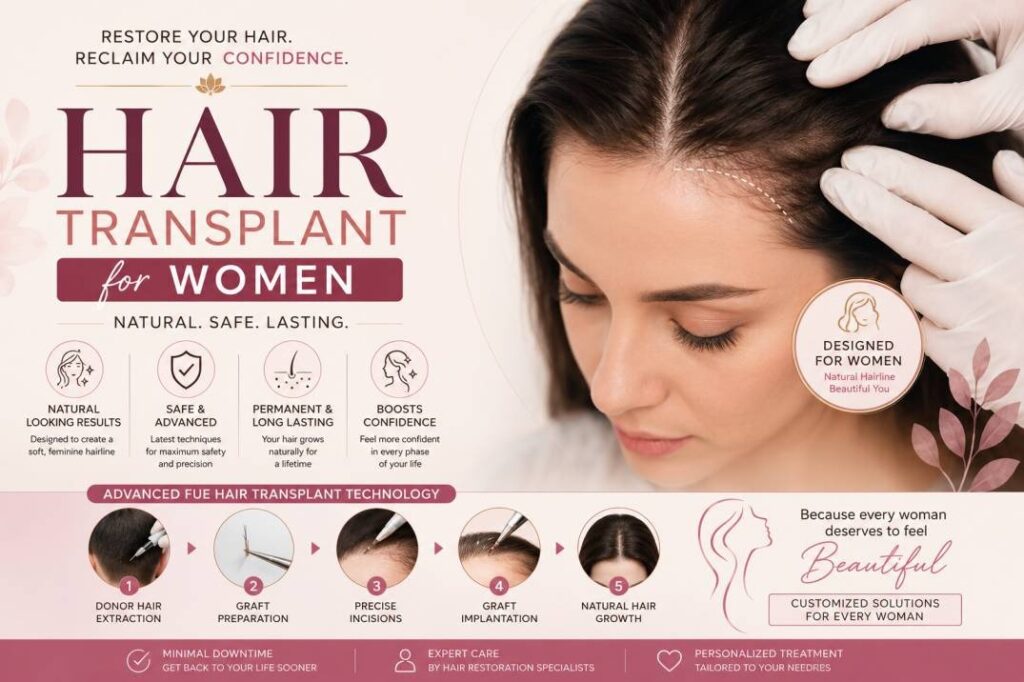
Hair Transplant for Women is a surgical hair-restoration option for women experiencing permanent or stable hair loss in areas such as the hairline, frontal scalp, temples, part line, or crown. Unlike temporary cosmetic solutions, a hair transplant redistributes the patient’s own hair follicles from a donor area to regions affected by thinning or hair loss.
However, women require a more detailed evaluation before transplantation because female hair loss is often diffuse and may have hormonal, nutritional, thyroid-related, inflammatory, genetic, or other medical causes. Hair transplantation is therefore usually considered only for carefully selected patients rather than as the first treatment for every woman with hair thinning.
What Is Hair Transplant for Women?
A Hair Transplant for Women involves removing healthy hair follicles from a donor area and implanting them into areas where hair density has decreased.
The goal is not necessarily to restore the density of teenage or childhood hair. Instead, the objective is to redistribute available donor hair strategically to create greater coverage and a natural-looking appearance.
Modern transplantation uses individual follicular units rather than older large “hair plugs.” This allows surgeons to control hair direction, angle, spacing and density more precisely.
Why Do Women Experience Hair Loss?
Female hair loss can have numerous causes. Common possibilities include:
- Female pattern hair loss
- Genetic predisposition
- Hormonal changes
- Menopause
- Pregnancy-related changes
- Iron or nutritional deficiencies
- Thyroid disorders
- Certain medications
- Stress or illness
- Traction from tight hairstyles
- Scalp disorders
- Scarring alopecia
- Autoimmune conditions
Because different causes require different treatments, identifying the reason for hair loss is an important part of deciding whether transplantation is appropriate.
In women with diffuse thinning, doctors may also evaluate the scalp and consider laboratory testing when another underlying cause is suspected.
What Is Female Pattern Hair Loss?
Female pattern hair loss, also known as female androgenetic alopecia, is one of the most common causes of progressive hair thinning in women.
Unlike the classic male pattern, women frequently experience diffuse reduction in density over the central scalp and widening of the part line rather than complete baldness.
The frontal hairline may remain relatively preserved in many women, although some women develop noticeable frontal or temporal recession.
Medical treatment is often the initial approach. Hair transplantation can be considered in selected women with appropriate donor hair and suitable patterns of hair loss.
Who Is a Good Candidate for Hair Transplant for Women?
Not every woman with hair loss is a good candidate.
A suitable candidate generally has:
- A stable or sufficiently controlled pattern of hair loss
- Adequate donor hair
- Good overall health
- Sufficient recipient areas capable of supporting transplanted follicles
- Realistic expectations
- A clearly identified cause of hair loss
- Appropriate expectations regarding achievable density
Women with extensive diffuse thinning throughout the scalp may not have enough donor hair for an effective transplant.
Hair-transplant guidelines specifically emphasize careful assessment of both the donor and recipient areas in women because diffuse thinning can make donor availability difficult to determine.
Who May Not Be a Good Candidate?
Hair transplantation may be inappropriate or require significant caution in women with:
- Rapidly progressive hair loss
- Severe diffuse thinning
- Insufficient donor density
- Active scarring alopecia
- Certain inflammatory scalp disorders
- Uncontrolled medical conditions
- Unrealistic expectations
- Hair loss that has not been properly diagnosed
A hair transplant should generally not be used as a substitute for diagnosing an active disease causing hair loss.
Hair Transplant Techniques for Women
Several techniques can be used for female hair restoration. The most appropriate method depends on donor density, hair characteristics, the size of the treatment area and the surgeon’s assessment.
1. FUE Hair Transplant for Women
Follicular Unit Extraction (FUE) involves extracting individual follicular units from the donor area.
The follicles are then prepared and implanted into the recipient area.
Advantages may include:
- No long linear donor scar
- Individual graft selection
- Precise follicle placement
- Smaller extraction marks
- Useful for targeted restoration
FUE has become an important technique in modern hair transplantation, although the quality of the result depends heavily on patient selection, graft handling and surgical technique.
- FUT Hair Transplant for Women
Follicular Unit Transplantation (FUT) involves removing a strip of hair-bearing skin from the donor area and separating it into individual follicular units.
Potential advantages include efficient harvesting of a substantial number of grafts, while the main consideration is the presence of a linear donor scar.
The choice between FUE and FUT should be individualized rather than based simply on which technique is marketed as newer or better.
3. Follicular Unit Transplantation
Follicular-unit-based transplantation aims to preserve the natural arrangement of hair follicles.
Individual follicular units can contain one or more hairs. For areas such as the frontal hairline, single-hair grafts can help create a softer and more natural transition.
Read also: Home Renovation Services in Parker, CO: Transform Your House Into a Better Home
Areas That Can Be Treated in Women
A Hair Transplant for Women can potentially be used to restore several areas, including:
Frontal Hairline
A transplant may help lower or rebuild a receded frontal hairline when the patient has suitable donor hair.
Temples
Small areas of temporal recession can sometimes be improved through strategic graft placement.
Central Part Line
A widening part can sometimes be addressed by increasing hair density around the affected region.
Frontal Scalp
Women with localized frontal thinning may benefit from carefully planned transplantation.
Crown or Vertex
Selected women with localized crown thinning may also be candidates, although diffuse loss must be carefully evaluated first.
Female hair-transplant guidelines describe treatment areas that may include the hairline, frontal zone, part line, vertex, frontotemporal recessions and central scalp.
Hair Transplant for Women: Step-by-Step Procedure
Step 1: Consultation
The first stage involves a detailed assessment of the hair and scalp.
The surgeon may evaluate:
- Hair-loss pattern
- Hair shaft thickness
- Donor density
- Scalp condition
- Family history
- Previous treatments
- Medical history
- Hair-loss progression
- Desired outcome
Step 2: Diagnosis of Hair Loss
Before surgery, the underlying cause of hair loss should be considered.
Depending on the clinical presentation, the doctor may recommend blood tests or other investigations. The purpose is to distinguish female pattern hair loss from conditions that may require medical treatment.
Step 3: Donor Area Assessment
The donor region is examined to determine whether enough healthy follicles are available.
The donor area should be carefully mapped because overharvesting can create visible thinning and reduce future treatment options. Hair-transplant practice guidelines recommend detailed donor-area assessment, including density, caliber and the stability of the donor zone.
Step 4: Hairline and Treatment Design
The surgeon creates a customized treatment plan.
For women, maintaining an appropriately natural hairline is particularly important because aggressive lowering of the hairline can consume a significant amount of limited donor hair.
Step 5: Donor Hair Extraction
Depending on the chosen technique, individual follicles may be extracted using FUE or a donor strip may be removed using FUT.
Step 6: Graft Preparation
The harvested follicles are examined and prepared for implantation.
Grafts are sorted according to the number of hairs they contain and their suitability for different recipient areas.
Step 7: Recipient Site Creation
Tiny openings are created in the recipient area.
The surgeon determines the:
- Angle
- Direction
- Density
- Distribution
- Spacing
These details are essential to achieving a natural result.
Step 8: Graft Implantation
The prepared grafts are carefully placed into the recipient sites.
The placement pattern should follow the natural growth direction of the patient’s existing hair.
Benefits of Hair Transplant for Women
Natural-Looking Hair Restoration
Modern follicular-unit transplantation can produce natural-looking results when performed appropriately.
Uses Your Own Hair
The procedure uses the patient’s own hair follicles, which can provide a more natural match in terms of color, texture and growth characteristics.
Long-Term Solution
Transplanted follicles from a stable donor region can provide long-term hair growth.
However, transplantation does not stop the underlying process of female pattern hair loss in the remaining untreated hair. Continued medical management may therefore be important.
Improved Hairline Definition
For women with localized frontal recession or an unusually high hairline, transplantation can improve the visual framing of the face.
Greater Styling Flexibility
Improved density may make certain hairstyles easier and can reduce the need to conceal thinning areas.
Potential Improvement in Confidence
Hair loss can affect self-image and confidence. Restoring hair coverage may improve how some patients feel about their appearance.
Hair Transplant for Women Cost
The Hair Transplant for Women cost varies considerably from one patient to another.
There is no single universal price because the total cost can depend on:
- Number of grafts
- Treatment area
- FUE or FUT technique
- Surgeon experience
- Clinic location
- Donor density
- Complexity of the procedure
- Number of sessions required
- Anesthesia and facility charges
- Post-operative care
- Additional medical treatment
A patient requiring a small frontal hairline correction may require substantially fewer grafts than someone needing extensive restoration.
For this reason, a personalized consultation and written treatment quotation are more useful than relying on an advertised starting price.
What Determines the Number of Grafts?
The number of grafts required depends on several factors.
Size of the Treatment Area
Larger areas generally require more grafts.
Existing Hair Density
If a significant amount of existing hair remains, the surgeon may focus on increasing density rather than covering a completely bald area.
Hair Characteristics
Hair thickness, curl and color can influence the visual coverage achieved by a given number of grafts.
Donor Hair Availability
The amount of safe donor hair places a natural limit on how much can be transplanted.
Desired Density
Trying to achieve extremely high density may consume donor hair unnecessarily and may not be appropriate for every patient.
Hair Transplant Recovery for Women
Hair-transplant recovery varies between individuals and depends on the technique and size of the procedure.
First Few Days
Temporary symptoms can include:
- Mild swelling
- Redness
- Tenderness
- Small scabs
- Mild discomfort
- Tightness
- Temporary sensitivity
Following the clinic’s post-operative instructions is important during this stage.
First Week
The recipient area should be handled gently.
Patients are generally advised to avoid scratching or picking at scabs and should follow the surgeon’s instructions regarding washing and hair care.
First 2–4 Weeks
Some transplanted hairs may shed. This is commonly referred to as shock loss or post-transplant shedding and does not necessarily mean the follicles have failed.
3–6 Months
New growth gradually becomes more visible.
Hair growth is not immediate because transplanted follicles must progress through their natural growth cycle.
6–12 Months
Density and coverage generally continue improving.
The final result can take many months, and some patients may require additional treatment depending on their goals and the degree of hair loss.
Hair-transplant guidelines emphasize that patients should understand that meaningful growth takes months rather than appearing immediately after surgery.
Hair Transplant Aftercare for Women
Proper aftercare can help protect the newly transplanted grafts during the early healing period.
Follow Washing Instructions
Use the washing method and products recommended by your surgeon.
Avoid aggressive rubbing or scratching of the recipient area.
Protect the Scalp
Avoid unnecessary friction, pressure or trauma to the transplanted area during the early recovery period.
Avoid Strenuous Exercise Initially
Your surgeon may recommend limiting strenuous exercise for a period after surgery.
Protect Against Excessive Sun Exposure
Direct and prolonged sun exposure should be minimized during early healing.
Avoid Picking Scabs
Allow the recipient area to heal naturally rather than removing scabs manually.
Take Prescribed Medication Correctly
If your surgeon prescribes medications, follow the instructions carefully.
Attend Follow-Up Appointments
Follow-up visits allow the medical team to assess healing and monitor hair growth.
Can Women Continue Hair-Loss Treatment After a Hair Transplant?
In many cases, yes.
This is an important part of female hair restoration because transplantation moves existing follicles but does not necessarily prevent future thinning of untreated native hair.
Medical therapy may therefore remain an important component of a long-term treatment plan.
Minoxidil is commonly used as a medical treatment for female pattern hair loss, although the appropriate treatment depends on the individual’s diagnosis and medical circumstances.
Women who are pregnant, planning pregnancy or breastfeeding should discuss hair-loss medications with their healthcare professional before use because some treatments are unsuitable during pregnancy.
Hair Transplant for Women vs Non-Surgical Treatments
Hair transplantation is only one option.
Depending on the cause of hair loss, other approaches may include:
- Topical minoxidil
- Prescription medications
- Low-level light therapy
- Platelet-rich plasma
- Scalp camouflage products
- Hair fibers
- Hairstyling changes
- Wigs or hair systems
- Treatment of nutritional deficiencies
- Treatment of underlying medical conditions
For many women with diffuse female pattern hair loss, medical treatment is considered before surgery.
Hair Transplant for Women vs PRP
Hair transplantation physically moves hair follicles from one area to another.
PRP therapy involves processing a patient’s blood and injecting a concentrated platelet-containing preparation into the scalp.
PRP does not create a new donor supply of hair. It is generally considered a non-transplant treatment option and may be used as part of a broader hair-loss management strategy.
Hair Transplant for Women vs Minoxidil
Minoxidil is a medical treatment intended to stimulate or maintain hair growth.
Hair transplantation redistributes existing follicles.
The two approaches are therefore fundamentally different. In selected patients, medical treatment may continue alongside or after transplantation to help protect native hair.
Risks and Possible Complications
Hair transplantation is a surgical procedure and carries potential risks.
Possible complications include:
- Bleeding
- Infection
- Swelling
- Pain
- Temporary numbness
- Scarring
- Poor graft growth
- Uneven density
- Unnatural hair direction
- Donor-area thinning
- Need for additional procedures
The final cosmetic result can also be affected by poor patient selection, unrealistic expectations or progression of untreated hair loss.
How to Choose a Hair Transplant Surgeon
Choosing the right surgeon is one of the most important decisions when considering a Hair Transplant for Women.
Look for a qualified professional who regularly treats female hair-loss patients and understands the differences between male and female hair-loss patterns.
Consider asking:
- How frequently do you perform hair transplants on women?
- What is causing my hair loss?
- Am I actually a suitable candidate?
- How much donor hair do I have?
- Which technique do you recommend and why?
- How many grafts do I need?
- What density can realistically be achieved?
- Will my existing hair continue thinning?
- Will I need medical treatment after transplantation?
- What happens if additional hair loss occurs?
- Who will perform the extraction and implantation?
- What is included in the total treatment cost?
Before-and-after photographs of women with a similar pattern of hair loss can also be useful when evaluating a surgeon’s experience.
Questions to Ask Before Hair Transplant Surgery
A consultation should not focus only on price.
Ask about:
- Diagnosis
- Donor-area quality
- Expected graft count
- Hairline design
- Surgical technique
- Recovery period
- Potential complications
- Future hair-loss management
- Follow-up schedule
- Additional treatment requirements
- Total cost
A reputable consultation should include realistic expectations rather than promises of a completely full head of hair. Hair-transplant guidelines specifically emphasize counseling women about the limitations of transplantation and the possibility of continued hair loss.
Frequently Asked Questions About Hair Transplant for Women
Is Hair Transplant for Women permanent?
Transplanted follicles from a suitable donor area can provide long-term hair growth. However, the native hair surrounding the transplanted area can continue to thin if the underlying hair-loss condition remains active.
Is hair transplant suitable for every woman?
No. Women with diffuse thinning, unstable hair loss, insufficient donor density or active scalp disorders may not be suitable candidates. Careful diagnosis and donor-area assessment are essential.
What is the best hair transplant technique for women?
There is no single technique that is best for every woman. FUE and FUT can both have a role, depending on donor availability, treatment area, hair characteristics, surgical goals and individual circumstances.
Does a female hair transplant look natural?
A properly planned transplant can create natural-looking results. Hairline design, graft selection, implantation angle, direction and density all influence the final appearance.
How long does it take to see results?
Hair growth takes time. Initial shedding may occur after transplantation, followed by gradual new growth over the following months. Meaningful results generally develop gradually rather than immediately.
Can women with a receding hairline get a transplant?
Yes, selected women with localized frontal hairline recession may be candidates if they have sufficient donor hair and a stable cause of hair loss.
Can a hair transplant fix a widening part?
In selected cases, transplantation can increase density around a widened part. However, diffuse female pattern hair loss must be evaluated carefully before surgery.
Can hair transplant treat hair loss after pregnancy?
Hair shedding after pregnancy may be temporary and can improve naturally. The cause and duration of hair loss should be assessed before considering transplantation.
Do transplanted hairs need special care permanently?
Once transplanted hair has fully established, it generally can be treated like normal hair. During the early healing period, however, special care is required to protect the grafts.
Can hair loss continue after a transplant?
Yes. Transplantation does not necessarily stop the underlying progression of female pattern hair loss in untreated native hair. Long-term medical management may therefore be recommended.
Final Thoughts
A Hair Transplant for Women can be an effective long-term option for carefully selected women with localized, stable hair loss and an adequate donor supply. Modern techniques such as FUE and FUT allow surgeons to redistribute individual hair follicles and create more natural-looking coverage.
The most important step is not choosing a clinic based solely on cost. A proper diagnosis, detailed donor-area assessment, realistic treatment plan and experienced surgeon are essential.
Women with diffuse or rapidly progressing hair loss should generally have the underlying cause investigated and consider appropriate medical treatment before deciding on transplantation. In suitable candidates, combining surgical restoration with long-term management of the underlying hair-loss condition can provide a more sustainable approach.