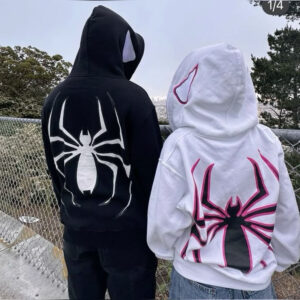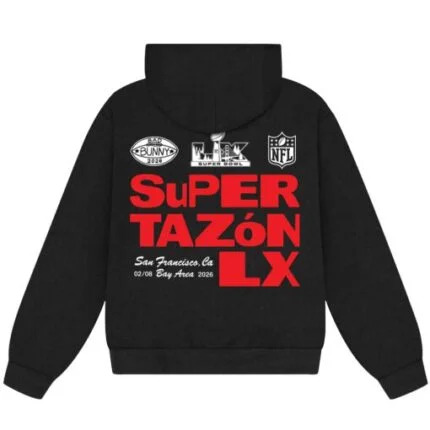
Of everything sold at a Bad Bunny show, the hoodie has quietly become the piece fans build their entire outfit around. It isn’t the cheapest item on the merch table, and it isn’t the fastest to sell out, but it’s the one people photograph, resell, and hold onto years after the tour that produced it has ended. What started as a practical concert layer has turned into one of the most recognizable pieces in his merchandise catalog — and, increasingly, a small collector’s market of its own.
More Investment Piece Than Impulse Buy
Bad Bunny hoodies sit at the top of his merchandise pricing, and fans treat them accordingly. Pieces tied to his 2025 Puerto Rico residency, “No Me Quiero Ir de Aquí,” have been documented selling for around $100 to $150 depending on the design, noticeably higher than the tour t-shirts sold alongside them. That price point hasn’t dampened demand — if anything, it’s reinforced the sense that a hoodie is the “real” purchase at a Bad Bunny merch stand, the piece worth waiting in line for rather than grabbing on the way out.
Buyers on resale platforms echo that hierarchy after the fact. Listings for hoodies from past eras — including the El Último Tour Del Mundo run and various NFL crossover collaborations — regularly resell in the $50 to $120 range, well above what a typical concert t-shirt commands secondhand, with buyers specifically calling out graphic detail and construction quality as reasons certain pieces hold their value.
Design Language Rooted in Puerto Rico
What separates a Bad Bunny hoodie from a standard tour pullover is how deliberately its graphics lean into Puerto Rican identity rather than generic tour branding. The Sapo Concho — a Puerto Rican toad frequently mistaken online for the island’s beloved coquí frog — has become a recurring motif across the Debí Tirar Más Fotos era, showing up on hoodies alongside Taíno-inspired sun imagery and Puerto Rican flag details. Fans have taken to social platforms specifically to correct the record on the mascot’s identity, a small but telling sign of how closely his audience tracks the cultural references baked into each design rather than treating them as decoration.
That specificity extends to where certain pieces can even be bought. Residency-era hoodies were sold not just at the venue itself but through pop-up retail experiences around San Juan, including locations inside Plaza Las Américas, meaning some designs were never available through his general online store at all — only to fans who physically showed up to specific locations on the island during the run.
A Global Tour, a Different Hoodie in Every City
The Debí Tirar Más Fotos World Tour carried that localized approach onto the road. As the tour moved through stops in London, Madrid, and beyond, fans documented picking up hoodies and long-sleeve pieces specific to each stop, comparing notes online about which cities got which colorways and how quickly certain sizes disappeared from tables. That city-by-city rollout mirrors the strategy behind his broader merchandise operation and his ongoing adidas partnership, which has built entire collections around the atmosphere of specific tour stops rather than shipping one universal design to every venue.
The result is a hoodie market that functions almost like a passport stamp system for fans — the specific piece someone owns says exactly which show, and often which exact night, they attended.
The Counterfeit Problem Hiding in Plain Sight
Success at this scale has predictably drawn a wave of unofficial and outright counterfeit product. Fans have posted warnings after encountering websites selling “Bad Bunny tour merch” hoodies that turned out not to be affiliated with his actual retail operation, and marketplaces like eBay and Etsy carry a mix of genuinely licensed resale alongside custom, unofficial designs sold at a fraction of retail price — some clearly labeled as fan-made, others less transparent about their origin. Buyers hunting for a deal have learned to check for details like official tags, verified store receipts, and consistent print quality before trusting a listing, particularly for anything claiming to be from a specific residency or tour leg rather than his general catalog.
That gray area hasn’t slowed demand. If anything, it’s created an entire secondary economy of “inspired by” designs — hoodies built around Puerto Rican pride symbolism or lyric references rather than official branding — sold openly alongside licensed product, aimed at fans who want the aesthetic without needing the item to be verifiably official.
Why the Hoodie Wins
Compared to a t-shirt, a hoodie carries more real estate for the kind of layered graphic work Bad Bunny’s design team favors — front and back prints, sleeve details, embroidered patches — and it survives being worn well past a single concert night in a way a thin cotton tee doesn’t. It photographs better for the outfit posts that circulate after every show, it holds resale value more reliably, and because designs are so often tied to a specific city or era, owning one has become a way of marking exactly where a fan was in Bad Bunny’s timeline, not just that they were a fan at all. In a merchandise catalog built almost entirely around specificity — this city, this residency, this album cycle — the hoodie has simply proven to be the piece with enough space to say all of it at once.